

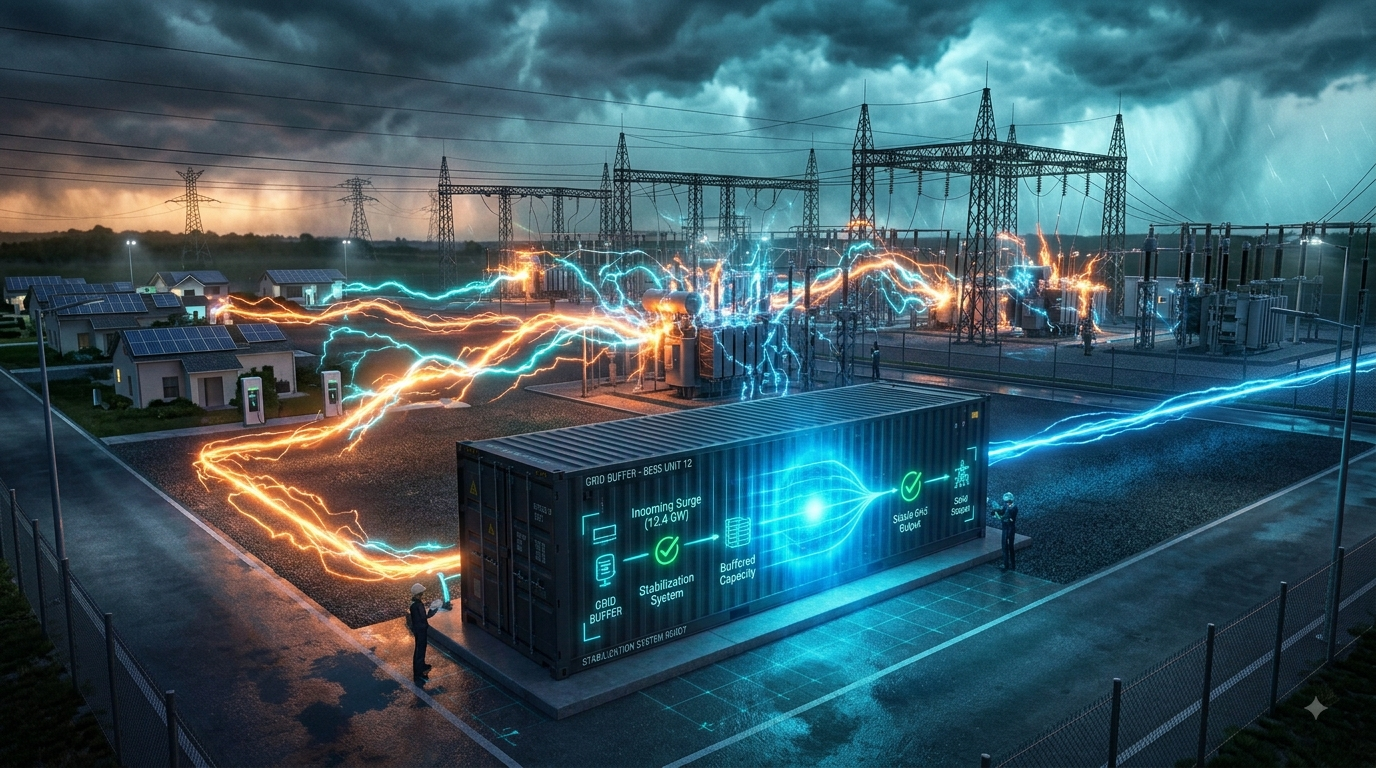
The Death of the “One-Way” Power Grid
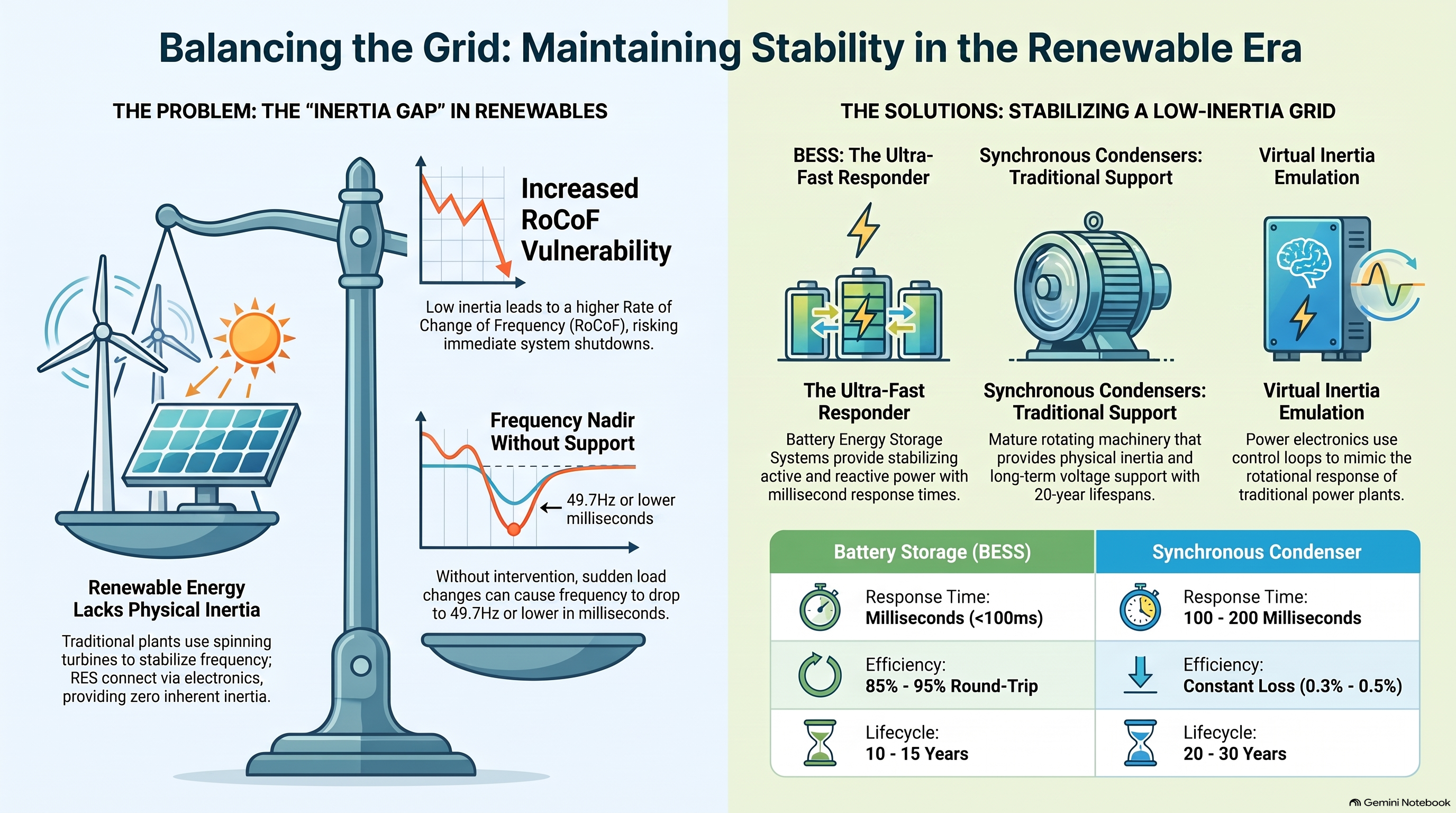
The old paradigm was comfortable: giant, centralized spinning turbines pushing power down a one-way street to passive sockets. That world is dead. Our current electrical infrastructure is becoming a “zombie grid”—a legacy system struggling to animate under the chaotic pulse of non-controllable renewable energy, high-speed EV charging surges, and the massive electrification of heat. Distribution System Operators (DSOs) are effectively flying blind into a storm of solar spikes. The grid was never designed to host distributed generation; it was built for consumption. To survive this transition without catastrophic network reinforcements, we need a “buffer” to absorb the shocks. Battery Energy Storage Systems (BESS) are that buffer, but as the following truths reveal, the way we deploy them is often based on outdated assumptions.
The Arbitrage Trap: Why Buying Low and Selling High Isn’t Enough
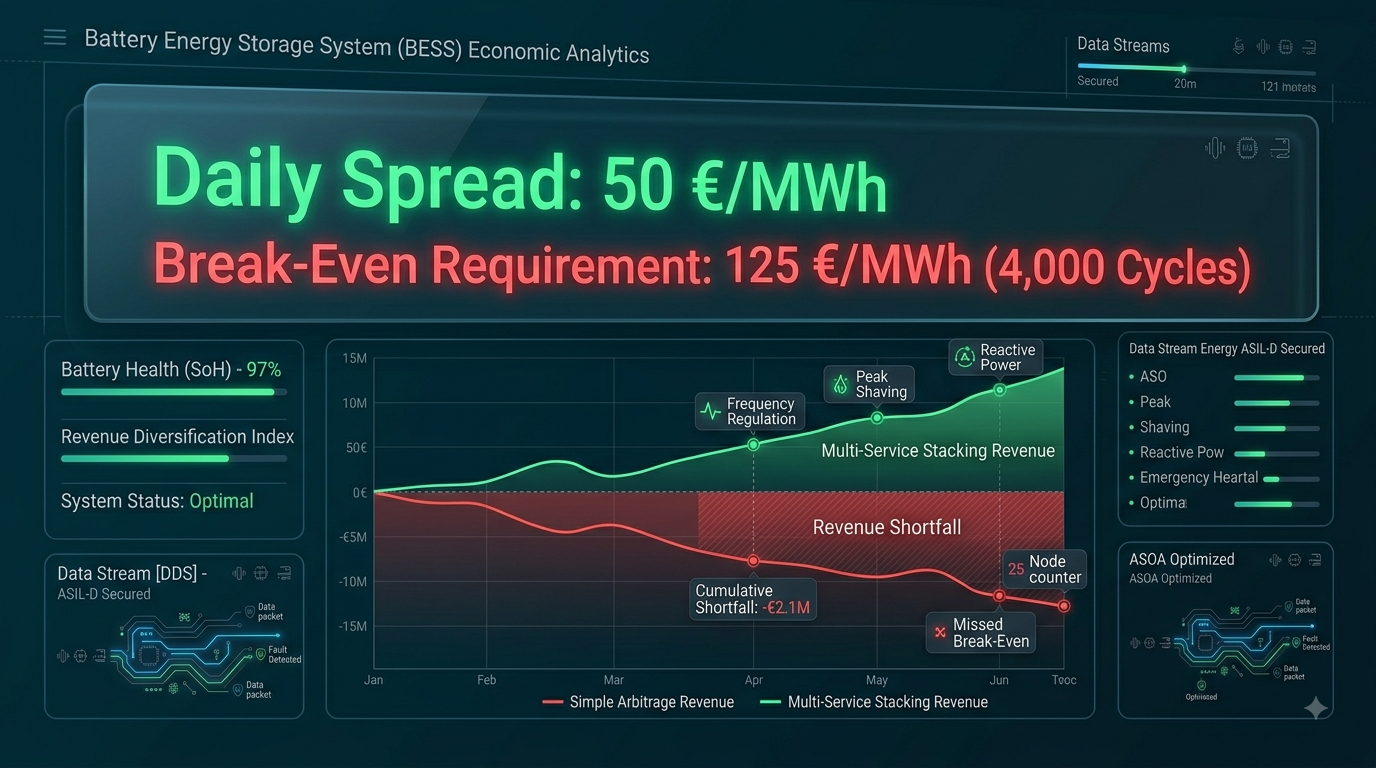
In energy circles, the most popular fairy tale is the “Arbitrage-Only” business model. The theory is simple: charge when the sun is out and prices are low, then sell when the moon is up and prices are high. In practice, this is an economic suicide mission for a standalone battery. If we look at the 2018 Day-Ahead Markets in Italy and the UK, the average daily price difference is frequently below 50 €/MWh. Now, look at the math for a typical battery with a capital cost of 500 €/kWh and a 4,000-cycle life. To simply break even over those cycles, you don’t need 50 €/MWh; you need a net revenue of 125 €/MWh. That leaves a massive 75 €/MWh gap that the current market cannot fill. “The target price for break-even within 4000 cycles would be 125€/MWh, a too high price for the present market, while 10000 cycles would be required to reach the break even for 50 €/MWh. “Unless you can magically extend your battery’s life to 10,000 cycles or find a market with extreme volatility, simple arbitrage is a losing game.
Lithium-Ion’s Monopoly: The “NMC” Advantage
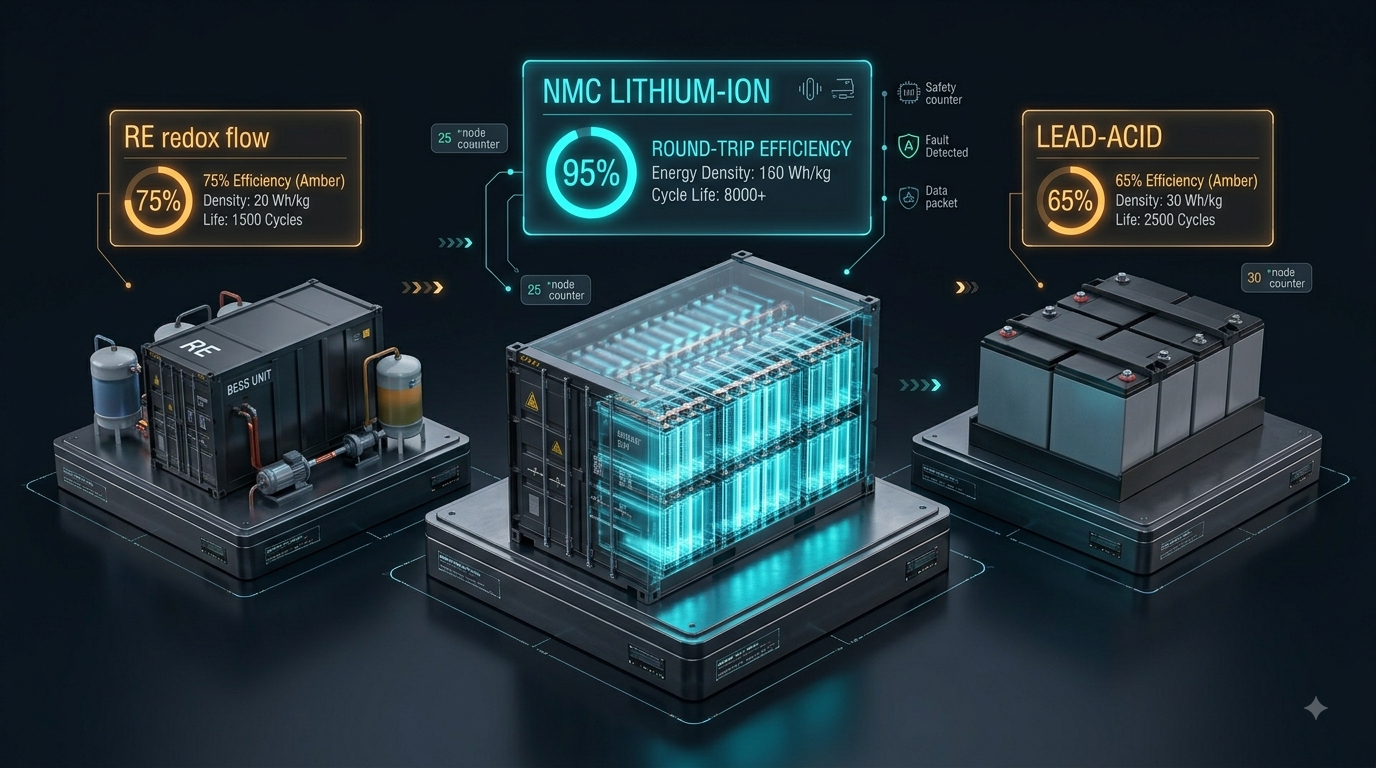
While academics love to debate the merits of exotic chemistries, Nickel Manganese Cobalt (NMC) has essentially won the stationary storage war. According to the latest performance data, NMC is the “best-in-class” technology across nearly every operational metric, making it the primary choice for both the grid and EVs. When we stack NMC against the field, the gap is glaring:
● Efficiency: Leading commercial Lithium-ion products now offer round-trip efficiency exceeding 95%. Compare this to the 75% efficiency typical of Redox Flow systems.
● Energy Density: At 90–190 Wh/kg, Lithium-ion dwarfs Lead-Acid (20–30 Wh/kg) and Redox Flow (15–30 Wh/kg).
● Cycle Life: While Lead-Acid components wither after 2,500 cycles, specific Li-ion chemistries can endure up to 10,000.
● The Price Collapse: Between 2013 and 2018, pack costs plummeted from $650/kWh to under $200/kWh, a trajectory no other chemistry has matched.
The Cost Shift: It’s No Longer Just About the Cells
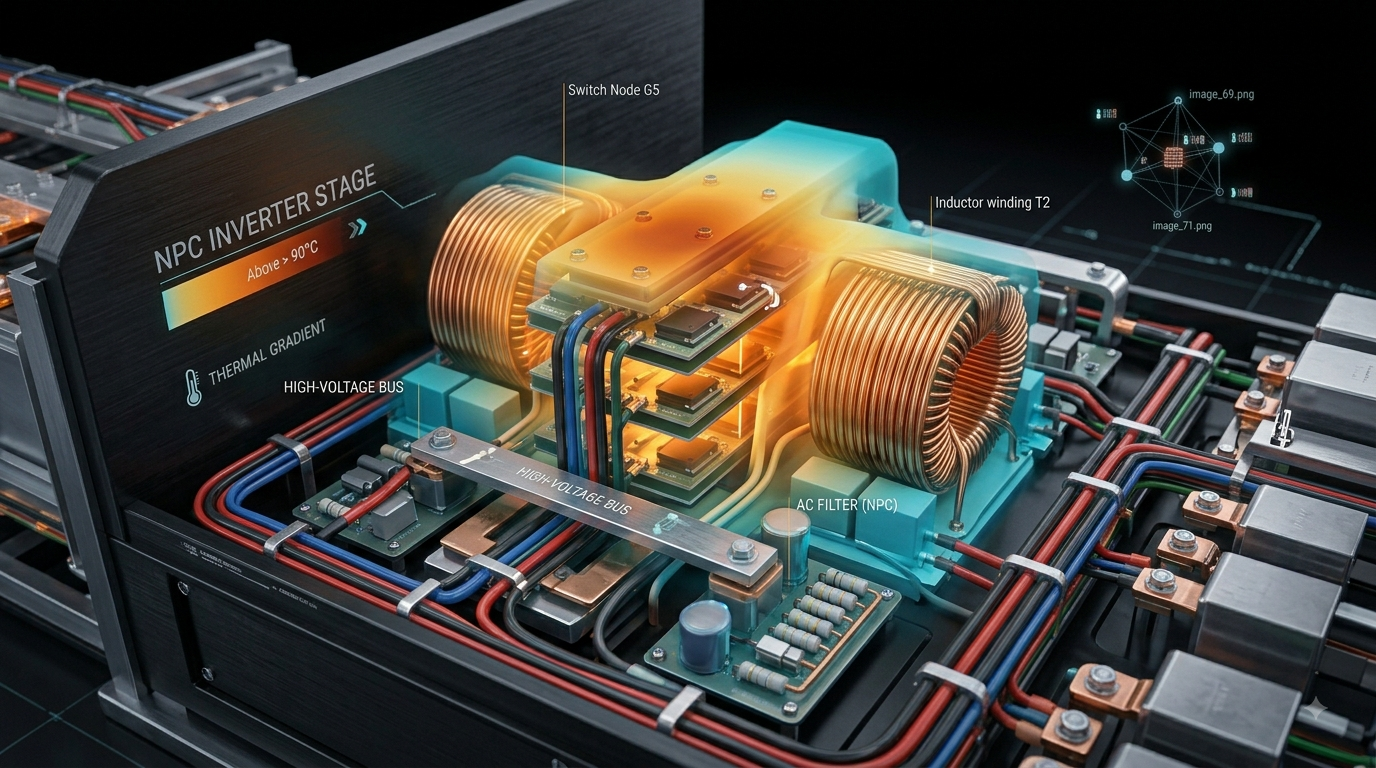
For a decade, we’ve obsessed over the cost of battery cells. But as cell prices bottom out, the focus is pivoting toward the Power Conditioning System (PCS)—the inverters and filters that act as the battery’s “brain and lungs.” The PCS is representing a higher share of the total cost of ownership, and that is where the next efficiency battle will be fought. The industry is moving away from basic “Two-Level” converters toward “Three-Level” topologies, specifically Neutral Point Clamped (NPC) designs. Why? Because these advanced converters distribute losses (heat) more evenly across components. By operating at higher switching frequencies (12-16kHz), we can drastically reduce the size of AC filters. This doesn’t just eliminate the annoying audible whine often associated with grid hardware; it shrinks the physical footprint and slashes the overall “Balance of System” costs.
Location Logic: Why a Battery at Node 69 Beats Node 27
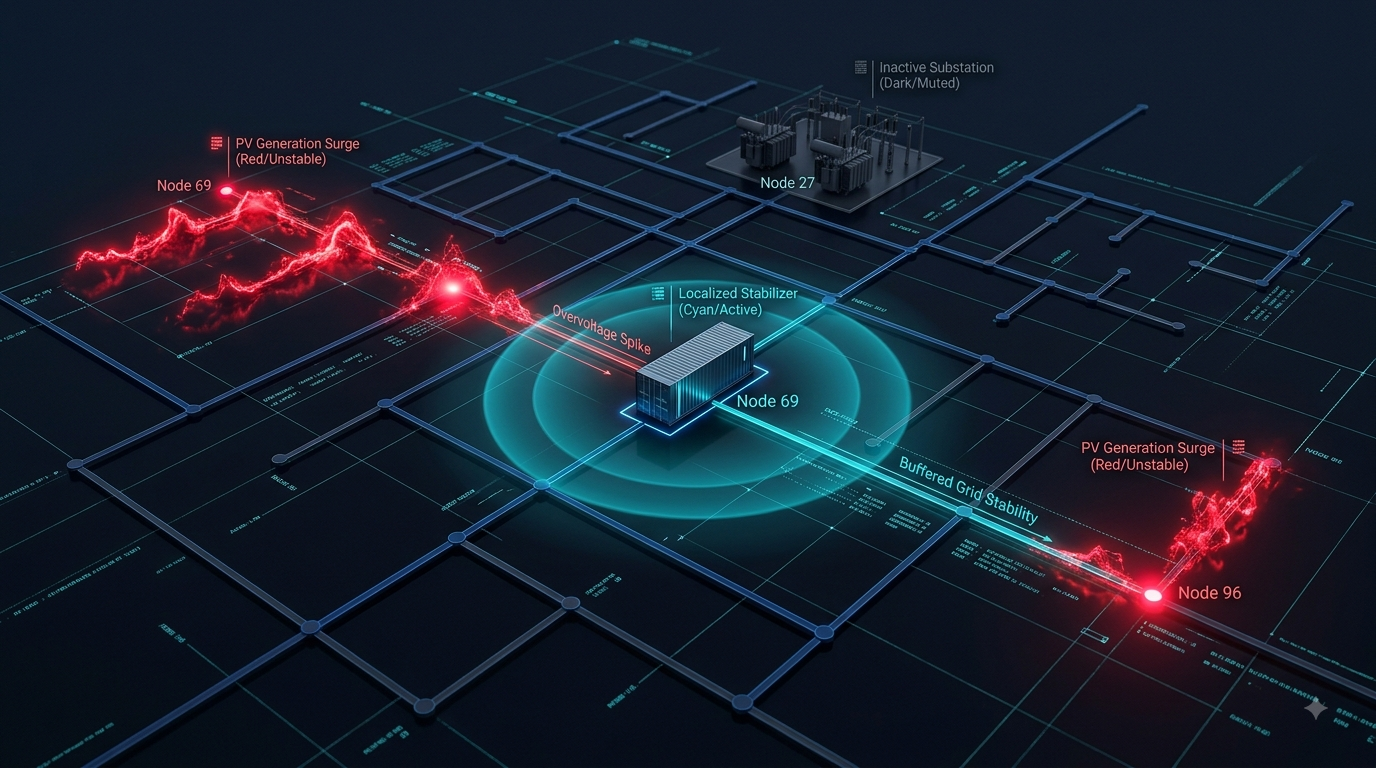
In the world of the grid, “sizing” a battery for capacity is useless if you don’t “site” it correctly. Strategic positioning is the difference between a functional asset and a paperweight. The IEEE European Test Feeder study highlights a critical reality: PV-induced overvoltage is a localized disease that hits hardest at the “end of the network.” If you place a battery at the substation (Node 27), it is essentially “shouting into a void” —it’s too far removed to influence the local voltage profile. However, if you place that same battery at the edge (Node 69 or Node 96), it acts as a localized pressure release valve. In grid management, proximity is power.
The “Service Stacking” Secret: 50.1% of Success

If arbitrage is a mathematical failure, how are project developers making money? They have discovered that a BESS must be a “Swiss Army Knife” not a single-use tool. We have reached a tipping point: 50.1% of all active projects now stack technical and commercial services. By combining functions, the business case finally closes. According to the Sandia National Laboratories database, the most successful projects today provide at least four of these stacked services :
● Frequency Regulation (The primary commercial driver)
● Electric Bill Management
● Renewable Capacity Firming
● Black Start Capabilities (Restarting the grid after a blackout)
● Microgrid Capability (Islanding from the main grid)
Conclusion: Beyond the Container
The era of treating a battery like a “fixed efficiency percentage” in a spreadsheet must end. Treating a high-performance, degradable electrochemical engine like a simple AA battery leads to poor scheduling and premature failure. We need more accurate battery modeling—digital twins that understand how variable efficiency and temperature gradients actually dictate the lifespan of the asset. Ultimately, we have to ask ourselves: does the future of the grid depend more on discovering a “miracle” chemistry, or on the intelligence of the control infrastructures that manage the chemistries we already have? The container is just the box; the real revolution is in the communication systems and algorithms that tell that box exactly when and where to breathe.