

The Ghost in the Machine
The modern factory isn’t quite what it looks like from the outside. Behind the pristine veneer of high-speed automation and clean sustainability dashboards lies a subsurface of chaos. Even on the most sophisticated lines, manufacturers are haunted by a kind of “ghost in the machine” — invisible micro-variances that traditional statistics and human operators are structurally incapable of catching. A 0.5-degree drift in a drying oven, a slight shift in slurry viscosity, a ten-millisecond lag in a network switch — any one of these can trigger a cascade of defects that stays undetected until thousands of units have already been scrapped.
The world’s leading gigafactories are no longer content to just react to these ghosts. By fusing agentic AI with Time-Sensitive Networking (TSN), they’ve built something closer to an industrial nervous system — one that has finally caught up to the machine’s brain. The result is a shift from a reactive, probabilistic model of manufacturing to an autonomous, deterministic one, where problems are reasoned through and corrected before they even fully manifest.
1. From 2.5 Days to 90 Minutes: The End of the "Root Cause" Mystery
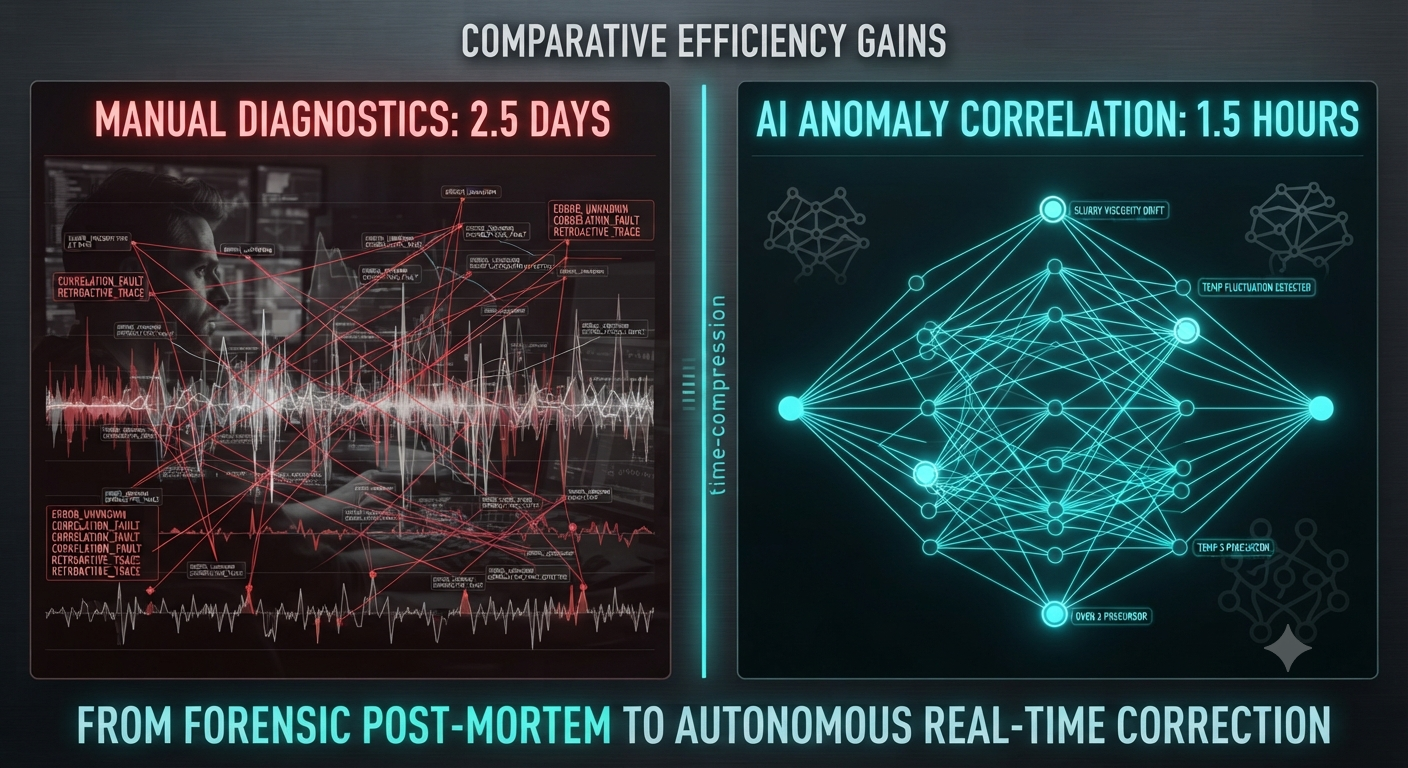
In a traditional factory, identifying a root cause is a forensic post-mortem that can take days — often while the line stays down, or keeps producing waste in the meantime. A case study from IndustrialMind.ai describes a battery manufacturer wrestling with a persistent 6.5% defect rate in electrode coating, where pinning down the “why” historically took 2.5 days of manual data hunting.
The breakthrough came from abandoning the manual dashboard altogether. Deploying an AI anomaly-detection agent let the system correlate variables no human analyst would think to link — the relationship between specific slurry batch compositions and minute fluctuations in drying temperature, for instance — catching the precursor to the defect in real time.
The result wasn’t just faster diagnosis; it was a full transformation of the quality lifecycle. Research published in the IJETRM journal on collaborative human-AI teaming models reports similarly large gains elsewhere: defect detection rates improving by 34–47%, and total validation cycles shrinking by 28–39%.
| Metric | Before AI Integration | After AI Integration |
| Electrode coating defect rate | 6.5% | 1.1% |
| Root cause identification time | 2.5 days | 1.5 hours |
| Defect detection capability | Baseline | +34–47% |
| Validation cycles | Baseline | -28–39% |
2. The Death of the 2% Sample: Why "Good Enough" Is a $50,000 Liability
Statistical sampling is a relic of an era with lower volumes and lower stakes. In a modern gigafactory producing 500,000 cells a day, testing only 1–2% of output is effectively a mathematical surrender. If a single defective cell slips through, the cost isn’t the scrap value of that part — it’s the potential total loss of the vehicle it ends up in, along with the brand damage that follows.
As strategists at iFactory AI put it, the math of failure here is unforgiving: a single defective battery cell can turn a $50,000 electric vehicle into a fire risk, and by the time a defect reaches pack assembly, it has typically already survived electrode coating, tab welding, formation cycling, and module stacking without ever being caught. Their answer is a move away from probabilistic sampling entirely, toward 100% inline AI vision inspection — checking every pinhole and every weld at the millisecond it occurs. Catching a defect at the electrode stage costs pennies. Catching it in the field, after a thermal event, costs millions.
3. The Millisecond War: When Ethernet's "First-In, First-Served" Fails
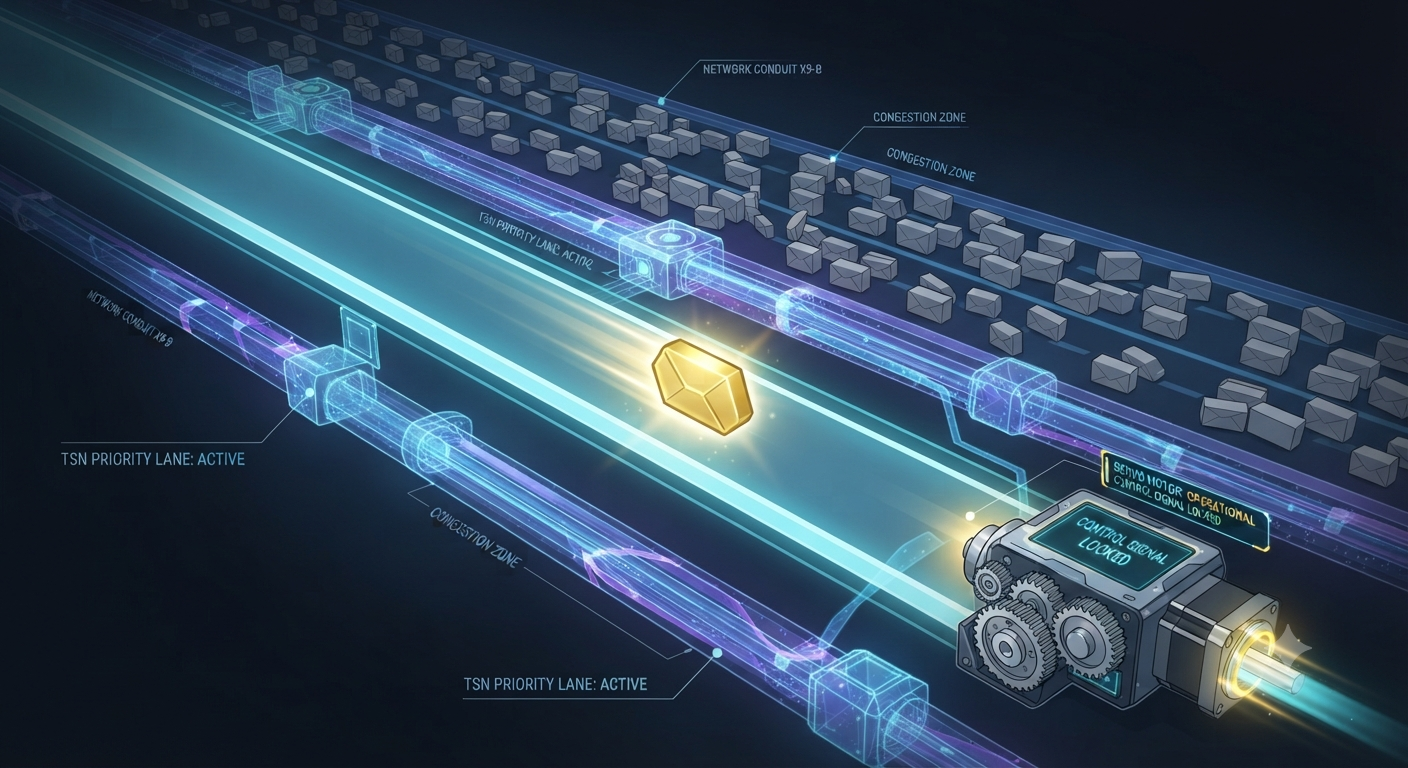
Standard Ethernet is a structural liability in high-precision environments. It runs on a first-in, first-served, collision-based architecture, where a burst of non-critical data can end up delaying a critical stop signal. In the context of electrolyte filling or high-speed motion control, a servo motor lagging by even 20 milliseconds isn’t a minor delay — it’s a spill, or a mechanical collision.
That’s why Time-Sensitive Networking (TSN), specifically the IEEE 802.1Qbv standard, has become non-negotiable on the autonomous factory floor. As analyzed by Moxa, TSN provides what’s essentially an HOV lane for critical control traffic — bounded, low-latency delivery. While the rest of the network handles the heavy lifting of AI vision data, the TSN infrastructure guarantees that time-critical control signals jump the queue, arriving with predictable, millisecond-level precision regardless of how congested the network gets.
4. From "Passive Observer" to "Agentic Actor": The Rise of Self-Correcting Lines
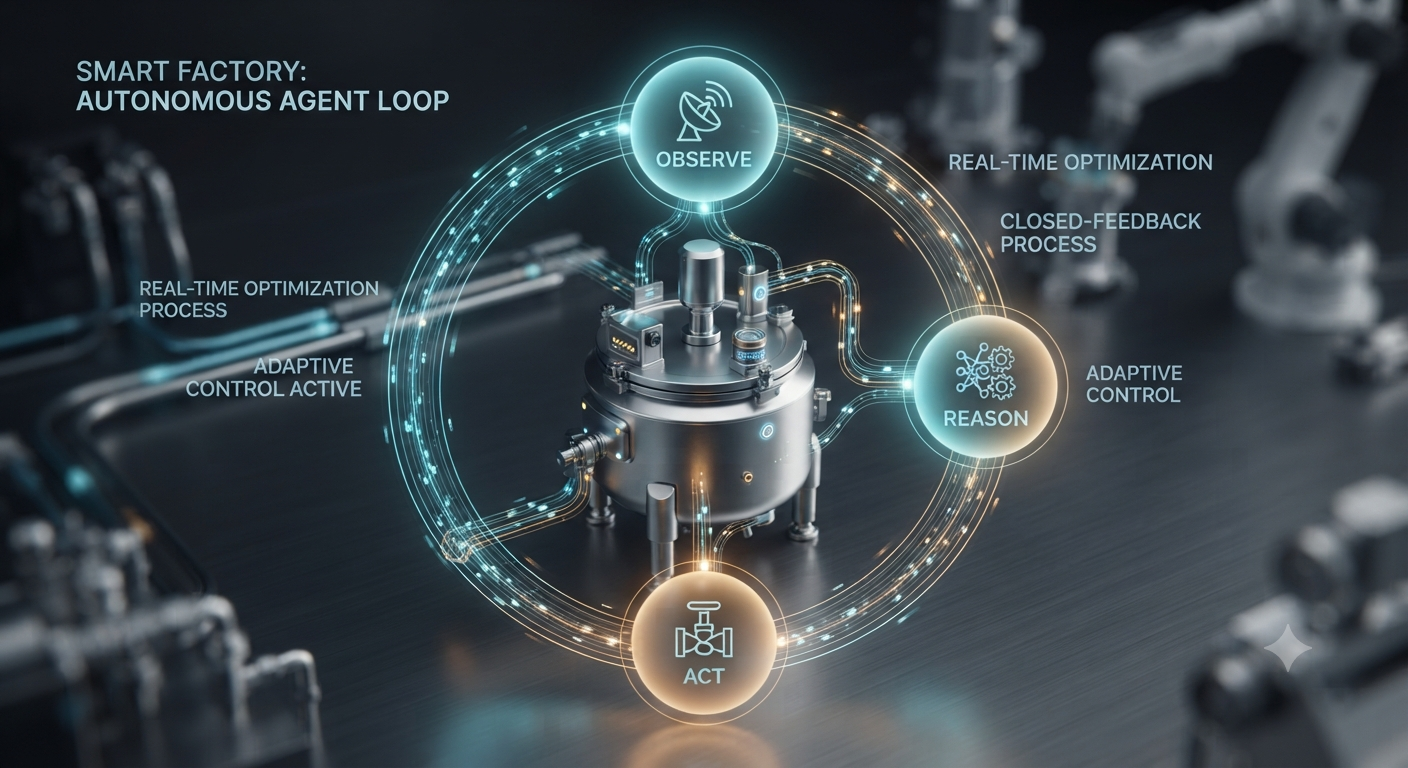
The industry is outgrowing Industry 4.0. Where 4.0 was primarily about connectivity and alerts, manufacturing is now entering an era of agentic operations. Traditional AI is a passive observer — it spots a problem and hopes a human reads the alert in time. Agentic AI, as implemented by companies like HiveMQ and OpenText, is an actor instead: it reasons across competing objectives and executes autonomous adjustments within defined safety guardrails.
Consider a scenario described by OpenText, sometimes referred to as the “18-minute window”:
- Observe — the AI detects a micro-variance in mixer torque alongside a shift in environmental humidity.
- Reason — it recognizes that this specific combination of conditions has historically preceded a 12% yield loss.
- Act — without waiting for a human, the agent autonomously adjusts mixer agitation and compensates for the temperature drift in real time.
That’s self-healing manufacturing in practice. By the time a human operator would have noticed the drift on a dashboard, the agentic system has already solved the problem — and logged the intervention for the audit trail.
5. Unlocking "Stranded" Capacity: The Hidden Wealth in Existing Infrastructure
One of the more disruptive realizations for any operations strategist is that existing infrastructure is often hiding 20–30% of its true capacity. Most facilities run on conservative margins because of what might be called “thermal uncertainty” — a fear of the unknown that leaves power and compute paid for but unused, or “stranded.”
Data from HiveMQ illustrates the same pattern in the data-center world: a hall capped at 3.5MW due to limited visibility can often safely support 4.4MW once AI-driven precision thermal control is in place. This isn’t only about saving energy — it’s about mass customization. By narrowing conservative margins, manufacturers can extract more battery throughput, or more productive compute, from the exact same physical footprint, operating closer to the true physical boundary and deferring millions in capital expenditure by simply putting stranded assets to work.
Conclusion: The Digital Twin Is No Longer Optional
The convergence of agentic AI, TSN, and digital twins is finally merging IT and OT into a single Unified Namespace (UNS) — a semantic foundation for the entire enterprise, letting the “brain” of the AI speak the same language as the “muscles” of the servo motors.
The path there isn’t smooth, though. IJETRM research warns that roughly 70% of AI transformations fail, largely due to ineffective change management and misaligned incentives. The technology is ready; a lot of organizations aren’t. The real competitive gap going forward isn’t between the fast and the slow — it’s between the deterministic and the probabilistic. If your quality model still relies on 2% sampling and human-monitored dashboards, you’re already running a legacy facility. The question worth asking is whether your current network and quality model are fast enough to survive the next decade of autonomous competition.