

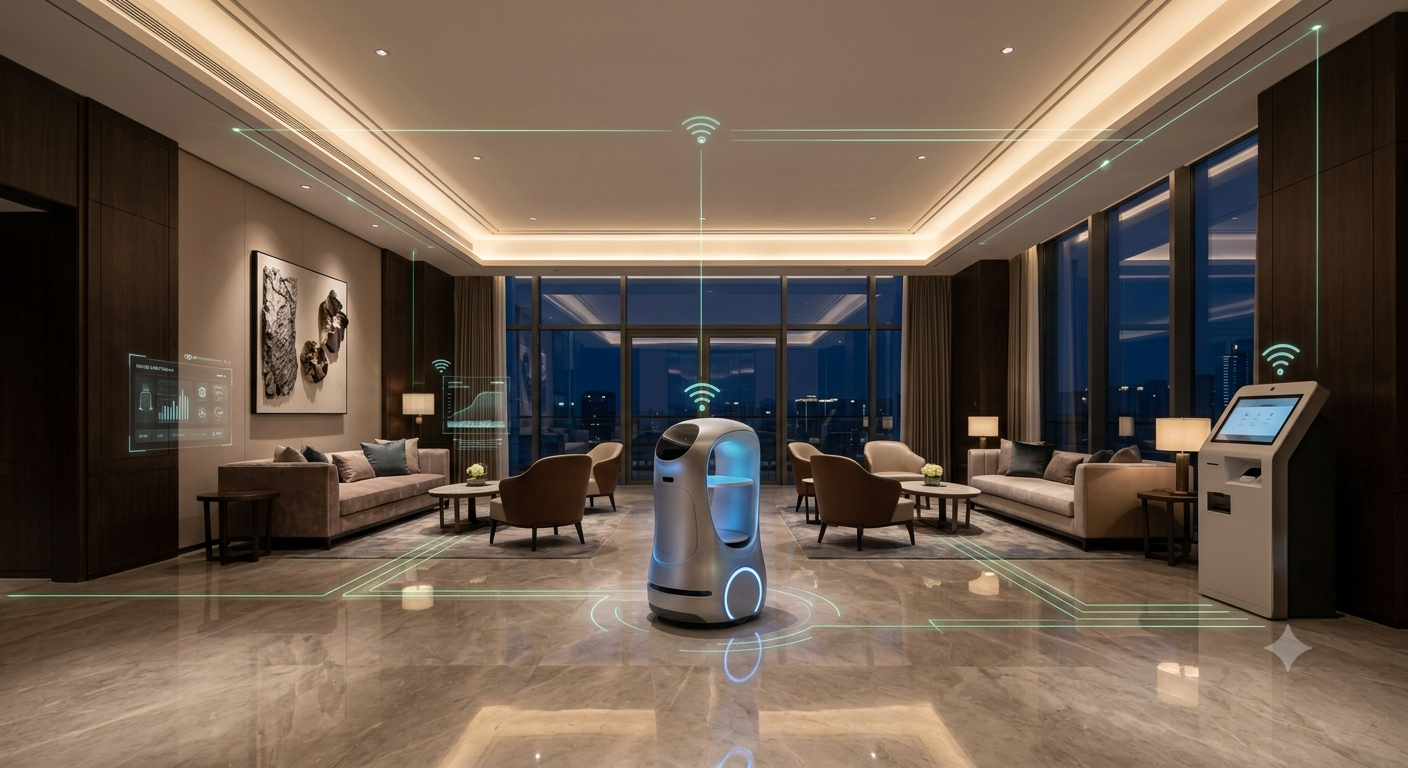
Inside the Five-Star Hotel That Runs Itself: How Agentic AI Is Automating Luxury Hospitality
Guests expect a five-star hotel to feel effortless — the room is exactly the right temperature when they arrive, towels never run short, the lobby never feels chaotic, and a parking spot is somehow always ready. Behind the scenes, that “effortless” feeling has traditionally required an army of staff coordinating manually across disconnected systems.
That’s starting to change. Agentic AIoT — a combination of dense sensor networks, edge AI, and autonomous reasoning agents — is being used to unify everything from room climate control to waste management into one coordinated system that thinks and acts largely on its own.
Why Traditional Hotel Automation Falls Short
Most hotels already have a Building Management System handling energy and HVAC. The problem is everything else — housekeeping schedules, laundry logistics, front desk operations — stays siloed across separate tools and manual workflows. If a late checkout throws off room readiness, or an elevator outage disrupts laundry carts, there’s no system smart enough to reroute things on its own.
Agentic AIoT closes that gap by giving AI agents the ability to perceive, reason, plan, and act continuously — handling messy, multi-step situations rather than just following fixed if-then rules.
The Four Layers of the System
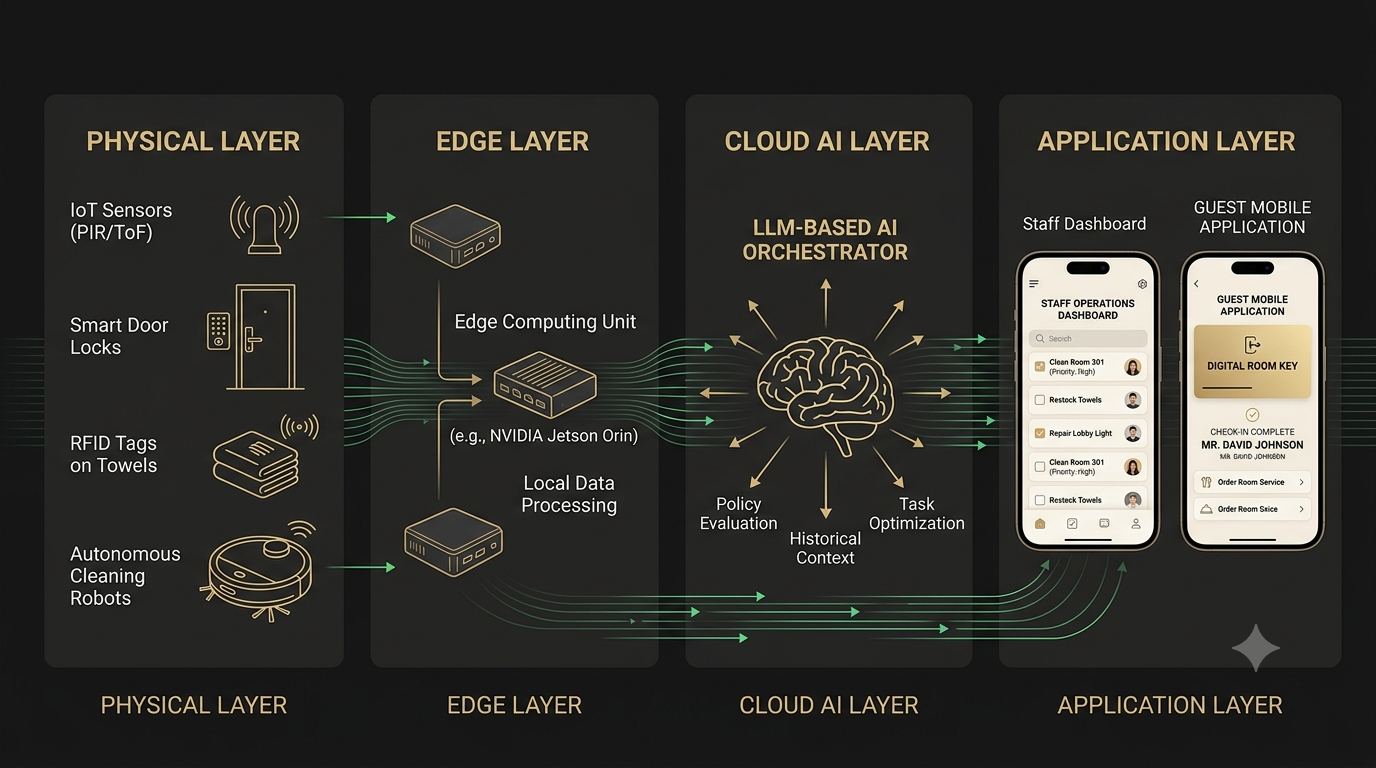
The architecture is built in four layers, all connected by a constant flow of data:
- Physical layer — room sensors, laundry RFID tags, lobby kiosks, parking cameras, cleaning robots
- Edge layer — gateways (NVIDIA Jetson Orin, Raspberry Pi 5) that process data locally, keeping safety-critical decisions under 50 milliseconds
- Cloud AI layer — LLM-based orchestrator agents that reason over the aggregated data and issue commands back down to the edge
- Application layer — a staff dashboard and a guest-facing mobile app, both tied into the hotel’s property management system
How the Agents Actually "Think"
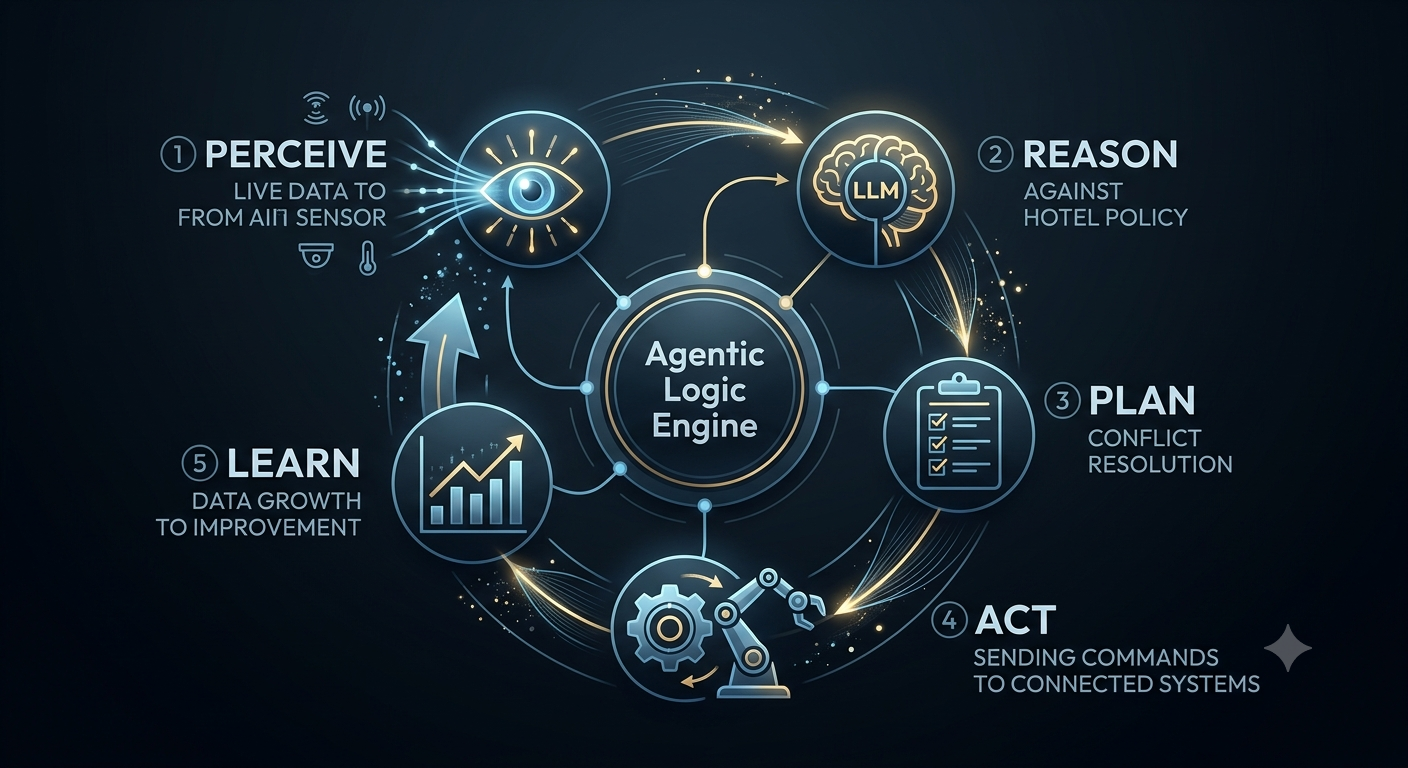
Every operational area — rooms, laundry, lobby, parking, cleaning, waste — is run by its own specialized agent, and each one follows the same five-step loop:
- Perceive — pull in live data from relevant sensors
- Reason — an LLM evaluates the situation against hotel policy and pulls in relevant historical context
- Plan — generate a task list, resolving conflicts over shared resources
- Act — send commands out to the actual devices and systems
- Learn — track outcomes and feed them back to improve future decisions
Room by Room: What Each Domain Actually Does
Guest rooms. Occupancy sensors, distance sensors, ambient light sensors, and even millimeter-wave radar (sensitive enough to detect a sleeping guest) feed into a smart panel controlling lighting, thermostat, blinds, and the door lock. A BLE beacon on the guest’s digital key starts pre-conditioning the room’s temperature once they’re within about 50 meters. When the room agent detects everyone has left, it drops HVAC to standby — cutting energy use in unoccupied rooms by as much as 38%.
Laundry. Every towel, sheet, and robe carries an RFID chip, tracked from chute to wash cycle. Computer vision on the sorting line flags items needing special treatment before they enter the main wash. The laundry agent predicts when linens are wearing out, automatically orders replacements, and times machine loads to cheaper electricity windows — cutting laundry energy costs by roughly 22%.
Lobby. Facial recognition kiosks handle self-check-in in under 90 seconds for enrolled guests. Overhead cameras track crowd density and open secondary service lanes automatically when things get busy. A humanoid service robot patrols the floor answering guest questions in natural language, and escalates to a live staff member the moment it senses guest frustration.
Parking. License plate recognition identifies arriving cars and raises barriers in under 1.5 seconds, cross-checking VIP and valet profiles automatically. The system assigns optimal parking slots — prioritizing shorter walks for guests with accessibility needs — and even times EV charging to align with peak solar generation from the hotel’s microgrid.
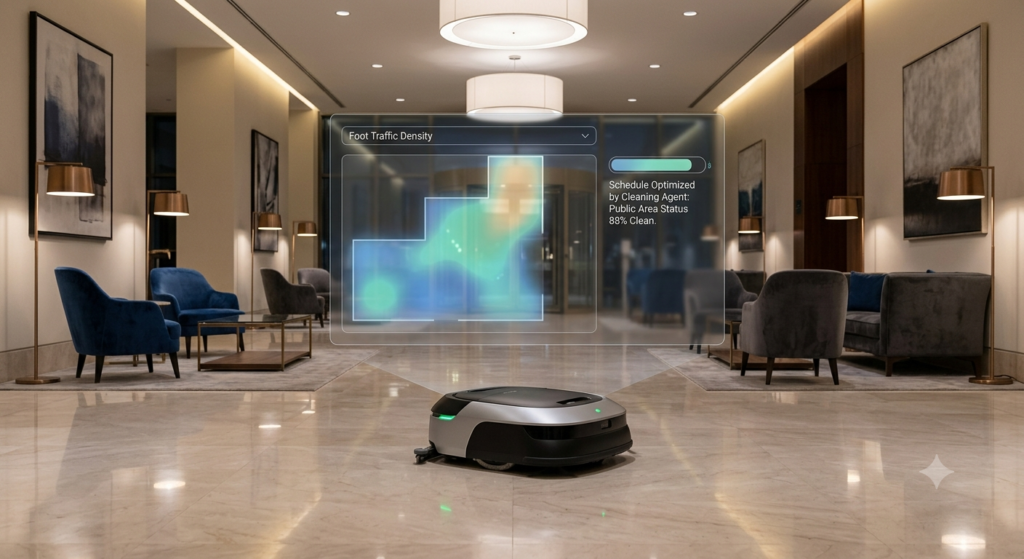
Cleaning. Autonomous robots handle corridor and public-area floor cleaning, scheduled based on real dirtiness scores, foot-traffic patterns, and upcoming events pulled from the hotel calendar. Housekeeping staff get optimized room-servicing sequences on a mobile app, and a camera-based inspection system checks room cleanliness automatically before a human inspector signs off.
Waste management. Fill-level sensors in every bin predict overflow risk before it happens, routing collection staff proactively instead of reactively. A robotic compactor runs during off-peak hours to save energy, and vision-based sorting improves recycling accuracy — with monthly sustainability reports generated automatically for ESG reporting.
The Technology Underneath
| Layer | Key Technologies | Role |
| Physical | PIR/ToF sensors, RFID, LiDAR, IP cameras, smart locks, AMRs | Data collection and physical action |
| Connectivity | Zigbee 3.0, BLE 5.3, Wi-Fi 6E, LoRaWAN, MQTT, CoAP | Low-latency, low-power data transport |
| Edge AI | NVIDIA Jetson Orin, Hailo-8, TF Lite, OpenCV, K3s | Local inference and gateway logic |
| AI Orchestration | LangGraph, GPT-4o/Gemini 2.0, LangChain, vector databases | Agent reasoning and planning |
| Application | React Native, Node.js, WebSocket, PMS/ERP integration | Guest and staff interfaces |
Real Outcomes, Not Just Theory
- A VIP guest arriving early gets their room ready 45 minutes ahead of check-in, triggered automatically by cross-checking booking data with room sensors
- Predictive ordering means zero linen shortages even during heavy banquet weekends
- Lobby crowding gets resolved with secondary check-in lanes, cutting wait times by 60%
- Waste surges after big events are handled with zero overflow and 18% energy savings
What Can Go Wrong (and How It's Handled)
No system like this comes without real challenges:
- Privacy and biometric compliance — facial recognition data must meet GDPR and similar regulations. The fix: storing only on-device templates, requiring guest opt-in at booking, and deleting data at checkout.
- Legacy building infrastructure — older five-star properties often run outdated wiring systems. Gateways bridge old and new hardware without requiring a full rewire.
- AI misjudgment in safety-critical moments — an LLM misreading a sensor could trigger the wrong action. A deterministic rule-engine layer double-checks every command before it’s executed.
- Internet outages — edge agents are built to keep operating locally using on-premise models and a local message broker, so a lost connection doesn’t freeze hotel operations.
Where This Is Headed
The bigger shift here isn’t any single robot or sensor — it’s moving hotel operations from reactive, rule-based automation to something that behaves more like an experienced operations manager who never sleeps. Properties adopting this kind of system are seeing operational cost reductions in the range of 25–40% across energy and labor, alongside far fewer service failures and a level of personalization that’s hard to match with staffing alone.
As AI inference gets cheaper and edge hardware keeps improving, this kind of full-property automation won’t stay limited to five-star flagships — it’s likely to become standard even for mid-scale hotels within a few years.
Based on research by Syed Aaqib Jaffer.
This article offers a fascinating look at how Agentic AI is transforming luxury hospitality through intelligent automation. The explanation of AI-driven decision-making, IoT integration, and autonomous hotel operations demonstrates how emerging technologies can enhance guest experiences while improving operational efficiency. A forward-thinking read that showcases the exciting future of smart hospitality.