


The High-Stakes Game of Energy on the Move
The lithium-ion battery is the undisputed engine of the green revolution, yet it remains, technically and legally, a volatile “dangerous good.” We’re living through a period where global demand for charge storage has fundamentally outpaced the proof of safety for the technologies delivering it. That creates a genuine paradox in the boardroom: how do you scale at the speed of the EV market while navigating a landscape of shifting legal liability?
The margin for error is shrinking fast. Organizations can no longer rely on reactive, manual compliance — they need an intelligent, predictive posture instead. Here are five pillars shaping that shift for the 2026 landscape.
1. Your Battery Has a Ghost: The Rise of the Cloud-Edge Digital Twin
The cloud-edge digital twin framework represents the current frontier of battery lifecycle management. Research pioneered by Abhishek Baer describes a dual-layered architecture in which a virtual “ghost” of the battery exists simultaneously on the vehicle’s own hardware and in the cloud. This isn’t just a monitoring tool — it’s a predictive system trained in part on the well-established NASA battery dataset.
The precision on display is genuinely striking: State-of-Health (SOH) estimation errors below 1.8% RMSE, and State-of-Charge (SOC) errors under 0.81% RMSE. Just as important, these models return inference times under one second — the benchmark an onboard Battery Management System needs to make millisecond-scale safety adjustments in real time. As the underlying research puts it, the retrainable SOC model is designed to adapt to aging effects, so accuracy holds up even as battery capacity degrades over the vehicle’s life.
2. ADR 2026: The New Rulebook for the Road
/*! elementor – v3.7.4 – 31-08-2022 */
.elementor-widget-image{text-align:center}.elementor-widget-image a{display:inline-block}.elementor-widget-image a img[src$=”.svg”]{width:48px}.elementor-widget-image img{vertical-align:middle;display:inline-block} 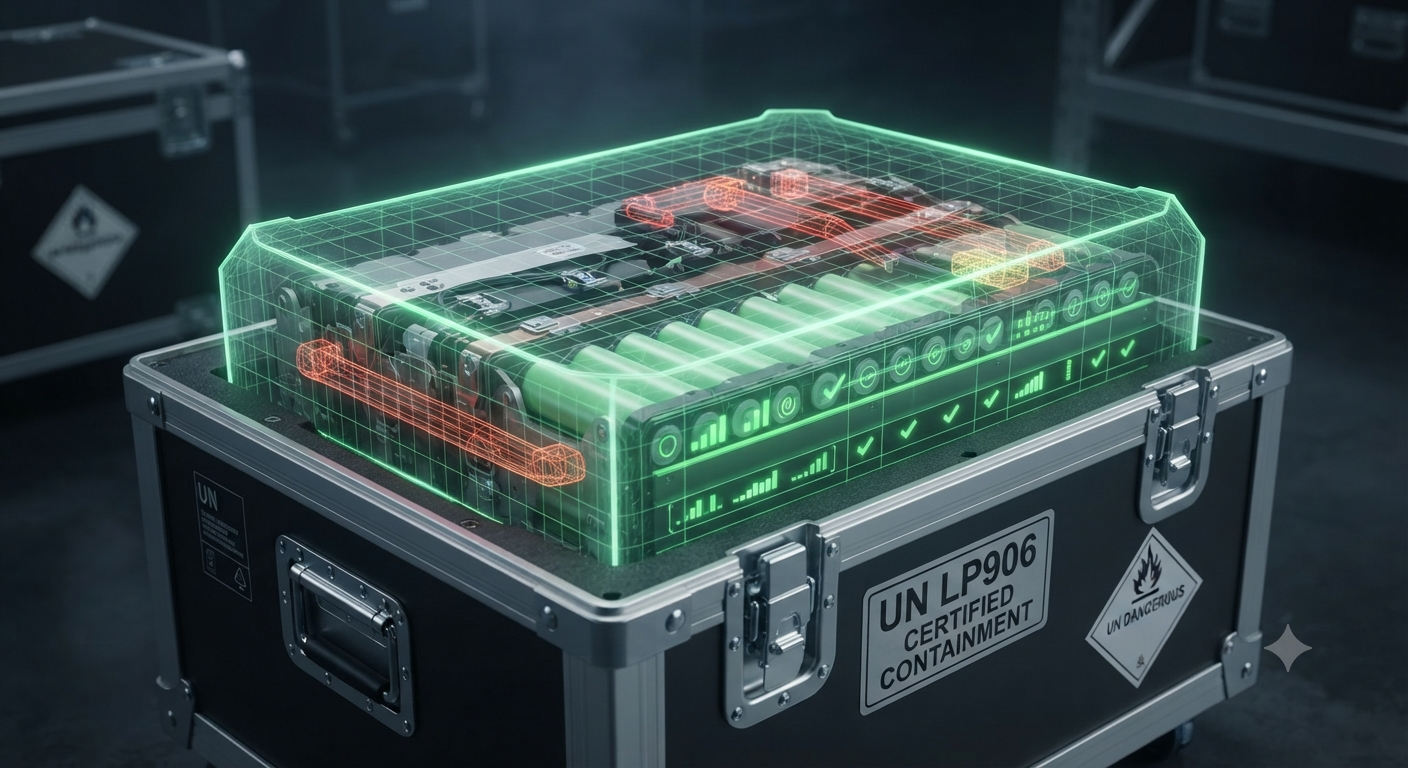
On January 1, 2026, the updated European Agreement Concerning the International Carriage of Dangerous Goods by Road (ADR) becomes mandatory — and it’s not a minor update. It’s a comprehensive legal shift affecting both lithium-ion (UN3480, UN3481) and lithium-metal (UN3090, UN3091) chemistries.
Logistics managers should be preparing for three main impacts:
- Updated packaging standards — particularly for damaged, defective, or “suspected” batteries, which often now require the expensive UN LP906 containment standard.
- Stricter thermal-runaway containment — new mandates around gas filtration, with specific attention to neutralizing hazardous effluents like hydrogen fluoride.
- Expanded documentation — consignment notes now need written declarations of a battery’s specific condition, along with precise UN number references.
The inclusion of “suspected” batteries is the toughest part of this to manage — but it’s also where digital twins earn their keep. A digital twin can supply the scientific evidence needed to prove a battery isn’t actually suspect, letting managers avoid the considerable cost of over-packaging perfectly healthy units that would otherwise fall under the strictest 2026 scrutiny.
3. 30% Faster Innovation: AI as the Ultimate R&D Lab
The era of blind trials and physical-first experimentation is winding down. Engineers now lean on physics-informed machine learning to run optimization loops on cell chemistry and thermal behavior entirely inside virtual environments — moving away from broad empirical testing toward narrow, high-probability “recipes” that are a real competitive edge.
That shift is already showing up on the bottom line: AI-driven digital-twin workflows have cut EV battery development cycles by roughly 30%. By simulating electrode mix and coating speeds before a single physical cell gets produced, manufacturers are reaching target performance levels with noticeably fewer physical experiments along the way.
4. From “Fixed Rules” to “Agentic AI”: The Supply Chain’s Brain
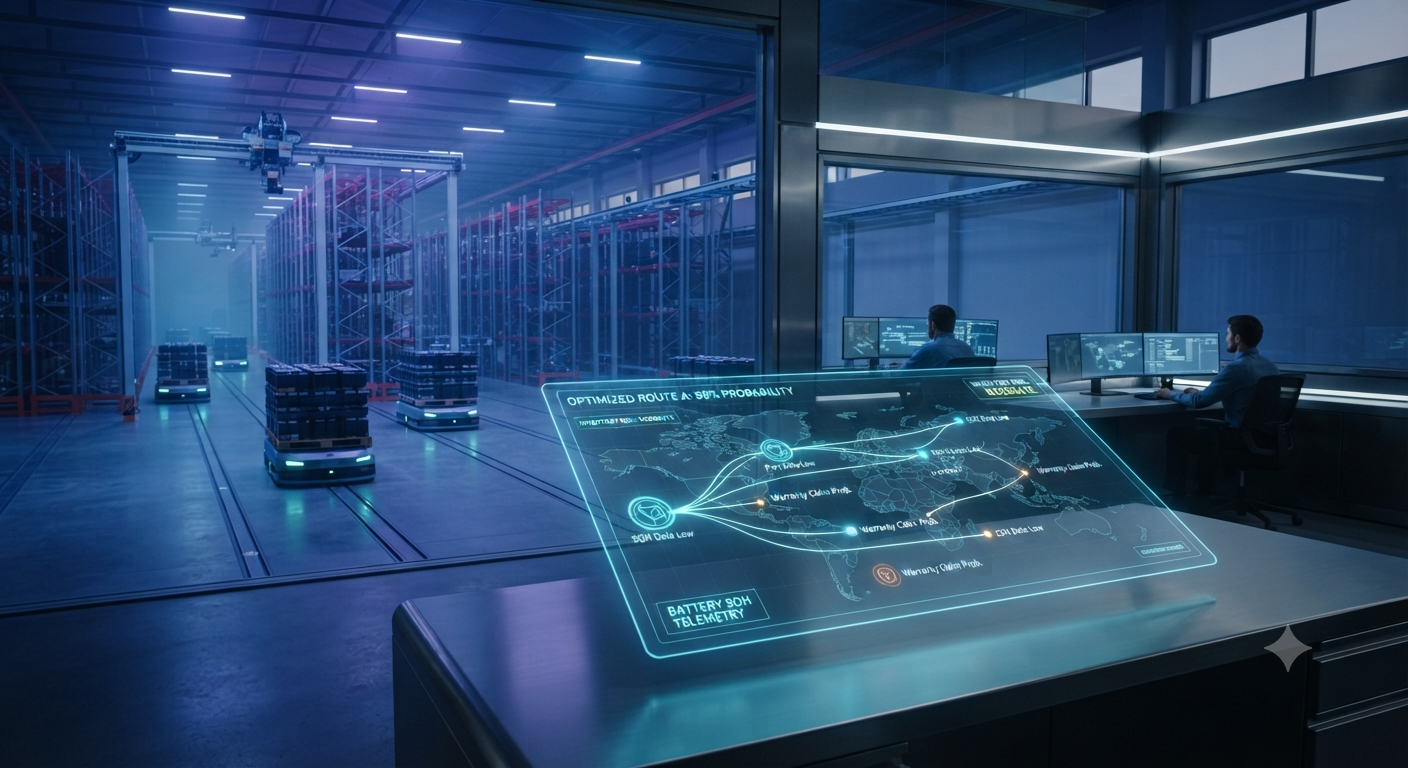
The supply chain is moving away from deterministic automation — simple if/then triggers — toward something closer to probabilistic supply chain management. Modern agentic AI systems sense, reason, and act on complex telemetry from warehouses and production lines. Rather than just following rules, they learn policies that let them make genuine contextual trade-offs.
In practice, that might look like an AI agent analyzing real-time SOH data and deciding to allocate higher-quality cells to a high-priority order — weighing the risk of future warranty claims against the immediate cost of expedited freight. That policy-learning approach lets the system keep improving its decision-making under uncertainty. Early trials of systems like this have already reported operational gains of 15–20% for early adopters, along with 20–30% fewer inventory errors where agents are managing reorder triggers directly.
5. The Safety Horizon: Containing the Unthinkable
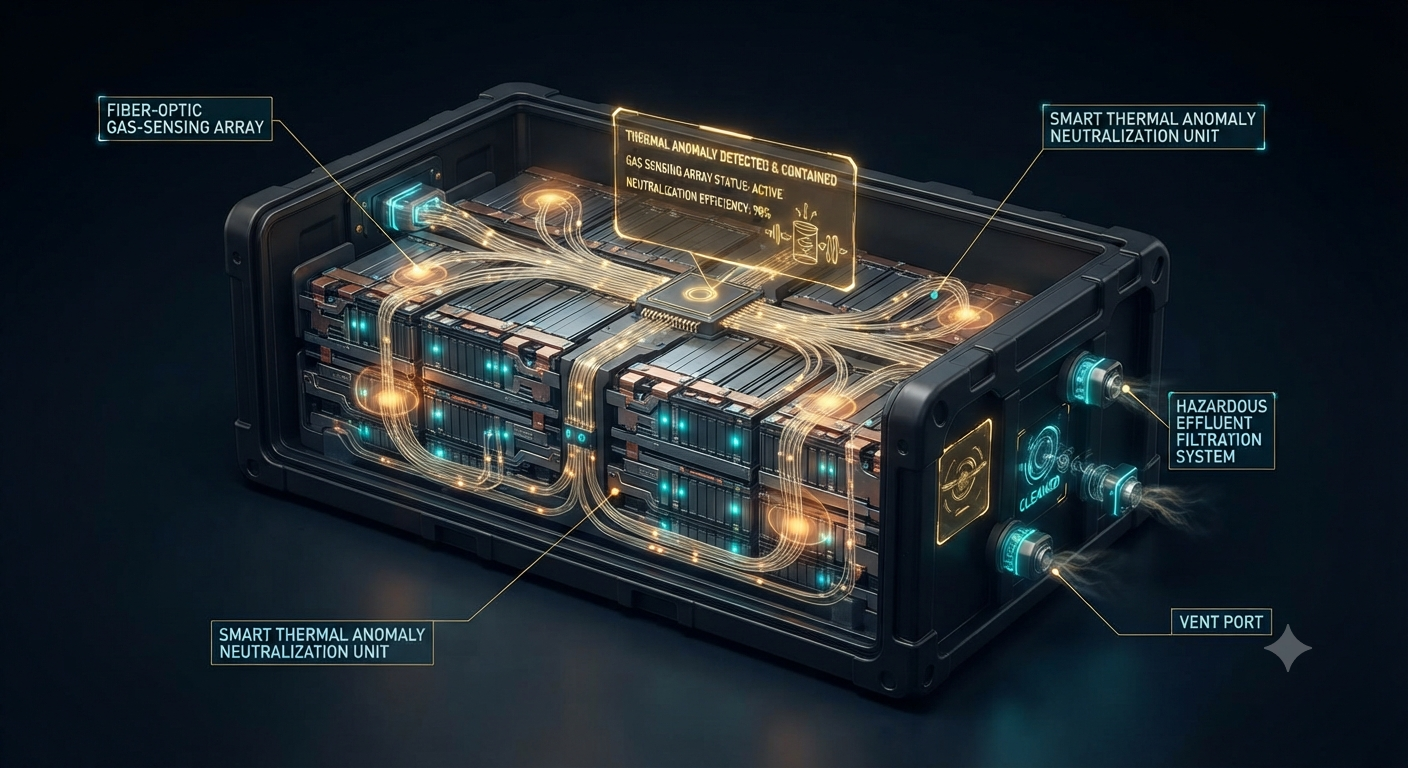
Safety is no longer just about a sturdy crate — it’s an integrated ecosystem of containment and early warning. Research from APT Research emphasizes that packaging now has to be proven to contain fire, fragments, and toxic gases during an actual thermal event. The next step beyond that is the Remote Monitoring Integrated System (RMIS), a notional concept using sensors to provide early-warning signals — off-gassing, for instance — across ground, sea, and rail transport.
Genuine safety depends on a protocol simple enough for laypeople with little to no training to use correctly. The APT report lays out three mandatory elements of that safety support structure:
- Proper classification — a simplified protocol that lets any operator identify the hazard level quickly.
- Proper handling and packaging — equipment that actually meets the rigorous ADR 2026 standards.
- Hazard control equipment — specialized tools designed to mitigate a hazard the instant it’s realized in transit.
Conclusion: The Path Toward 2026 and Beyond
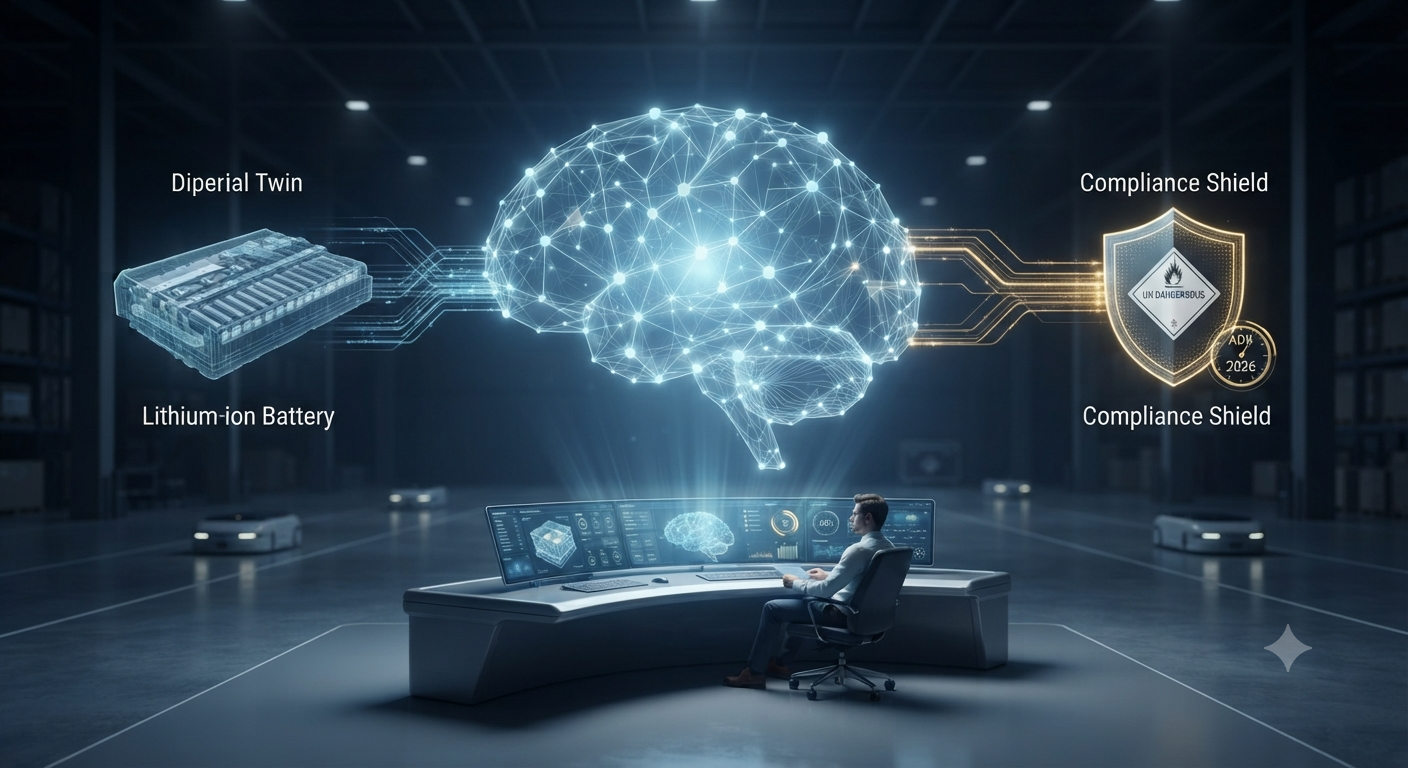
The future of battery logistics won’t be defined by better chemistry alone — it will be defined by superior intelligence paired with absolute compliance. The convergence of digital twins and agentic AI is giving the industry the “brain” it needs to safely manage the engine of the green revolution.
The window for adjustment is closing quickly. With the ADR 2026 grace period ending on June 30, 2026, the time for strategic planning is now — the real question for any organization moving batteries at scale is whether it has the technical depth and the agentic infrastructure to make the leap from fixed rules to intelligent, compliant energy logistics.