

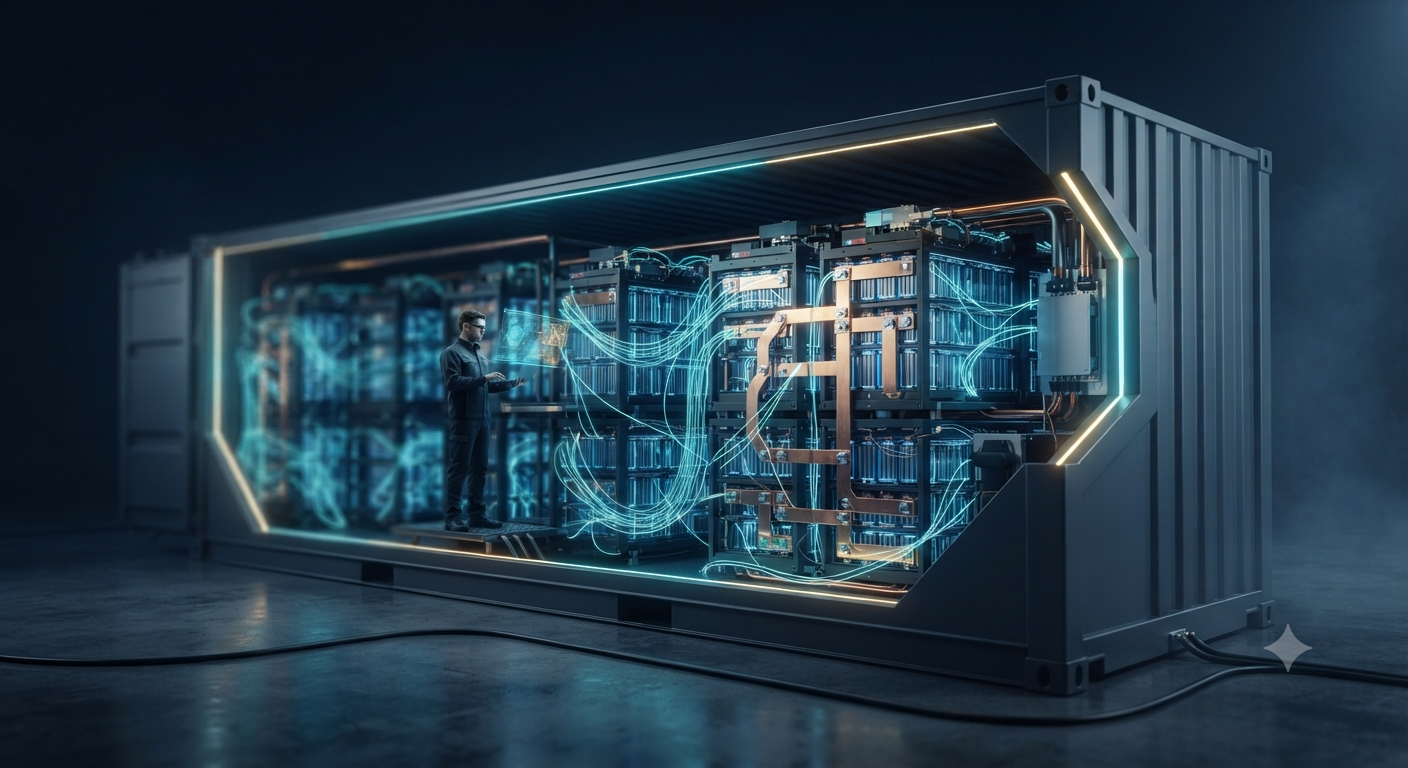
The "Steel Box" Illusion
To the casual observer, a utility-scale Battery Energy Storage System (BESS) looks like a row of static shipping containers — silent, monolithic, and deceptively simple. Call it the steel box illusion. In reality, as we move into the 2025/2026 state of the art, these systems have evolved into some of the most complex industrial orchestrations on the modern grid.
Inside those walls, a BESS has to manage current densities capable of powering entire districts, all while “speaking” a hierarchy of digital languages to coordinate internal cells, utility dispatchers, and cloud analytics. The engineering has moved on from the experimental, boutique-scale projects of the last decade toward high-precision, automotive-grade automation. To understand how the global energy transition actually functions day to day, it helps to look past the container itself and into the sophisticated integration of sub-millisecond protocols, high-voltage physics, and the robotic precision that now defines the modern BESS.
1. The Digital Tower of Babel: The Protocol Gateway
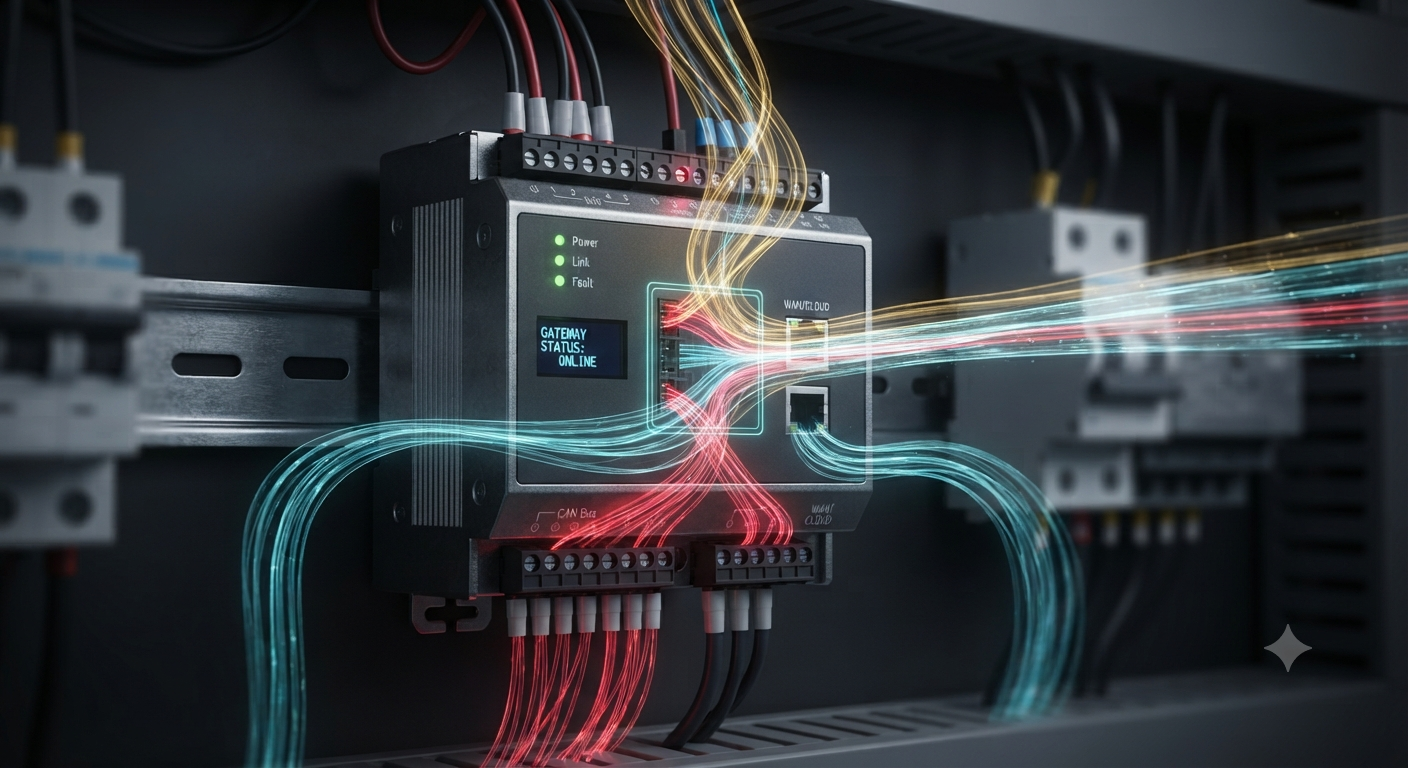
The golden rule of BESS design is that no single communication protocol can cover the entire system. A BESS is a multi-layered digital hierarchy, and different components need very different data speeds and security levels to operate correctly.
Internally, the near-universal language is CAN Bus — a standard borrowed from the automotive world for its ability to resist electromagnetic interference through differential signaling inside a noisy battery rack. The external world runs differently: utility grids typically communicate over IEC 61850 or DNP3, while the real workhorse — Modbus — remains the most widely used BESS communication protocol globally. Despite its age, Modbus TCP still links the BMS to the EMS in nearly every project today, largely because of its simplicity and reliable master-slave architecture.
Because these layers are fundamentally incompatible with one another, the protocol gateway is arguably the single most important component for future-proofing an asset. It acts as the central translator, reconciling the event-driven world of internal CAN Bus traffic with polling-based legacy Modbus systems and the secure, cloud-ready MQTT or OPC UA stacks above them. As one industry voice puts it, getting the choice of BESS communication protocols wrong doesn’t just slow integration down — it drives up costs and turns commissioning into a genuinely painful process.
The gateway is really the strategic heart of the system. It’s what lets operators update software requirements and security layers — adding TLS 1.2 for California Rule 21 compliance, for instance — without having to rip out and replace 15-year-old hardware.
2. The "GOOSE" That Saves the Grid: Sub-Millisecond Protection
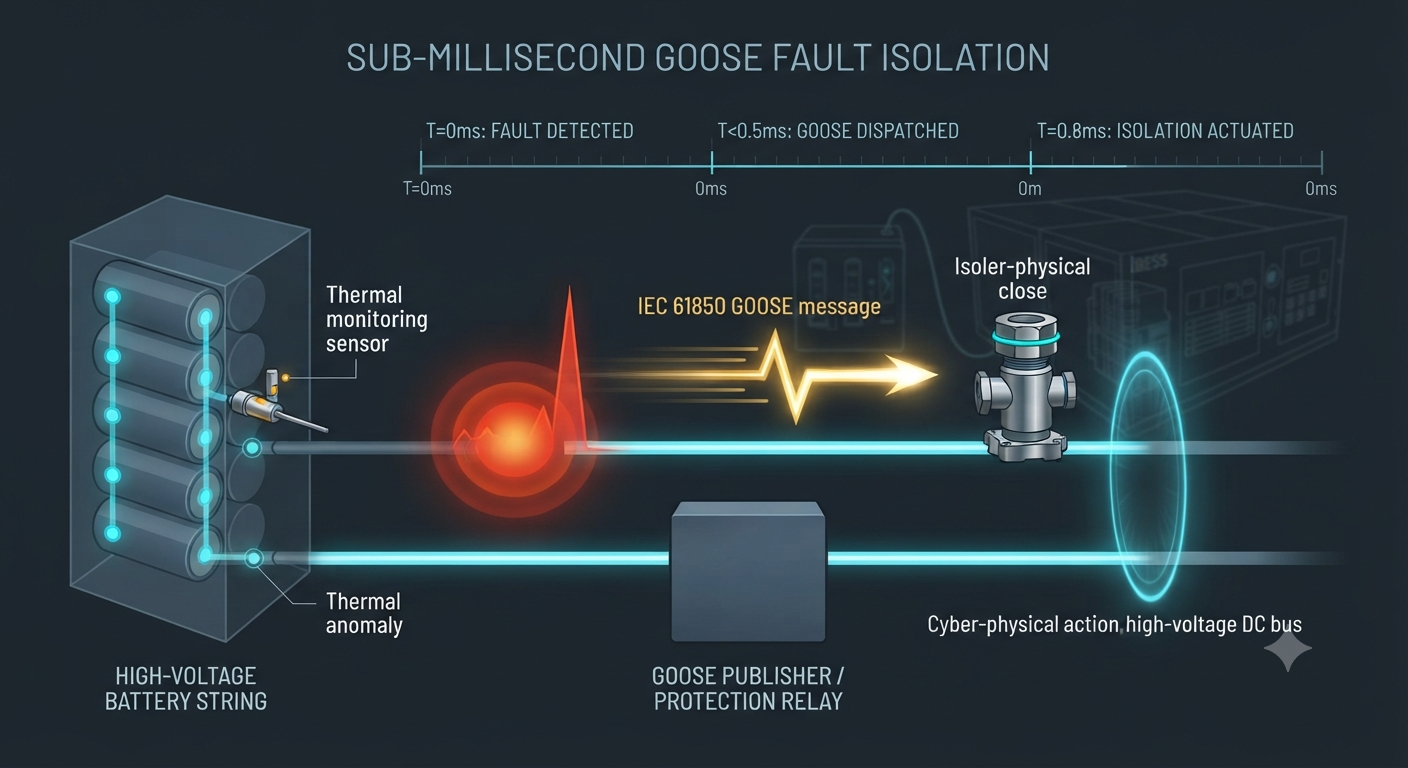
Energy storage tends to get categorized as a “slow” technology, discharging steadily over hours. But its protection logic has to operate with near-instantaneous, deterministic precision — and that’s made possible by GOOSE (Generic Object-Oriented Substation Event) messaging within the IEC 61850 standard.
Traditional systems rely on a polling model, where a controller sequentially asks each device for its status — a process that introduces latency no safety system can afford. GOOSE messaging works the opposite way: it’s event-driven, delivering fault signals in under one millisecond.
For a system architect, that speed isn’t a nice-to-have — it’s a non-negotiable safety requirement. In a high-voltage string, a fault can escalate into a thermal event in the blink of an eye. By the time a traditional Modbus polling cycle would even register that something is wrong, a GOOSE signal has already triggered a sub-millisecond shutdown, isolating the fault before it becomes a catastrophic equipment loss.
3. The 1500V High-Voltage Revolution
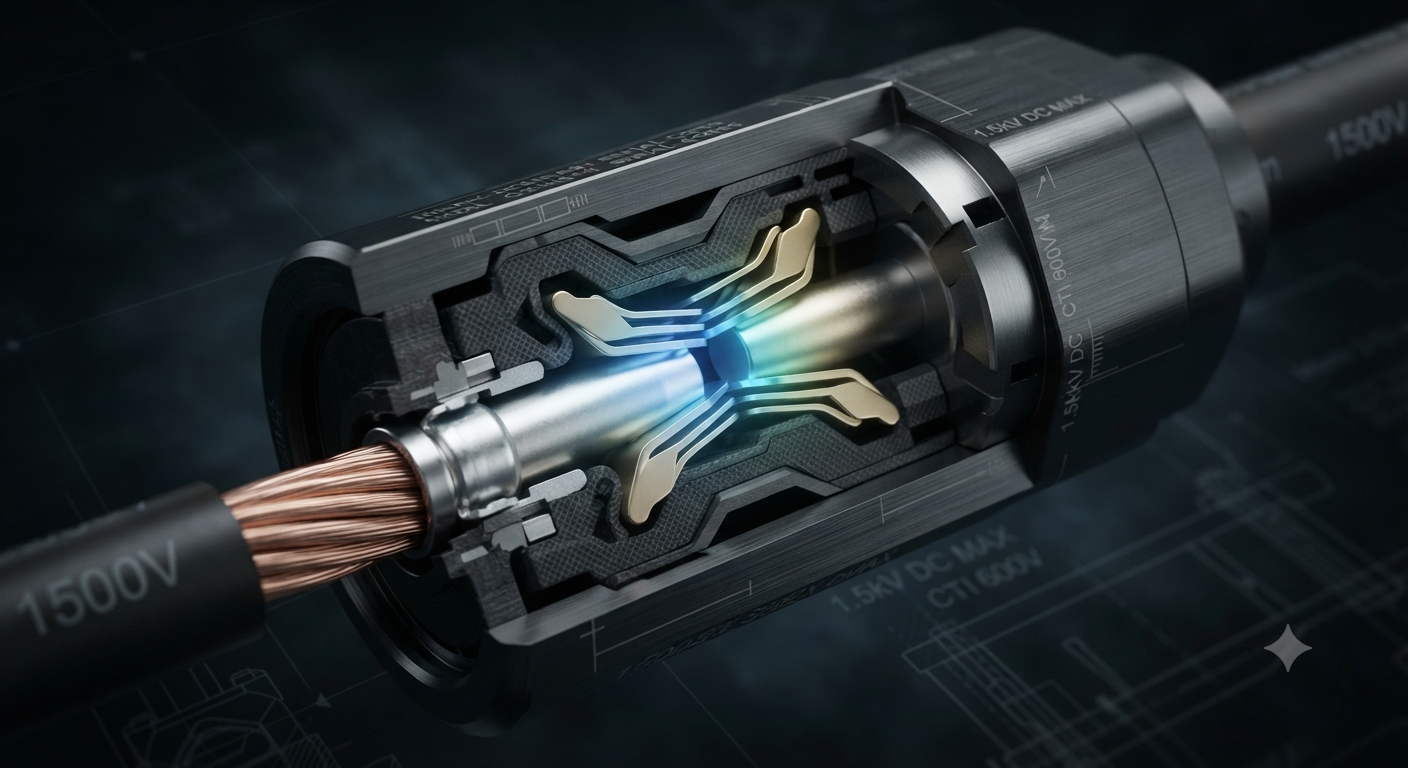
The industry has decisively shifted from 1000V DC architectures to 1500V DC. The engineering logic is sound: higher voltage means lower current is needed to deliver the same power, which allows for thinner, lighter copper cabling. But that efficiency gain comes with a cost — significantly higher dielectric stress on every component in the system.
At 1500V, even the humble connector becomes a critical failure point. Engineers now have to account for Comparative Tracking Index (CTI) — using specialized insulating plastics to prevent surface carbon tracking — while carefully managing the temperature rise (Delta T) inside tightly packed containers. To keep contact resistance below 0.3 milliohms, modern connectors rely on advanced “crown spring” or “wire spring” technology, creating dozens of high-pressure contact points that resist oxidation and wear on the silver plating. As one industry source puts it, verifying that a manufacturer uses high-CTI insulating plastics to prevent surface carbon tracking and arc flashes is essential across the system’s full 10-to-15-year lifespan.
The stakes here keep climbing: modern testing protocols now verify insulation resistance at voltages as high as 1650V, and architects are designing in a 20–30% safety margin on current ratings specifically to guard against ambient temperatures inside the container turning a minor resistance spike into an arc flash event.
4. Automation Is No Longer Optional: The 99% Quality Leap
The days of assembling BESS containers by hand are ending. In 2025, the sector shifted decisively to automotive-grade assembly lines — and this isn’t primarily a cost-saving move. It’s about hitting the 99% qualified rate that project bankability now demands.
Automated lines are cutting human intervention by roughly 70%, while pushing production capacity up to a striking 15–20 units per minute. These facilities lean on vision-guided robotics and AI-powered defect detection to make sure every crimp and connection meets spec.
This is where manufacturing scale and engineering strategy meet directly. At 1500V, a single human error in a cable crimp isn’t just a minor defect — it’s a thermal event waiting to happen three years into a twenty-year project. Automation ensures the as-built impedance of the system actually matches the design specification, which is what’s turning BESS from a custom, boutique project into a genuine mass-market commodity.
5. The "Skeleton" Is a Heat Sink: The Hidden Logic of Bus-bars
The bus-bar is the electrical backbone of a BESS container, but its role goes well beyond simply carrying current. In high-performance 2026 designs, the bus-bar doubles as a strategic tool for managing thermal gradients across the system.
Because these are massive metallic conductors — typically copper or aluminum — they function as high-efficiency heat sinks in their own right. Strategic placement lets engineers minimize impedance and resistive losses, which has a direct economic impact on the asset’s round-trip efficiency (RTE). By distributing current uniformly, well-designed bus-bars prevent the localized hot spots that would otherwise drive uneven cell degradation.
The longevity of a lithium-ion cell is, in the end, a direct function of its thermal environment. Using the electrical infrastructure itself as a secondary cooling mechanism lets architects meaningfully extend the life of the battery racks — a well-designed, modular bus-bar system is one of the quieter secrets behind maintaining system equilibrium and maximizing the project’s 20-year internal rate of return.
Conclusion: Beyond the Container
The global energy transition is being built on a foundation of components that rarely make headlines. Battery chemistry gets the attention, but it’s really the protocol gateways, the sub-millisecond GOOSE signals, the 1500V crown-spring connectors, and the automated assembly lines that let the grid function reliably day after day.
As storage moves toward a “plug-and-play” future, it’s worth asking whether enough attention is going to the silent components holding the whole system together. Success in the 2026 market will likely belong to the teams that look past the steel box and master the intricate, high-stakes architecture hidden inside it.