

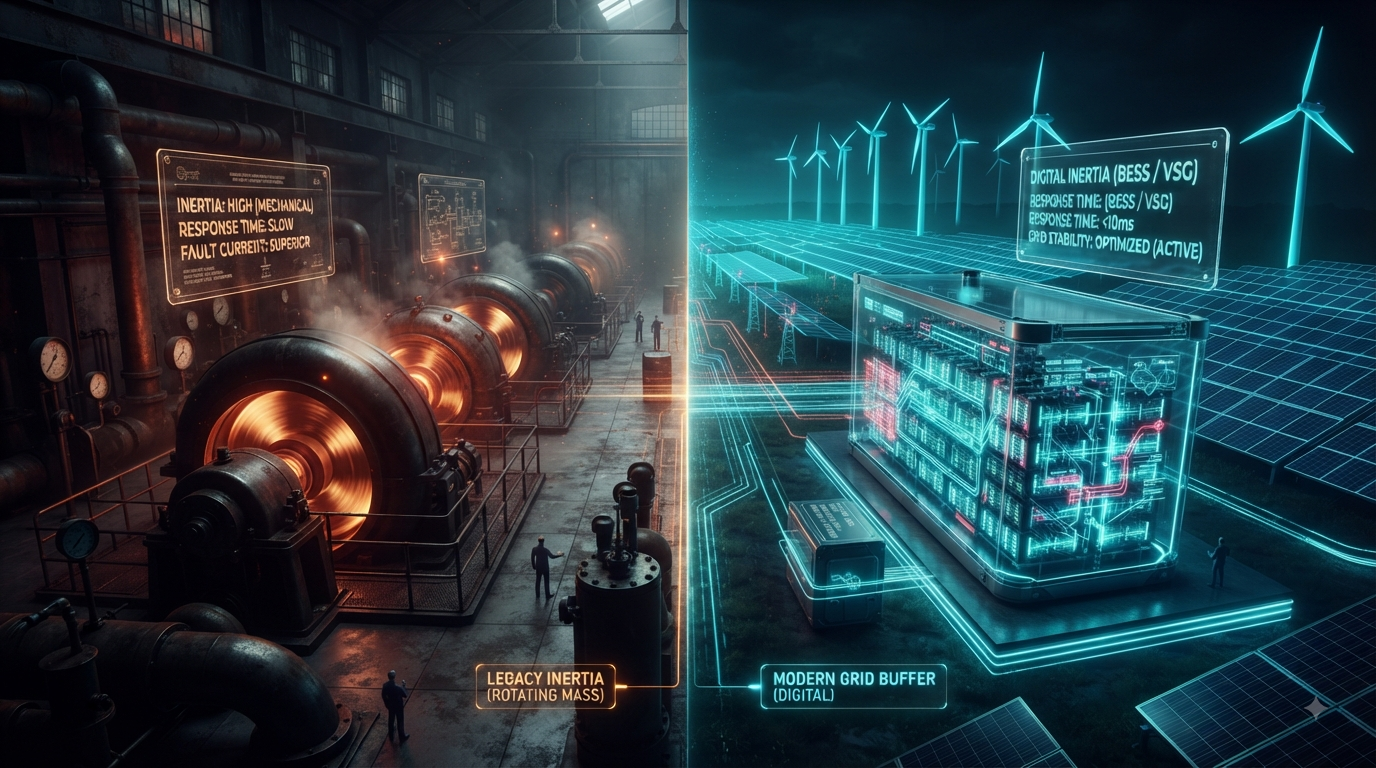
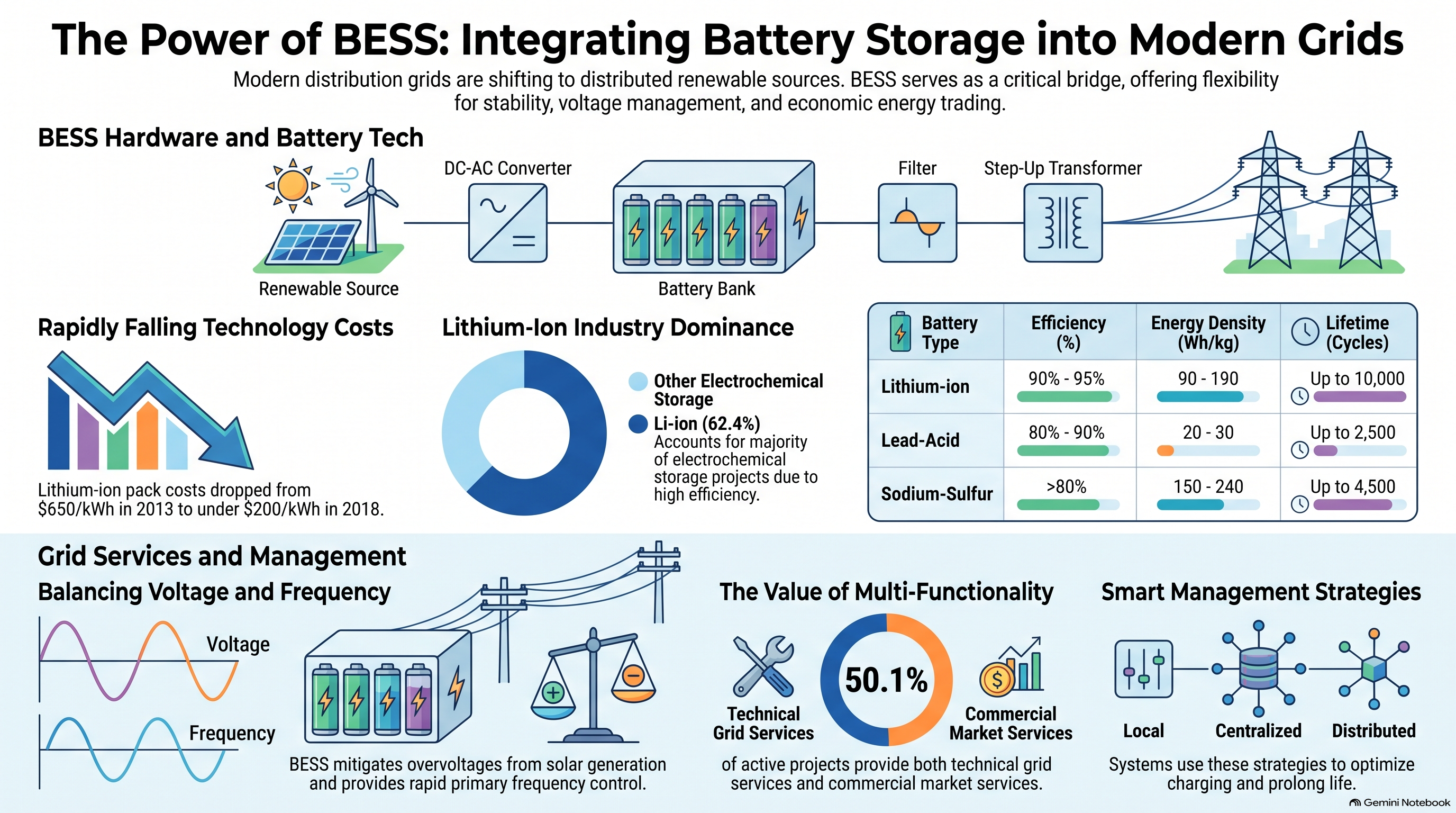
For decades, the global electrical grid was anchored by the sheer physical weight of industrial progress. Massive coal, gas, and hydro plants relied on giant spinning turbines that generated “kinetic energy.” This physical momentum acted as an invisible shock absorber; if a power plant tripped or demand spiked, those heavy rotating masses continued to spin, providing the grid with a few precious seconds of “system inertia” to stabilize itself. Today, we are racing toward a cleaner future, replacing these heavy machines with vast fields of solar panels and wind farms. However, this transition is making the grid increasingly “nervous.” Unlike traditional generators, solar photovoltaic (PV) systems and many wind turbines connect to the grid through electronic conversion systems rather than direct mechanical rotation. The result is a grid that lacks its historical physical anchor, making it more vulnerable to sudden, violent swings in frequency that can lead to catastrophic blackouts.
Renewables are “Weightless”—And That’s a Problem
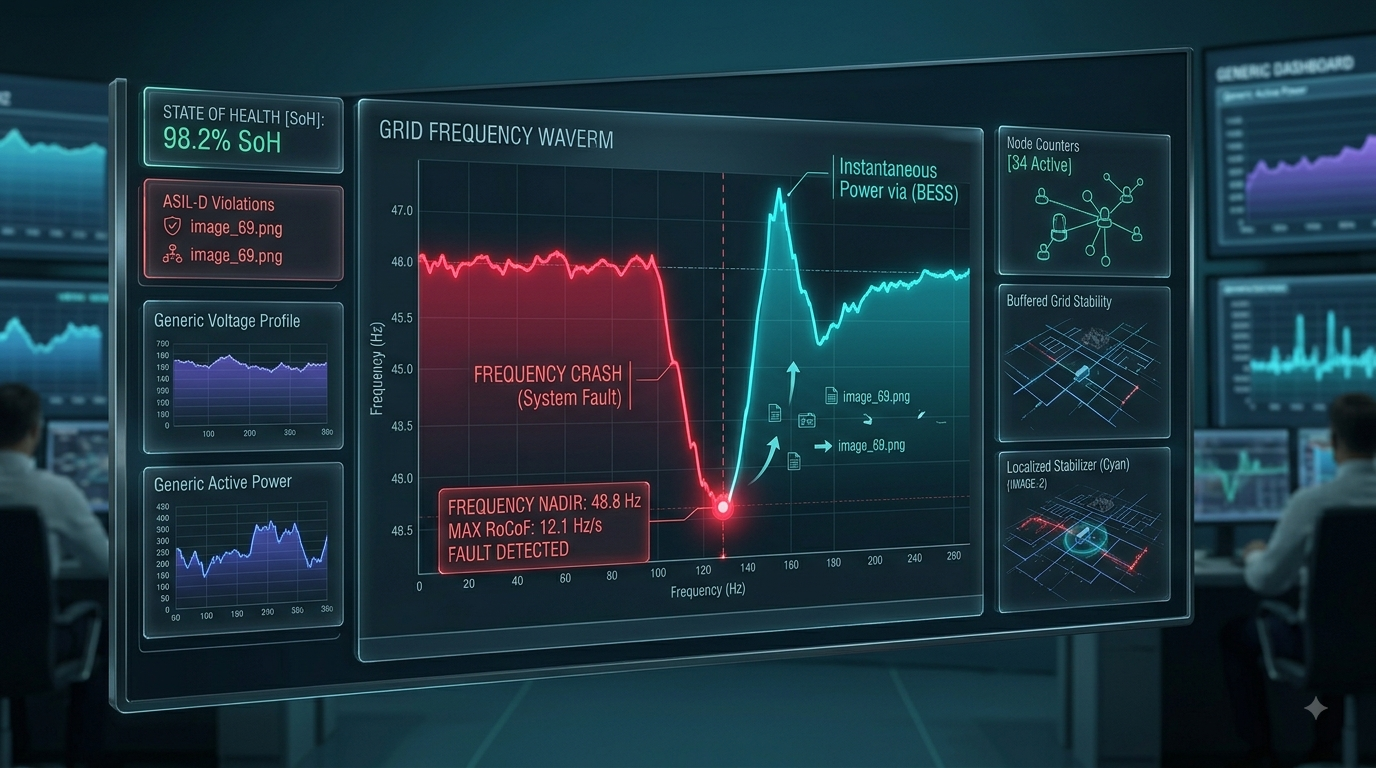
The move toward renewable energy systems (RES) presents a counter-intuitive engineering challenge: solar panels have zero rotating parts. In a traditional system, inertia is the first line of defense. Without it, the “Rate of Change of Frequency” (RoCoF) accelerates. To visualize this, think of the grid like a vessel on the ocean: a large-scale network with traditional inertia is like a massive ship, resistant to the waves; a low-inertia renewable grid is more like a small boat, tossed violently by the slightest disturbance. When a disturbance occurs in these “weightless” systems, the frequency doesn’t just dip—it crashes, reaching a “frequency nadir” (the lowest point) so quickly that traditional safety systems cannot react. As research into these stability challenges notes: “Expanding the PV system in the electrical network will cause frequency variations and reduce system stability. “This means the transition to a 100% renewable future requires more than just installing more panels; it requires a total rethink of grid physics. We are moving from a system stabilized by heavy iron to one that must be stabilized by high-speed silicon.
Batteries Aren’t Just Storage; They’re the Grid’s Adrenaline
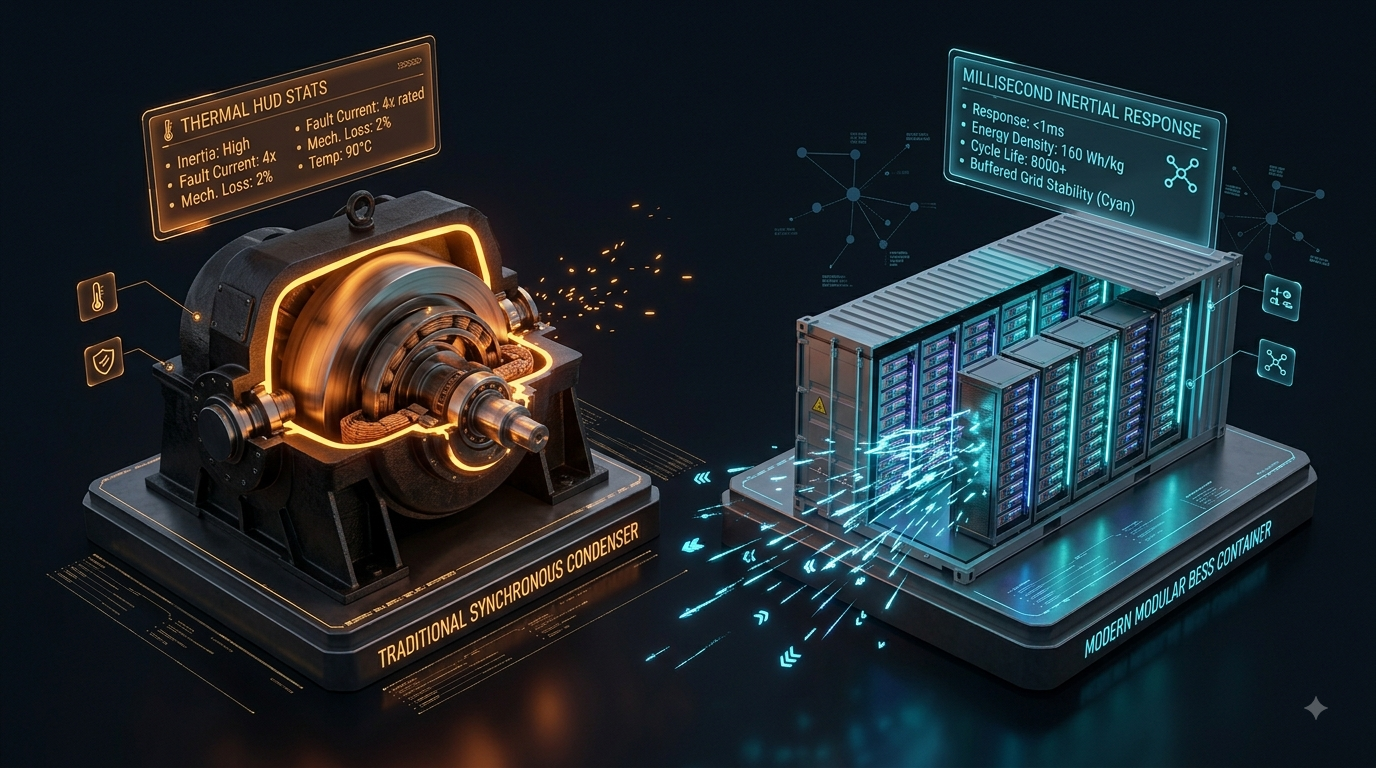
If the traditional grid was a heavy flywheel, the modern grid is becoming an Olympic sprinter. To compensate for the loss of physical inertia, grid operators are increasingly weighing two primary “stabilizers” : traditional Synchronous Condensers and modern Battery Energy Storage Systems (BESS).From an investment and strategy perspective, the choice depends on whether the grid needs raw physical strength or digital precision. BESS provides “Digital Adrenaline,” reacting in milliseconds to catch a frequency crash during Phase 1 (Inertial Response) . Furthermore, BESS units are multi-functional assets; they don’t just sit idle—they generate revenue through energy arbitrage and participation in Ancillary Service Markets.
● BESS: 85-95% round-trip efficiency, multi-service revenue potential, but requires replacement cycles every 10-15 years.
● Synchronous Condensers: 20-30 year maintenance intervals, superior fault current, but suffers from mechanical losses of 1-3% and constant power consumption (0.3-0.5% of rated capacity) just to keep the rotors spinning. The millisecond response of batteries makes them the “first responders” of the modern grid, providing a bridge that prevents the system from tripping before slower, traditional reserves can even wake up.
The Rise of the “Virtual Synchronous Generator”
One of the most elegant solutions to the inertia problem is “Virtual Inertia. ” Since we are removing the heavy spinning machines, engineers are using software to make inverters “mimic” them. Through a technique called “droop control” a Virtual Synchronous Generator (VSG) programs an inverter to sense frequency changes and adjust power output instantly, simulating an inertial response. This technology is critical for stabilizing the first ten seconds of a grid disturbance (Phase 1). There is a certain irony in this technological evolution: we are deploying sophisticated software and high-speed electronics specifically to simulate the physical behavior of the heavy, clunky machinery we are trying to leave behind.
Hacking the Demand—Grid Stability Through Math
The final piece of the stability puzzle isn’t about how we generate power, but how we use it. Through “Demand Side Management” (DSM), the grid is moving from a passive delivery system to an interactive organism. This is where software meets the bottom line. By using Convex Optimization , utilities can find “Globally Optimal” solutions to grid stress. Unlike standard calculations that find a “good enough” fix, convex optimization ensures the mathematically best, most robust stability plan is executed, preventing the grid from crashing under pressure. This math is the engine behind Optimal Power Flow (OPF) , which allows BESS and other assets to function profitably by calculating exactly when to discharge for maximum grid stability and market return. This optimization manages the transition into Phase 2 (Governor Response) and Phase 3 (Reserve Deployment) by “hacking” consumer behavior through Price-Based Demand Response:
1. Time-of-Use (TOU) Pricing: Pre-defined rates for peak and off-peak periods, incentivizing industrial shifts to late-night operations.
2. Critical Peak Pricing (CPP): Temporary, extreme price hikes during grid stress (like heatwaves), usually with a day-ahead notice to curb non-essential load.
3. Real-Time Pricing (RTP): Continuously updated prices based on hourly market conditions, allowing data centers to shift computing loads when electricity is cheapest and most abundant. In this new era, your dishwasher running at 2 AM is no longer just a chore; it is a critical engineering variable—a “virtual anchor”—that helps keep the entire regional power system stable.
Conclusion: The Grid is Becoming an Intelligent Organism
The future of energy is no longer a simple binary of “clean” vs “dirty” It is a transition from a passive, mechanical system to a proactive, intelligent organism. Maintaining a stable grid in 2050 will require a hybrid approach: the rapid-fire adrenaline of batteries for Phase 1 response, the simulated physics of virtual inertia, and the global optimality of mathematical demand management for Phases 2 and 3.As we move toward 2050, the question is no longer ” Can we generate enough clean power?” but “Can we make our technology smart enough to keep that power stable?”