

Introduction
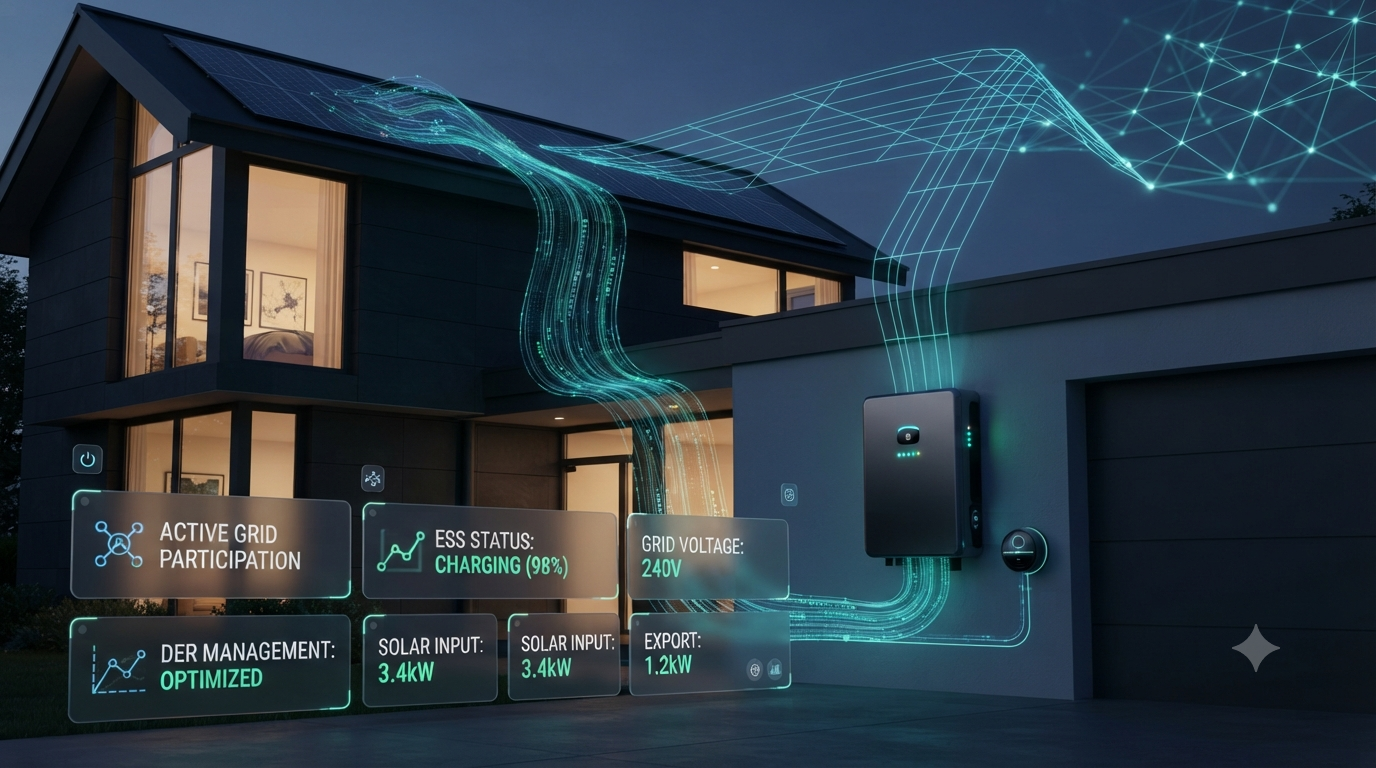
The global transition to renewable energy is frequently oversimplified as a hardware purchase—as if a homeowner is merely buying a larger version of a backup generator. However, as a systems architect, I view the installation of a residential energy storage system (ESS) not as adding a “battery box” but as deploying a sophisticated, active management ecosystem. We are entering the era of Distributed Energy Resources (DERs) , where the focus has shifted from passive backup to active grid participation .Modern storage must navigate the complex intersection of market-driven grid services and the delicate chemistry of the cells themselves. By synthesizing research from Sandia National Laboratories and industry-leading hardware providers, this post distills the technical complexities of energy storage into five essential truths that define how we will manage power in the coming decades.
The “Brain” is a Hierarchy, Not a Single Box
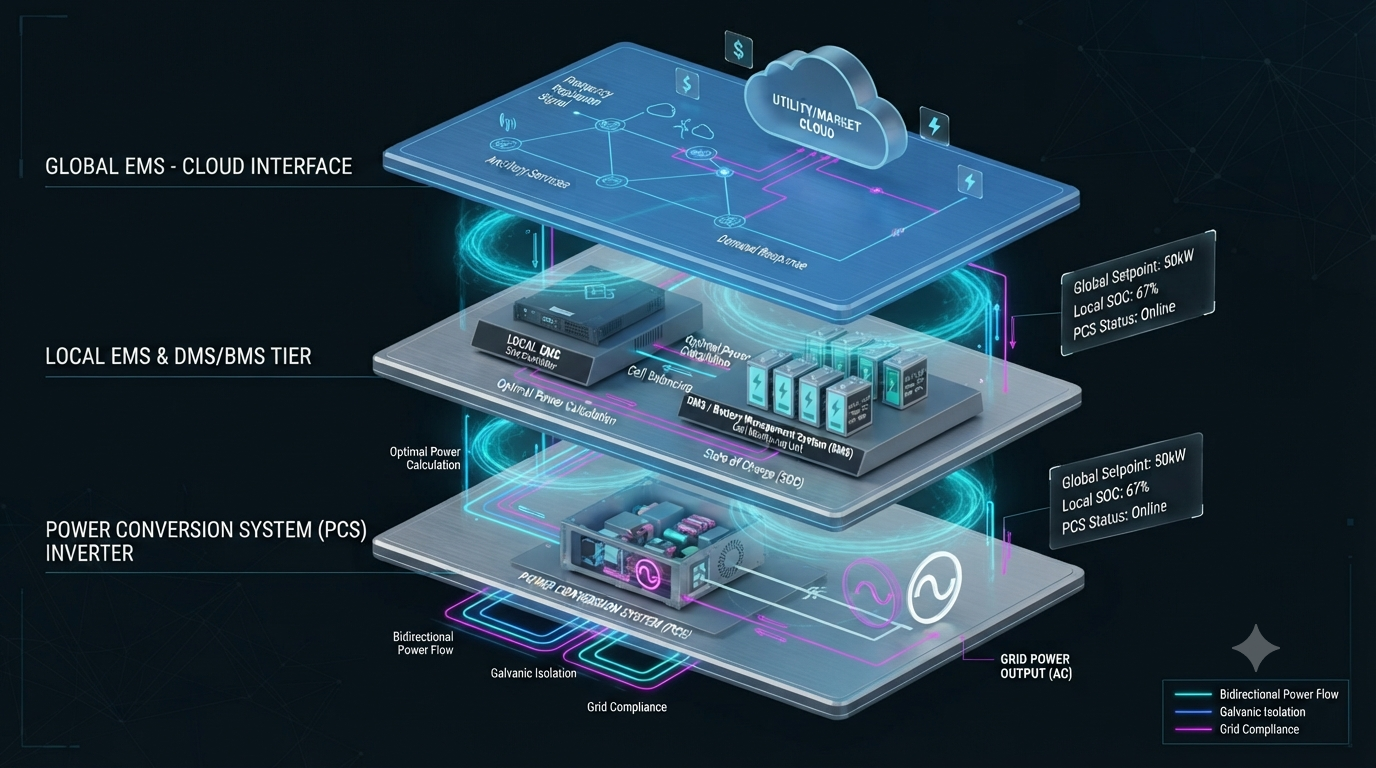
An ESS operates via an Energy Management System (EMS), which is not a single component but a tiered control architecture. According to Sandia National Laboratories, this hierarchy ensures that a system can fulfill high-level market demands without violating the physical safety limits of the hardware.The hierarchy follows a "bottom-up data, top-down command" protocol:
● Global EMS: The high-level interface that coordinates with utilities and markets. For a homeowner, this is the literal interface you interact with via the SolaXCloud or the ESYSUNHOME APP .
● Local EMS: The onsite controller that calculates optimal charge and discharge power.
● Device Management System (DMS): The technology-specific software layer. In the context of lithium-ion storage, the Battery Management System (BMS) is the DMS, responsible for cell balancing and health.
● Power Conversion System (PCS): The inverter hardware that handles bidirectional conversion and provides necessary galvanic isolation from the grid. “A typical energy management architecture where the global/central EMS manages multiple energy storage systems (ESSs), while interfacing with the markets, utilities, and customers… while delivering these required powers, the PCS also interfaces with the BMS to ensure that none of the battery limits are violated.” — Sandia National Laboratories This structure allows your home system to act as a “flexible grid asset,” performing high-speed tasks like frequency regulation while simultaneously managing your local energy arbitrage.
Temperature—Not Capacity—is Often the Real Bottleneck
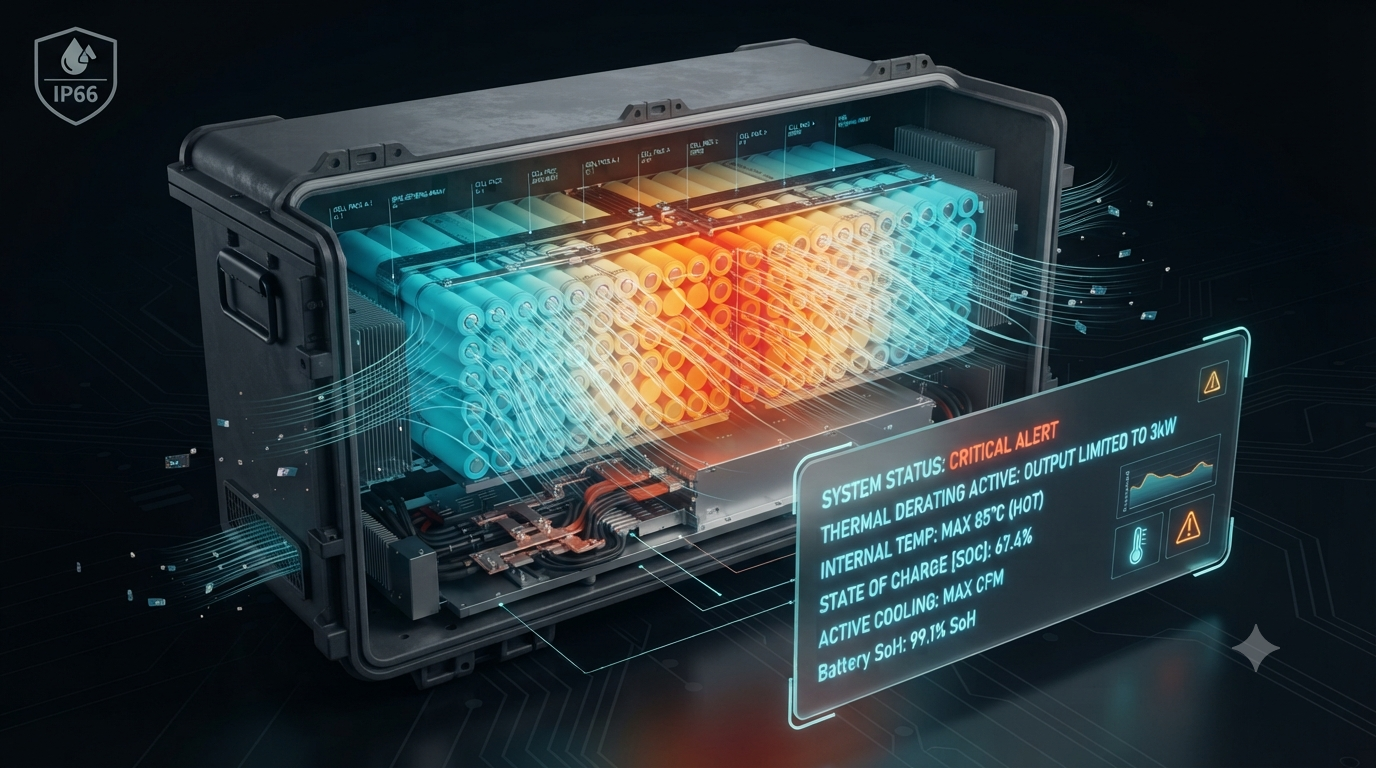
A common engineering misconception is that energy capacity (the low voltage limit) is the only constraint on performance. In practice, thermal dynamics often dictate operational limits. If a battery’s internal temperature rises too quickly, the EMS will force the system into a protective derating state—meaning you may only receive 3kW of output when you expected 5kW or 6kW during a critical peak period. To mitigate this, architects prioritize systems with superior thermal management. For example, the ESY sunhome architecture utilizes natural heat dissipation rather than forced air cooling, allowing the unit to maintain an IP66 rating for outdoor installation while keeping noise levels below 25dB.To maintain precise control, the DMS must estimate the State-of-Charge (SOC) using different parameters depending on the technology:
● Electrochemical Batteries (Li-ion): Voltage, current, temperature, and age.
● Vanadium Redox Flow: Voltage, temperature, and electrolyte concentration.
● Flywheels: Rotor speed and moment of inertia.
● Pumped Hydro: Reservoir water level.
The Retrofit Reality: Why “Less Efficient” AC Coupling Often Wins
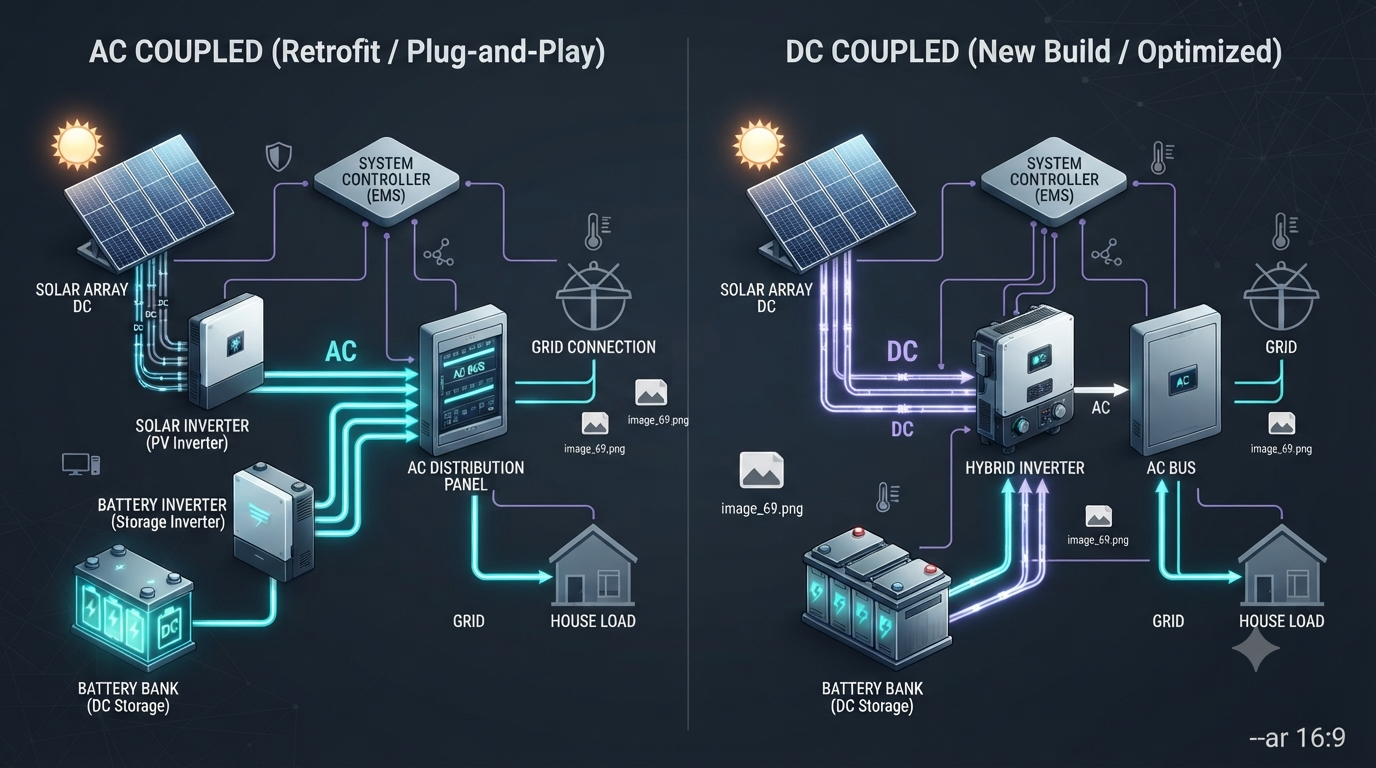
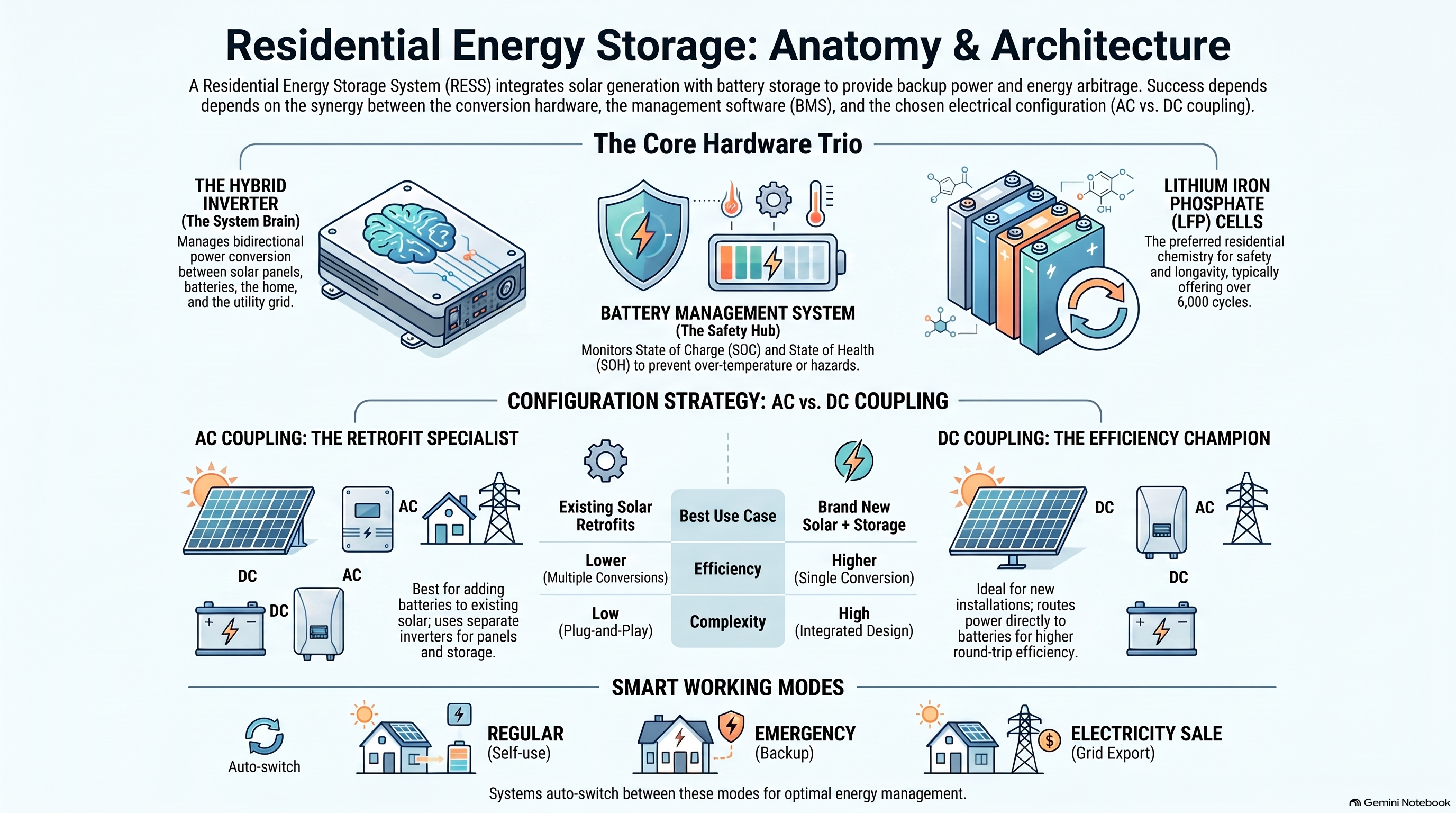
When integrating storage with solar, architects must choose between AC and DC coupling. While DC coupling is the “Efficiency Champion” for new builds—performing a single conversion from DC to AC—it is often a “Retrofit Nightmare” for existing solar owners because it requires replacing the core inverter hardware.AC coupling, or the “convert first, store later” approach, allows for a plug-and-play installation. Though it involves more conversion steps, it provides unparalleled system flexibility.| Metric | AC Coupling | DC Coupling || —— | —— | —— || Core Equipment | Solar Inverter + Battery Inverter | Single Hybrid Inverter || Round-trip Efficiency | Lower (multiple conversions) | Higher (Single DC-AC conversion) || Daytime AC Load Efficiency | Up to 97% | High (but includes extra conversion) || Best Use Case | Adding batteries to existing solar | New-build solar+storage installs || Retrofit Complexity | Low, independent integration | High, requires core replacement |
Safety is Both “Passive” and “Active”
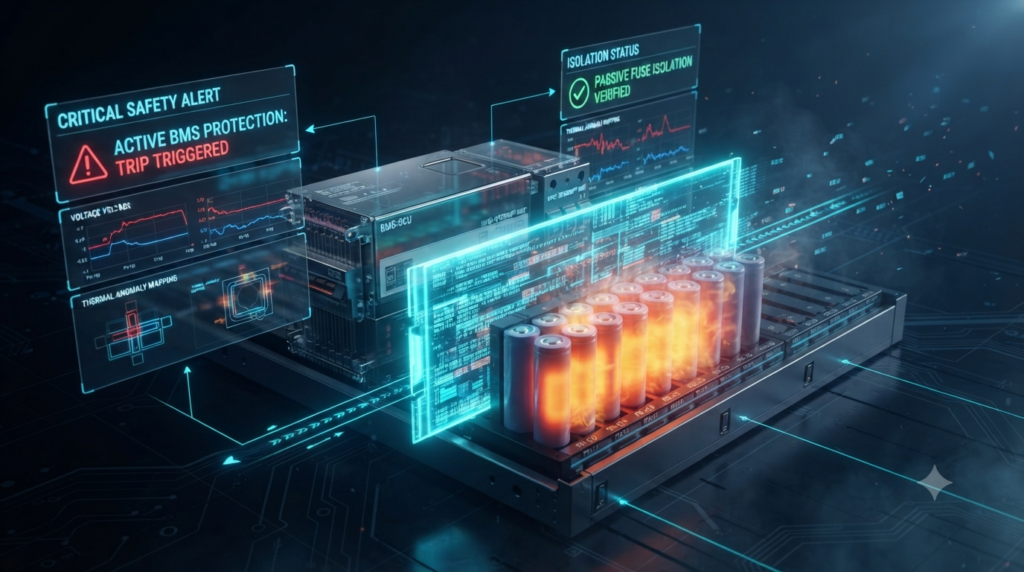
Safety in energy storage isn’t just about robust casings; it’s a dual-layered engineering strategy.
● Passive Safety: These are non-computational measures triggered by physical events. This includes fuses for short-circuits, reinforced underground containment for flywheels, or secondary/tertiary containment for the electrolytes in flow batteries.
● Active Safety: This is the “safety officer” role of the BMS. Through feedback control loops, the system monitors for over-charge and over-temperature. If limits are breached, the system executes a protective shutdown , utilizing circuit interrupts to prevent thermal runaway before it begins. “Grid-scale ESSs can store a significant amount of energy. Therefore, safety mechanisms, either passive or active, are required to prevent that energy from causing a hazard.” — Sandia National Laboratories
The 20-Year Battery: LFP and the End of Cobalt
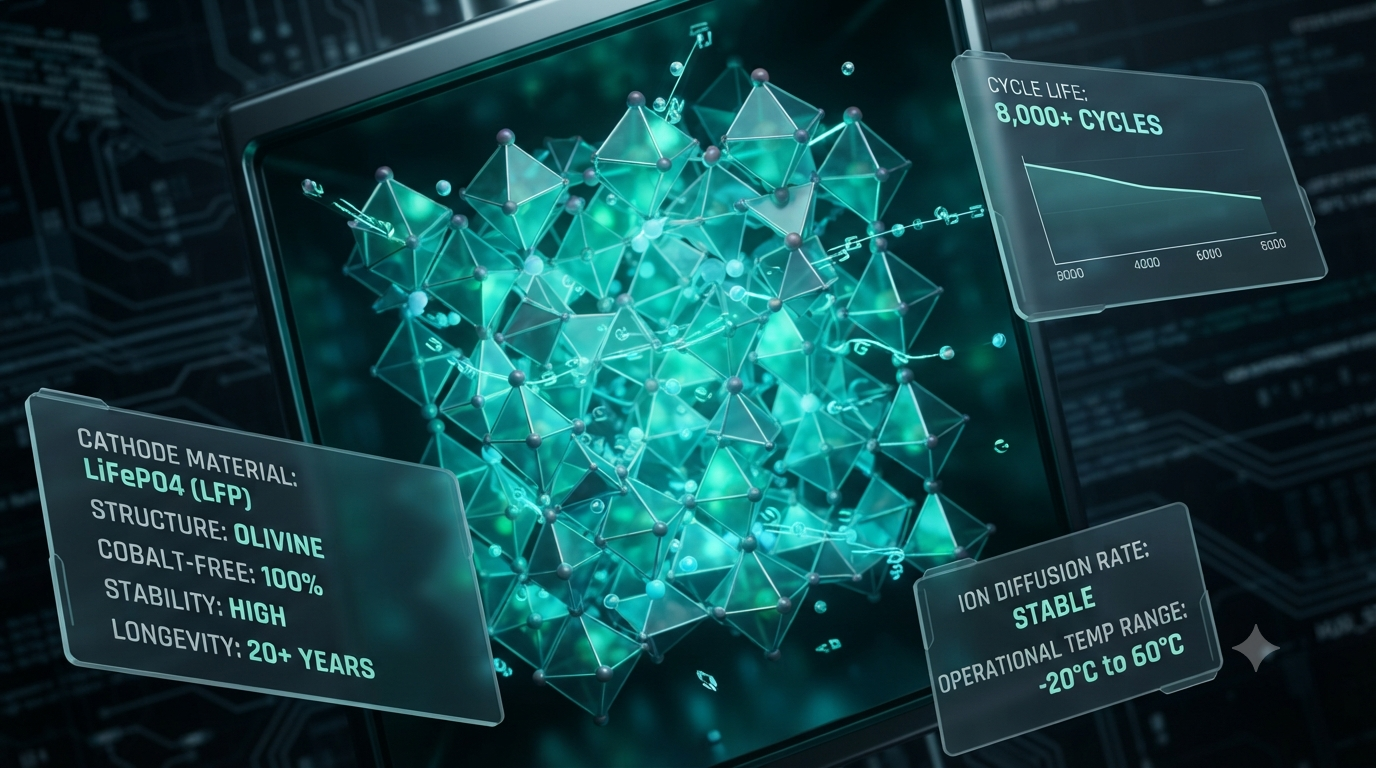
The industry has moved decisively toward Lithium Iron Phosphate (LFP) for residential applications. While LFP has lower energy density than the Nickel Manganese Cobalt (NMC) cells used in mobile devices, its thermal stability and cobalt-free chemistry make it the architect’s choice for stationary storage. The key metric here is cycle life. While older technologies might fail after 2,000 cycles, modern LFP cells are rated for 6,000 to 8,000 cycles . At a typical usage rate of 300 cycles per year, a 6,000-cycle battery easily achieves a 20-year service life. Stepping up to 8,000 cycles pushes the service life well beyond two decades, drastically lowering the annualized cost of the system.
Conclusion: From Storage to Optimization
We are witnessing a fundamental shift from simply “owning a battery” to” optimizing a resource.” The future of the industry lies in “stacked benefits” —the ability for a single ESS to simultaneously provide customer bill reduction through peak-shaving while offering grid services like frequency regulation to the utility. As regulatory environments evolve, the challenge remains in creating generic models that can adapt to varying market structures. This leads to a final question for the future homeowner: Do you see your system as a mere consumer of grid power, or are you ready to become a prosumer —operating a mini power plant that contributes to global grid stability?