


The Billion-Dollar Scale-Up Challenge
We’re currently watching the most aggressive scale-up of a complex chemical experiment in human history. To hit global sustainability targets, renewable energy capacity needs to double by 2030 — a mandate that has catapulted battery production out of quiet laboratory benches and into a high-stakes industrial sprint. In the last decade alone, the average output of lithium-ion battery plants has grown from 0.5 GWh to 7 GWh.
But that rapid expansion has a dark side. We’ve already seen cautionary tales of digital hubris: European battery startups like Northvolt and Morrow struggling to stabilize large-scale operations, with some sliding into bankruptcy. The industry’s reflex response has been to throw money at the Digital Twin — an AI-powered savior meant to optimize every atom of production. And yet millions of dollars in silicon and code are still falling short. Why? Because even the most advanced megawatt-scale AI hits a wall without a 20-watt human co-pilot to navigate the black box of industrial manufacturing.
A "Digital Twin" Is Not Just a 3D Model
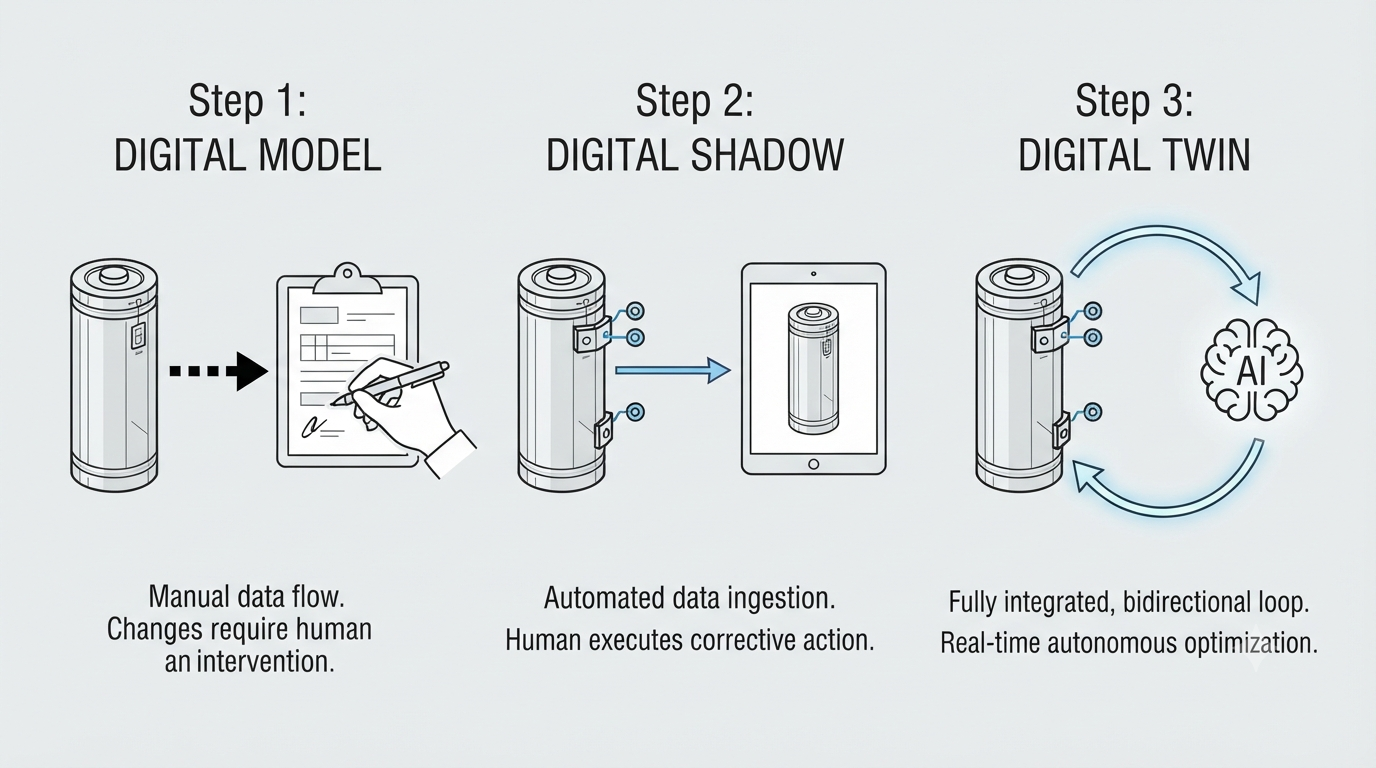
In the rush to digitalize, the term “Digital Twin” has become a victim of marketing inflation — slapped onto basic mathematical models or 3D dashboards that don’t really earn the name. In the rigorous world of Industry 5.0, the distinction matters, and there are three real levels of digital maturity:
- Digital Model — a digital representation where all data flow is manual. Change a parameter on an electrode slurry coater, and you have to manually update the model to see the result.
- Digital Shadow — data flows automatically from the physical machine to the digital model via sensors, but any corrective instruction — say, adjusting a drying oven’s temperature — still has to be executed by a human.
- Digital Twin — a fully integrated, bidirectional loop. In a true digital twin, the digital brain monitors the slurry coater in real time and sends automated instructions back to the hardware to optimize performance without human intervention.
Closing that loop is the holy grail of automation, and it remains elusive. Most systems marketed as “twins” today are really just shadows — able to ingest data, but not act on it.
The Secret Pioneer in Your Garage
The “futuristic” Digital Twin isn’t actually new — it’s been sitting in driveways for decades. The 1996 GM EV1 was a quiet pioneer, using what we’d now call a digital shadow to monitor its lead-acid battery pack. By the 2000s, that had evolved into a true digital twin: the Battery Management System (BMS).
A battery pack isn’t a single unit — it’s a collective of thousands of individual “personalities.” Slight variations in manufacturing mean no two cells are truly identical, and those functional differences mean one cell might run hotter or degrade faster than its neighbor. The BMS exists to manage that chaos. Its core job is to keep the cell pack operating safely and efficiently throughout its service life, monitoring voltage and temperature in real time and performing cell balancing along the way — making it, in effect, the original digital co-pilot for a world full of chemical variation.
Why AI Struggles "Outside the Box"
The current hype cycle suggests AI will eventually replace human engineers outright. But there’s a fundamental human-in-the-loop necessity that pure AI can’t get around.
AI is genuinely excellent at inside-the-box optimization — finding patterns within historical training data. But when a brand-new material or an unfamiliar parasitic reaction shows up, one the model has never seen before, its reliability drops off fast. This is what might be called the 20-watt advantage: a human brain runs on roughly the power of a dim lightbulb, yet carries scientific intuition that megawatt-scale data centers simply don’t have.
Where an AI might land on a local optimum within a predefined parameter space, a human can recognize that a better optimum exists entirely outside that box. Humans reach for causal reasoning to make sense of unexpected physical phenomena — reframing the whole problem where a machine just sees an error code. That’s the low-power, high-reasoning outlier that keeps a system from optimizing blindly toward disaster.
Scaling Up Isn't Just "Making It Bigger"
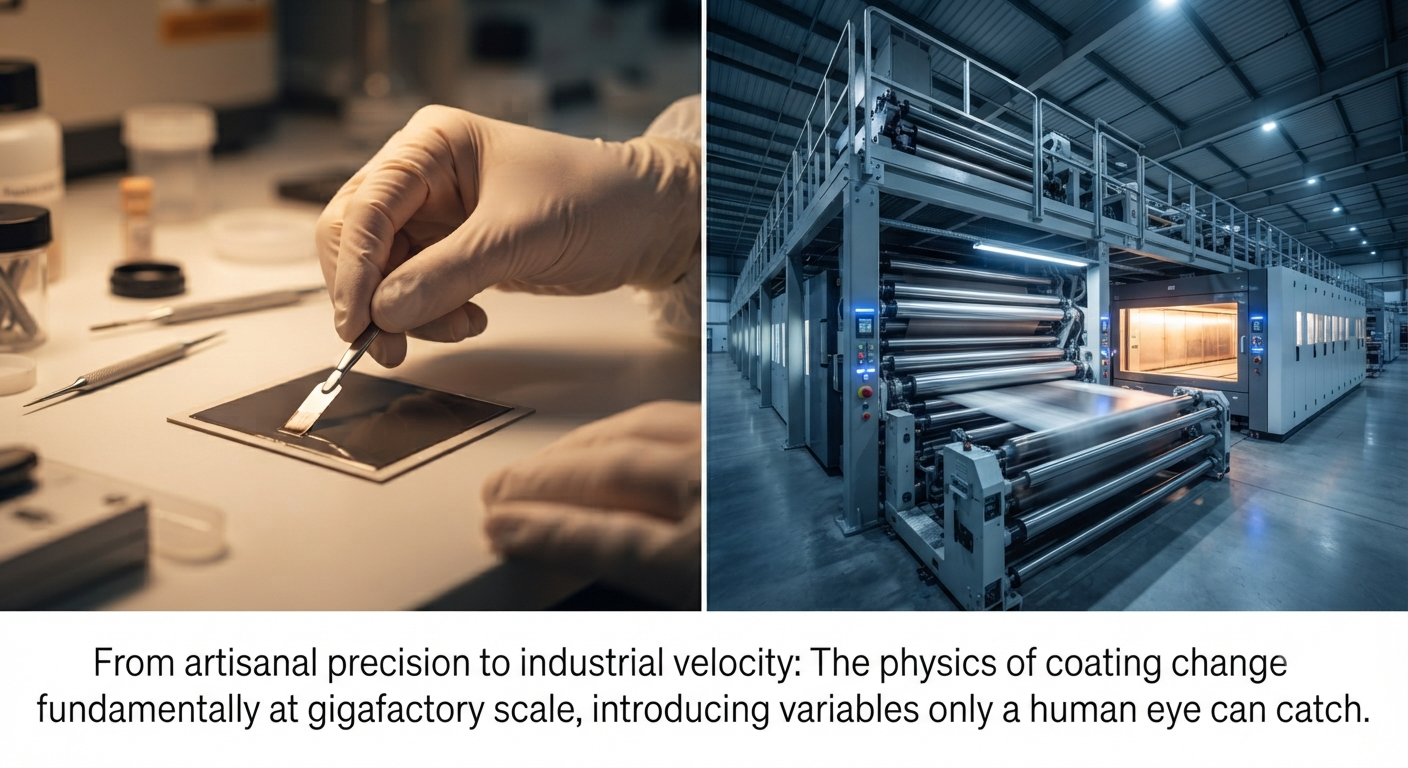
Taking a battery from the lab to a gigafactory isn’t a linear process — it’s a phase shift in the underlying physics. In a lab, electrode slurries get coated with a doctor-blade. In a factory, that becomes high-speed roll-to-roll manufacturing.
That shift fundamentally changes the shear stress the materials experience. It alters porosity, tortuosity (the winding path ions have to travel through the material), and drying gradients in ways a simple model can’t fully predict. This produces what’s sometimes called the irony of automation: as systems get more complex and automated, the human role becomes more critical, not less. Humans are the ones who catch the black-box failures or subtle material deviations that automated sensors might just dismiss as noise.
Bridging that gap requires something like a digital brain for the factory floor — which is where the ARTISTIC platform comes in. As an ecosystem of physics-based and AI models, it links the entire manufacturing chain, from mixing and coating through to calendering and performance testing, acting as the connective tissue between laboratory theory and industrial reality.
Industry 5.0 and the "Champion" Model
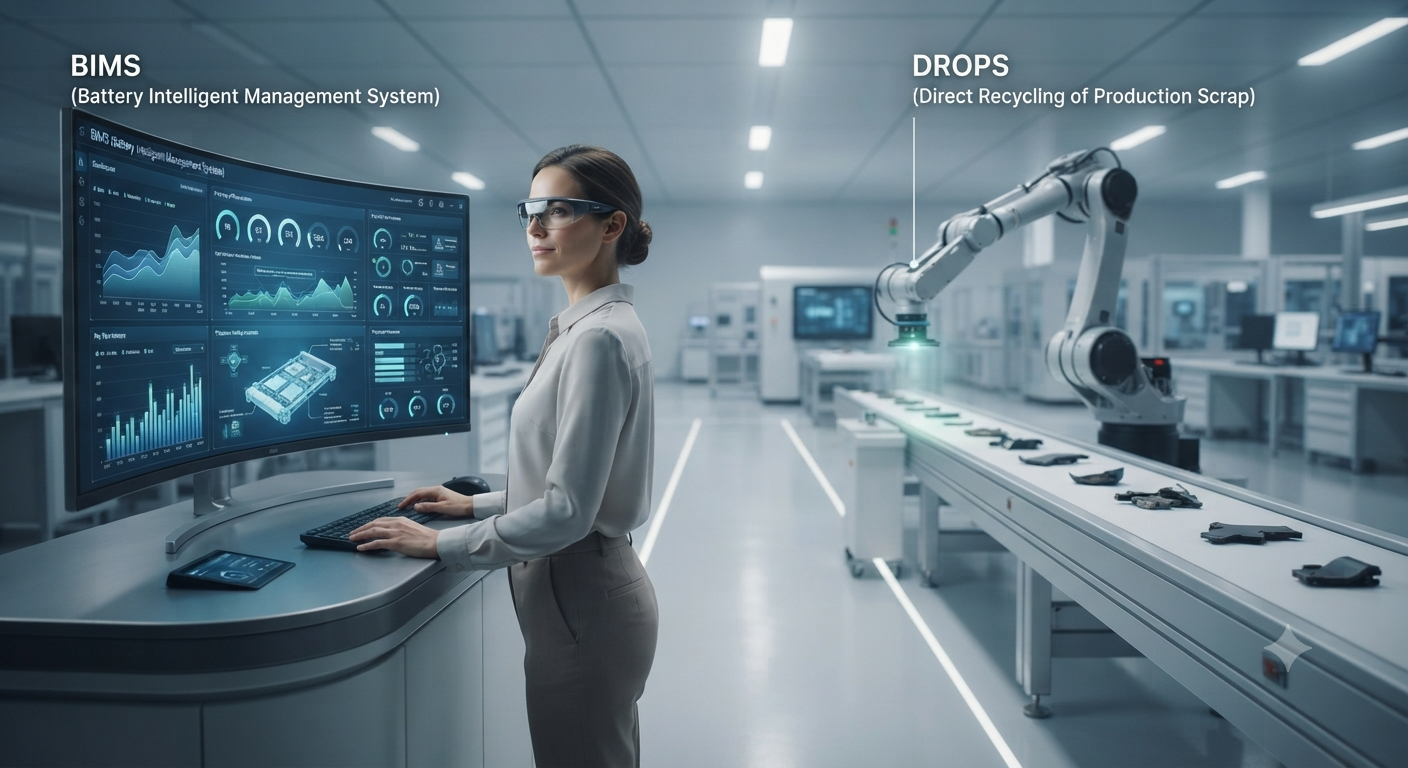
The tide is shifting from Industry 4.0 — pure productivity — toward Industry 5.0, a paradigm that prioritizes human-centricity and sustainability. Leading that charge in Europe is the French battery champion Verkor, whose strategy relies on a unifying project to localize the European value chain, underpinned by two technologies that exemplify a genuine human-AI partnership:
- BIMS (Battery Intelligent Management System) — a combination of hardware and software sensors that digitizes the process and surfaces high-level strategic data for human supervisors.
- DROPS (Direct Recycling of Production Scrap) — a system that uses digital intelligence to identify and reinsert scrap into the production circuit with minimal human input.
The synthesis is the interesting part: automation absorbs the low-value tasks, like scrap identification through DROPS, which frees the 20-watt human brain to focus on the high-value work of optimization and strategic supervision, through BIMS.
The Road to Industry 8.0: From Factories to Organisms
Where does all this lead? The industrial eras appear to be converging on something closer to a biological model of production:
- Industry 6.0 — cognitive modular manufacturing: machines that handle unexpected scenarios autonomously.
- Industry 7.0 — “fluid” machines: systems capable of physically reconfiguring their own hardware architecture in situ to meet new needs.
- Industry 8.0 — cognitive, distributed production ecosystems.
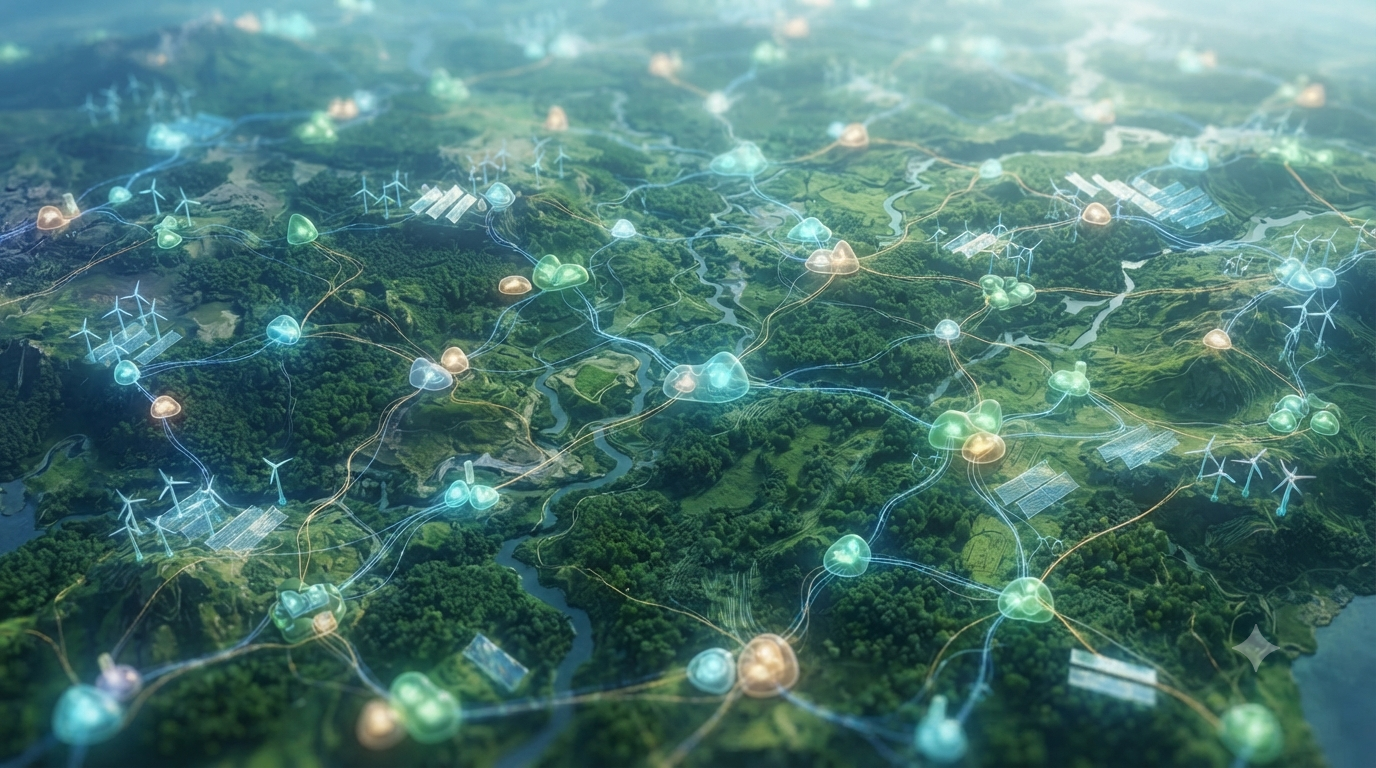
In that ultimate vision, the traditional monolithic factory dissolves entirely. In its place: a decentralized network of autonomous micro-facilities, behaving more like biological organisms than machines — sourcing recycled materials locally and manufacturing at the exact point of need, with essentially zero waste.
Conclusion: The Human as the Ultimate Safeguard
As we build these hyper-autonomous manufacturing ecosystems, it’s worth resisting the urge to treat the human operator as a bug to be engineered out. In the high-stakes world of battery fabrication, the human remains the vital safeguard for ethical compliance, safety judgment, and scientific vision.
We’re entering an era of industrial biology, where factories increasingly behave more like cells than machines. But as we work a 20-watt brain into a megawatt world, the real question is whether we stay the masters of these systems — or whether we’ll need to evolve our own “internal interfaces” just to keep pace. In the end, the most sophisticated sensor in any gigafactory is still the one between our ears.