

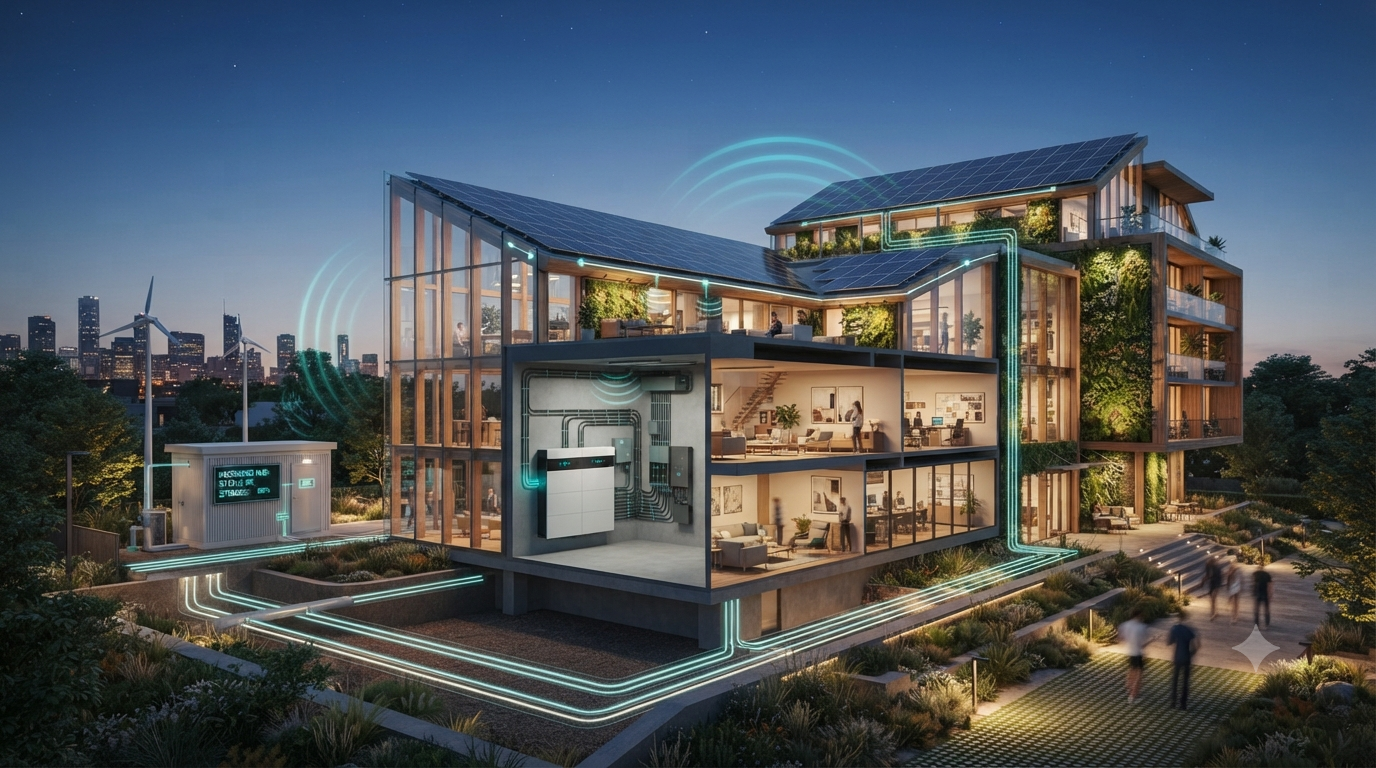
Introduction: The Quiet Revolution in Our Walls
For decades, the global energy paradigm was a rigid, one-way street. Centralized power plants generated current that traveled hundreds of miles across high-voltage lines to passive end-users. However, as grid instability and volatile utility costs become the new normal, we are witnessing a fundamental pivot toward “Behind the Meter” (BTM) systems. This is the “hidden hero” of the modern energy transition. BTM storage resides at the point of consumption—within our homes, warehouses, and industrial complexes. This shift is more than just localized backup; it represents a transition toward prosumer microgrid architectures and decentralized energy patterns. We are moving from a model of fragile dependency to one of connected energy management, where the very walls of our buildings are becoming active participants in the grid’s stability.
Takeaway 1: The $50 Billion Power Shift
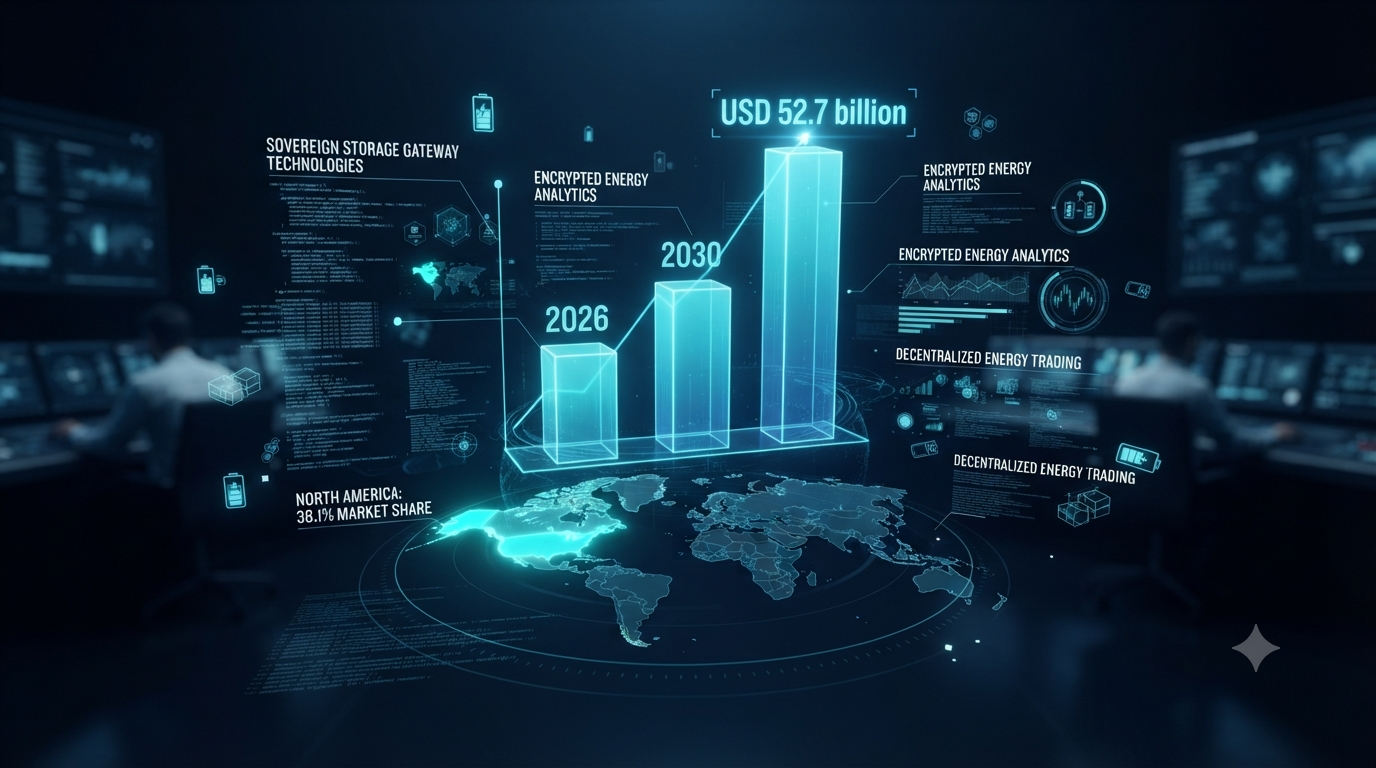
The BTM sector is no longer a niche hobbyist market; it is a measurable economic tidal wave. Strategic market analysis indicates that we are moving toward a future where energy independence is a critical financial asset.
● 2026 Estimated Market Value: USD 9.6 billion
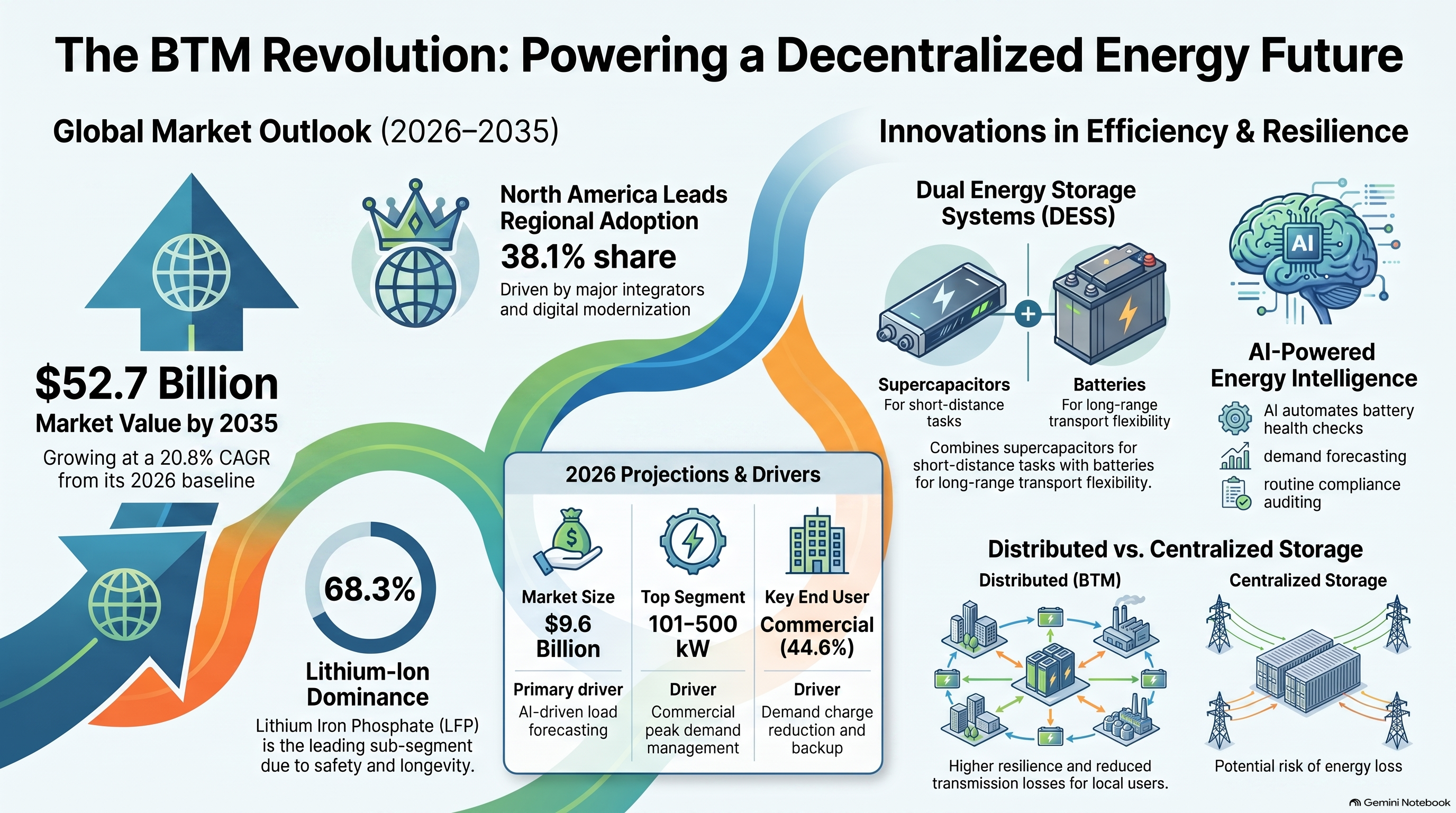
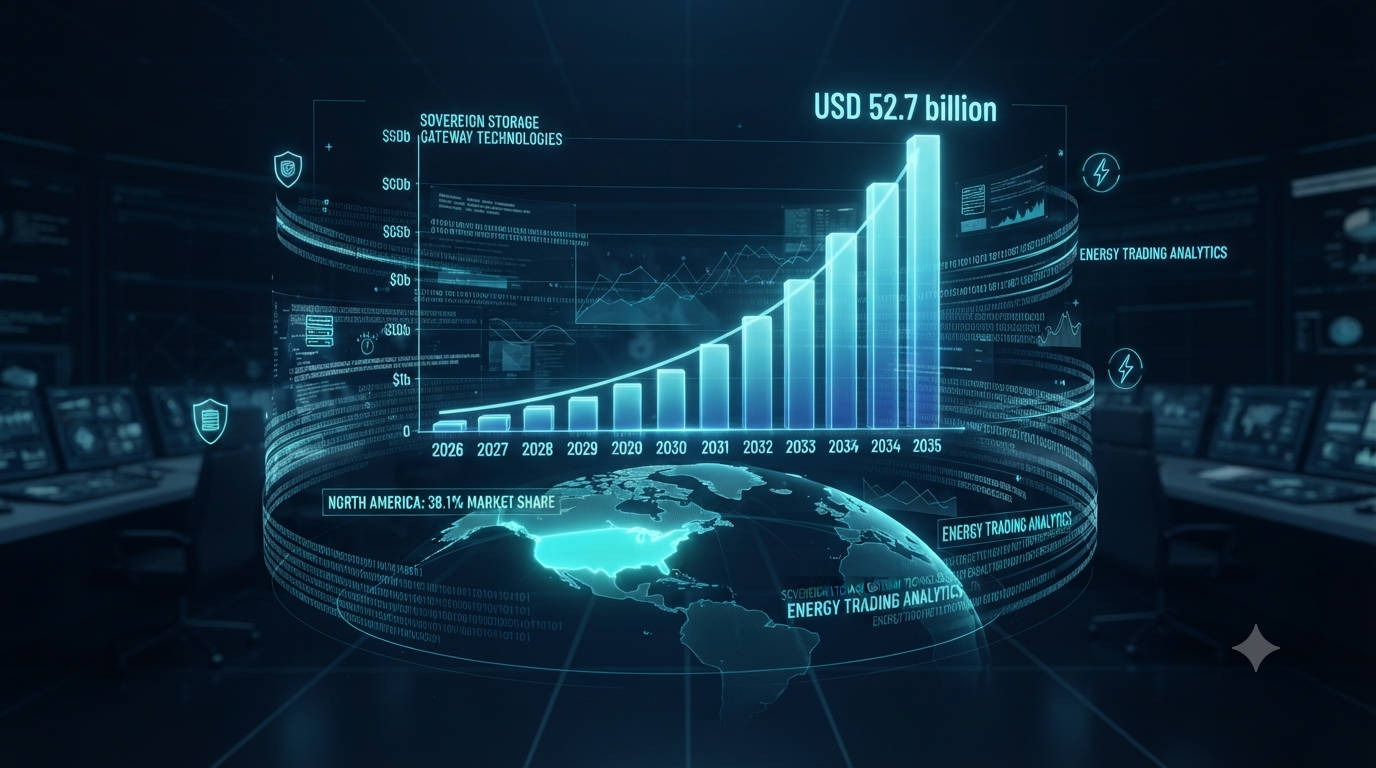
● 2035 Projected Market Value: USD 52.7 billion This represents a robust compound annual growth rate (CAGR) of 20.8%. North America currently commands the lead with a 38.1% market share. This dominance is driven by aggressive private and public investment, specifically through Inflation Reduction Act (IRA) incentives and the push for NEM 3.0 compliance in residential sectors. This growth signals that we aren’t just buying hardware; we are investing in the digitization of energy transaction management—moving away from simple storage toward encrypted energy analytics and sovereign storage gateway technologies.
Takeaway 2: AI is the New Grid Operator
The transition from reactive hardware to proactive energy management is being powered by Artificial Intelligence. Modern BTM platforms have evolved into zero-trust energy architectures that utilize cloud-native management to handle sensitive energy payloads at machine speed. By employing runtime peak detection and automated demand response, AI allows for a level of efficiency manual oversight cannot match. Furthermore, automated warranty lifecycle handling and battery degradation tracking ensure that these systems are optimized for long-term ROI rather than just immediate discharge”. This has resulted in operations being cost-effective, quicker, and more efficient than the old manual review method. Predictive analytics is the essential safeguard of the modern grid. By analyzing anomalous consumption patterns and checking safety policies in real-time, AI-driven systems provide a localized resilience that acts as a buffer against wider grid failures.
Takeaway 3: Distributed Resilience vs. Centralized Scale
As we balance the energy transition, the industry is weighing the “economies of scale” of centralized plants against the “localized independence” of distributed BTM systems. While centralized facilities offer lower costs per unit of energy stored, they remain uniquely vulnerable to large-scale disruptions and technical failures.| Category | Centralized Systems | Distributed (BTM) Systems || —— | —— | —— || Resilience | Vulnerable to widespread disruptions and natural disasters | High; localized independence prevents widespread outages || Initial Cost | High upfront infrastructure investment required | Higher cost per unit of energy stored || Efficiency | Significant transmission losses over long distances | Minimized losses; energy is stored near the point of use | The future landscape points toward a hybrid approach. By combining the price-competitiveness of centralized scale with the flexibility of distributed BTM workloads, grid operators can achieve a more stable, resilient energy economy.
Takeaway 4: The "Dream Team" of Batteries—The Dual Energy Storage System (DESS)
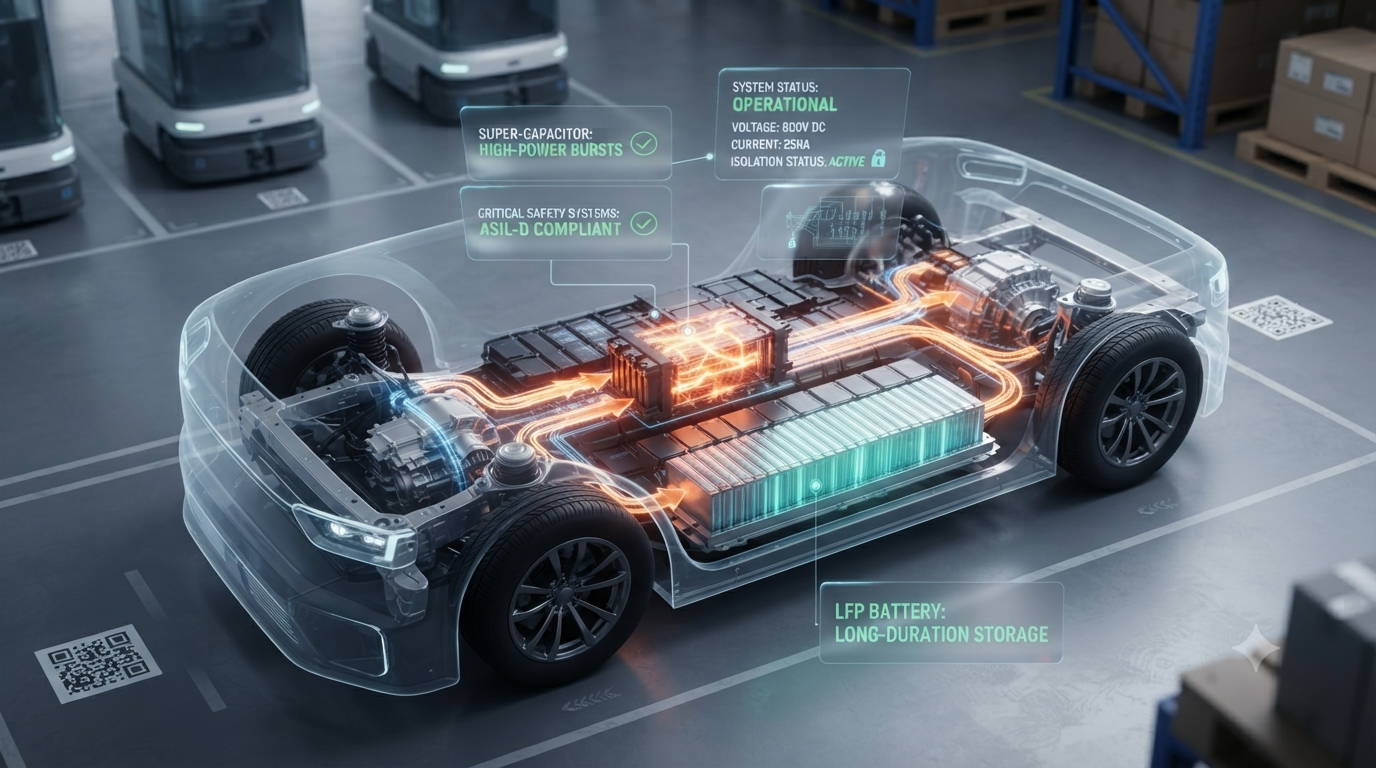
The industry is moving toward “Green Logistics” by optimizing battery chemistry for specific tasks. The Dual Energy Storage System (DESS) concept—pairing Supercapacitors (SC) with Lithium-ion batteries—is a game-changer for industrial mobility, particularly for Automated Guided Vehicles (AGVs) and intralogistics. This “dream team”; logic uses Supercapacitors for short, high-power bursts and rapid charging at transfer stations, while reserving the battery for long-duration tasks. In an AGV setting, the SC can even charge the battery while the system is in motion. This approach directly addresses lithium scarcity by minimizing energy storage capacity to the necessary minimum .Current market data shows that within the dominant Lithium-ion segment, Lithium Iron Phosphate (LFP) leads with a 68.3% share , favored for its safety margins and thermal stability—critical for these high-performance industrial DESS applications.
Takeaway 5: Why C&I Hubs, Not Homes, Are Leading the Charge
While residential solar captures public attention, Commercial and Industrial (C&I) hubs are the true market leaders, holding a 44.6% end-user share. These enterprises are not just seeking sustainability; they are using BTM storage to manage electricity cost profiles with surgical precision. The top three applications driving this commercial dominance are:
1. Peak Demand Management (32.5% share): Utilizing stored energy to avoid expensive “demand charges” during peak utility events.
2. Energy Cost Optimization: Leveraging arbitrage strategies to charge during off-peak hours and discharge when rates are highest.
3. Backup Power: Ensuring production continuity and protecting critical loads in retail, hospitality, and office environments during grid instability.
Conclusion: The Grid of One

We are standing at the threshold of the “Grid of One” where energy science further digitizes basic storage and data processing tasks. The BTM revolution is effectively turning every building into a self-sufficient micro-utility, capable of predicting its own needs and managing its own health via cloud-based analytics. As we look forward, the strategic question for businesses and homeowners alike is no longer where they will buy their power, but how they will manage the power they already have. Is the “Utility Provider” of the future a massive plant miles away, or is it the very building you are standing in right now?