

It’s one thing to talk about AI-powered hotels in theory. It’s another to see the actual numbers — a 28% cut in room energy use, check-in times dropping from six minutes to under sixty seconds, a 40% reduction in lost linens. Those aren’t projections; they’re documented results from properties already running Agentic AIoT systems today.
Here’s a look at how this technology is actually being deployed across six hotel domains, the vendors and tools behind it, and the measurable payoff.
The Architecture, Briefly
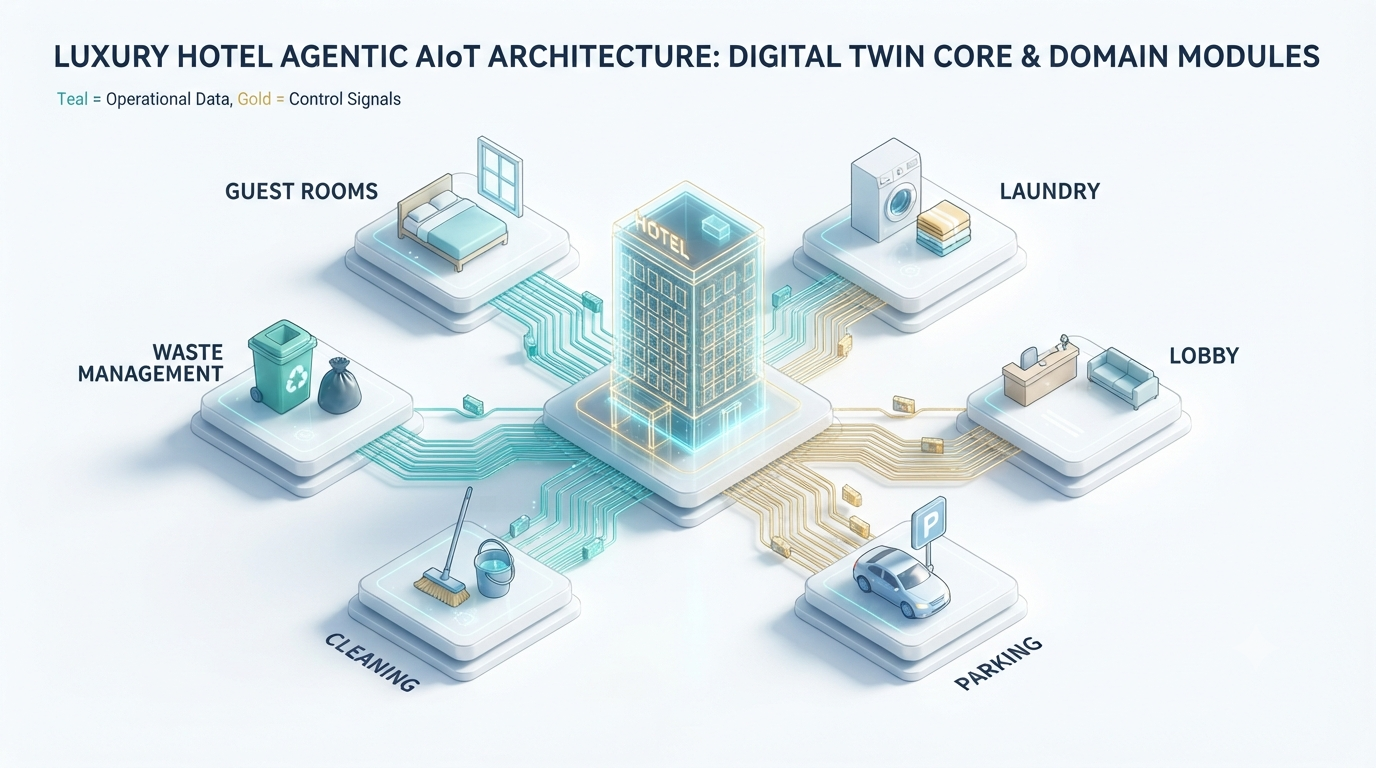
The system runs as a layered pyramid. At the bottom, thousands of sensors — PIR motion detectors, CO2 monitors, RFID tags, LiDAR, smart meters — collect raw data. Edge compute nodes process that data locally, keeping safety-critical responses like fire suppression or emergency lighting under 100 milliseconds. Above that, domain-specific LLM agents (built on frameworks like LangChain or AutoGen) interpret the data and issue commands back down. A cloud platform — AWS IoT Greengrass or Azure IoT Hub — handles device management, firmware updates, and long-term analytics.
Connectivity is chosen deliberately for each use case: Zigbee 3.0 for low-power room controls, Wi-Fi 6 for cameras and tablets, NB-IoT for outdoor infrastructure like parking barriers and waste bins, and LoRaWAN wherever running new cables isn’t practical. For properties that need to keep data on-premises, quantized open-source models like Mistral 7B or Llama 3 run locally instead of relying on cloud inference.
Guest Rooms: Comfort That Adjusts Itself
At check-in, guest preferences — temperature, lighting scene, wake-up time, dietary notes — pass from the property management system straight to a Room AI Agent, which then controls HVAC, motorized blinds, and lighting scenes automatically.
Millimeter-wave radar detects occupancy without using cameras at all, distinguishing between sleeping, reading, or an empty room, and adjusts HVAC accordingly — cutting energy use in vacant rooms by up to 30%. Smart locks tied to a mobile key trigger automated welcome lighting the moment a guest walks in, and an on-premises voice assistant lets guests give natural instructions like “dim the lights to 20% and play jazz,” which the agent translates into simultaneous device commands.
Laundry: Tracking Every Towel
White canes and guide dogs are proven, but limited — they can’t identify objects, read text, recognize a face, or explain what’s happening around someone in real time. Even most existing “smart” assistive devices just relay sensor data without actually reasoning about it.
Agentic AI changes that. Instead of just detecting “object nearby,” the system can understand context, learn a person’s habits over time, and proactively offer help — like noticing someone’s in the kitchen at breakfast time and suggesting what’s available to eat, without being asked.
Lobby: From Six Minutes to Sixty Seconds
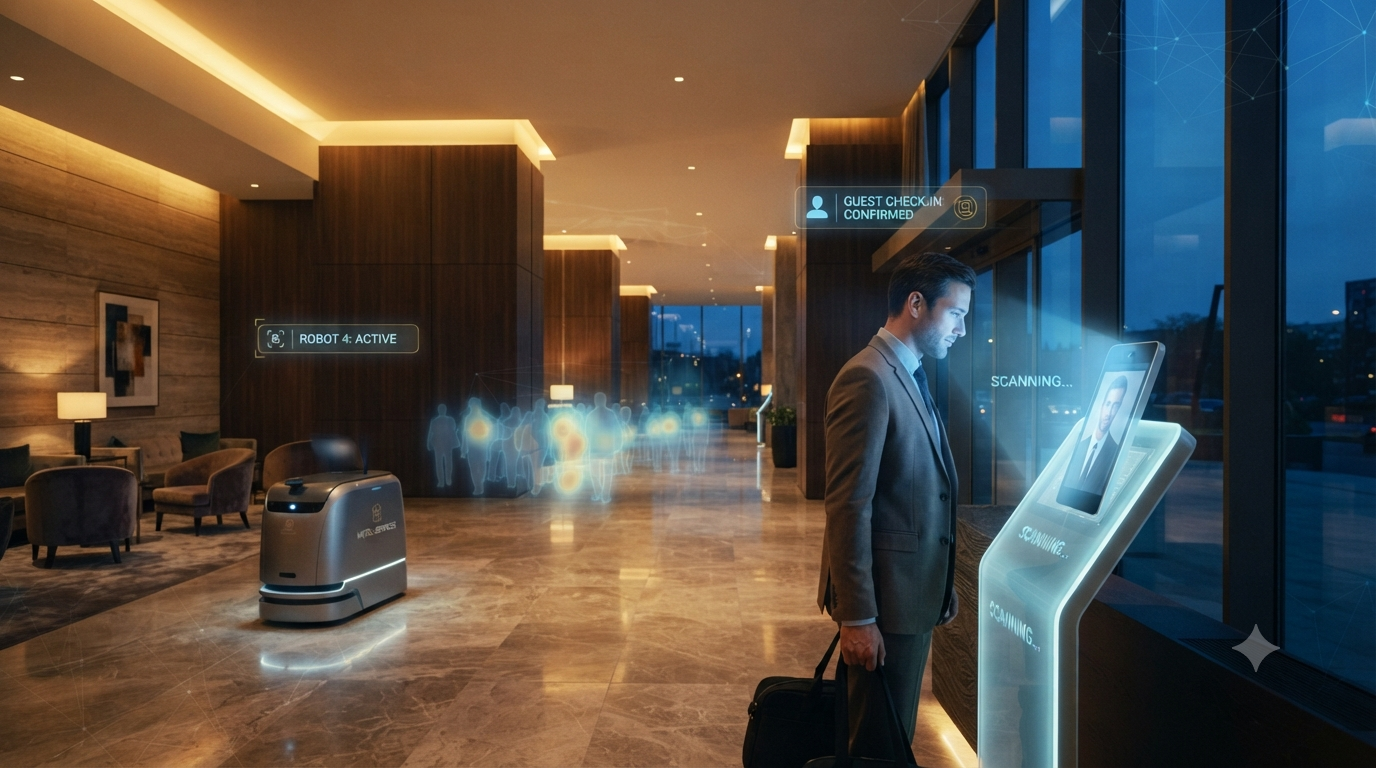
The lobby agent pulls together facial recognition kiosks, crowd density sensors, concierge chatbots, and elevator dispatch into one coordinated system. Computer vision kiosks verify a guest’s identity and documents in under 4 seconds, then automatically send a mobile key to their phone and baggage instructions to bellhop staff. Indoor navigation using ultra-wideband beacons gets guests to their room with roughly 30 cm of accuracy through an AR-guided app.
Delivery robots navigate autonomously from service kitchens to guest rooms, rerouting in real time around crowded corridors, and can call and ride elevators without human help.
Parking: Smarter Use of a Finite Resource
License plate recognition cameras identify arriving vehicles in under 200 milliseconds and cross-check them against the booking system, opening barriers instantly for recognized guests along with a personalized welcome message on digital signage. Ultrasonic sensors track slot availability in real time, feeding LED guidance signs and the guest’s mobile app.
The parking agent uses demand forecasting based on historical occupancy patterns to dynamically price event-day visitor parking, and coordinates valet robot fleets to maximize how efficiently the space gets used.
Cleaning: Faster Turnaround, Less Wasted Motion
The cleaning agent combines reactive dispatch (a checkout triggers room cleaning) with proactive scheduling (high-traffic public areas get cleaned before they visibly need it), using occupancy data, motion sensors, and visual soil-detection from ceiling-mounted cameras.
Autonomous floor-cleaning robots work during low-traffic hours using nightly-refreshed navigation maps. Human housekeeping staff get room assignments automatically prioritized by checkout time, room category, and staff location — a system that’s reduced room-ready time by an average of 22 minutes per deployment in large hotel chains. UV-C disinfection robots handle post-checkout sanitizing in suites automatically, with completion confirmed through door sensors and robot telemetry.
Waste Management: Collection That Responds to Reality, Not a Clock
Instead of fixed pickup schedules that either leave bins overflowing or send staff on unnecessary trips, ultrasonic fill-level sensors report status continuously. When a bin crosses 75% capacity, the waste agent dispatches a collection cart along an optimally calculated route.
Computer-vision sorting systems in the central waste room classify recyclables from general waste at over 80 items per minute, and the agent automatically generates sustainability reports for ESG compliance — increasingly required for luxury certifications like Green Key and LEED for Hospitality.
How It's All Tied Together Securely
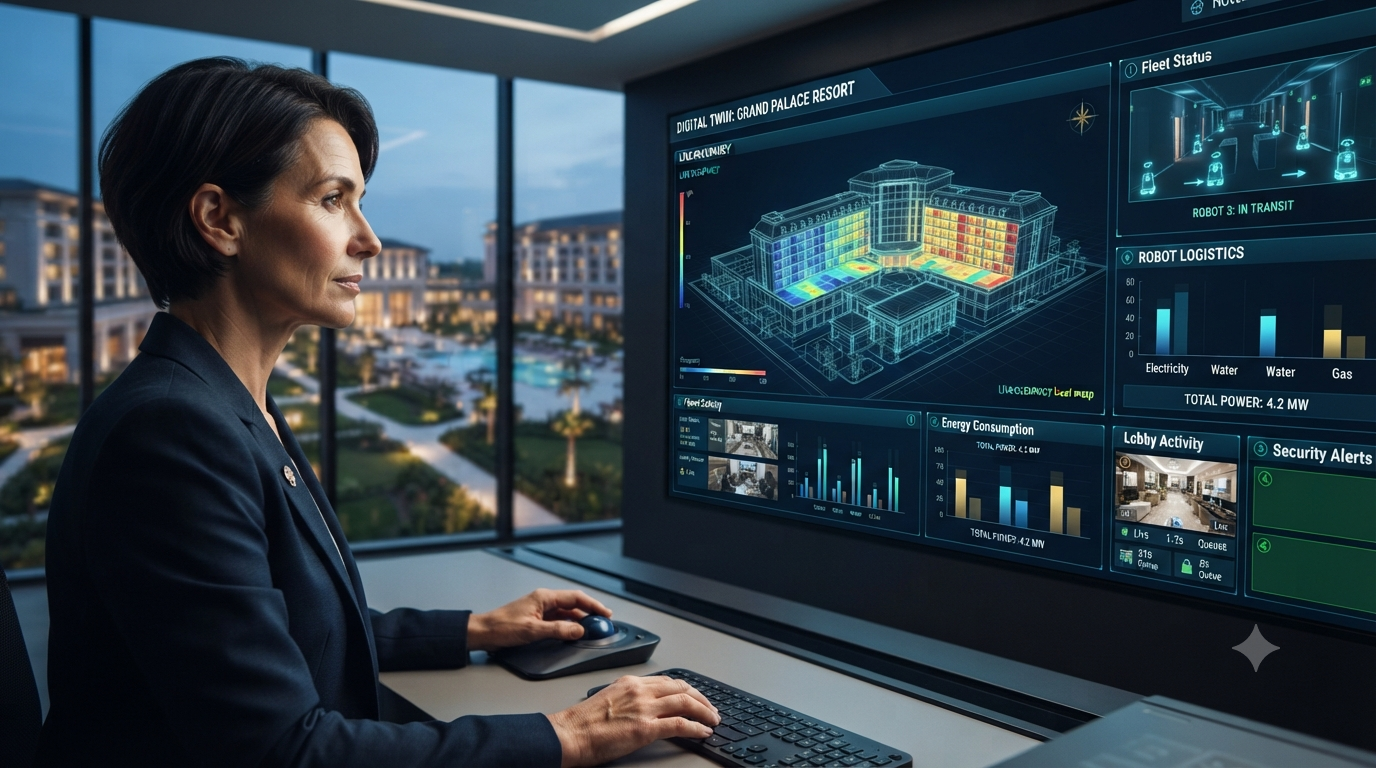
All the domain agents share a unified data pipeline built on event streaming and time-series databases, with a digital twin platform giving operations teams a live 3D model of the entire property — sensor status, robot positions, occupancy heat maps, all in one dashboard.
Security runs in layers: device certificates, zero-trust network segmentation, and end-to-end encryption. Sensitive data like facial recognition templates gets stored in encrypted enclaves and automatically purged at checkout, in line with data protection regulations. Every AI agent action gets logged immutably for accountability.
The Numbers That Actually Matter
| Domain | What the Agent Does | Measured Result |
| Guest Room | Dynamic HVAC based on occupancy | 28% energy savings |
| Laundry | RFID tracking + predictive maintenance | 40% less linen loss, 20% water savings |
| Lobby | Facial recognition + mobile key + robot concierge | Check-in cut from 6 minutes to under 60 seconds |
| Parking | Slot sensors + demand-based pricing | 12% revenue uplift, zero valet wait time |
| Cleaning | Vision-based dispatch + autonomous robots | 22 minutes faster room turnaround, 30% labor optimization |
| Waste | Smart bins + AI sorting + dynamic routing | 35% fewer collection trips, 60% recycling diversion |
The Bottom Line
This isn’t a future concept — it’s already running in forward-thinking hotels today. Falling costs for edge AI hardware, mature wireless protocols, and increasingly capable LLM-based agents have pushed this technology past the point where the investment pays for itself within 2–3 years through energy savings, labor efficiency, and the revenue lift that comes from happier guests.
The practical path for most properties: build a unified data foundation first, then layer in AI agents starting with the highest-return domains — typically rooms and parking — before expanding into laundry, cleaning, and waste. Done well, the result is a hotel that quietly optimizes itself while delivering the seamless, personalized experience premium guests expect.
Based on research by Suleiman Mohammed Rabbani.