


As solar and wind keep growing their share of the grid, the hardest problem isn’t generating clean power — it’s storing it intelligently enough to handle the fact that the sun doesn’t always shine and the wind doesn’t always blow when demand peaks. Traditional battery storage systems need constant human oversight to manage that mismatch, which doesn’t scale well as grids get more complex.
Agentic AIoT offers a different model: rather than one system trying to do everything, a team of specialized AI agents split up the work — monitoring, predicting, deciding, detecting faults, communicating, and securing the whole operation — all coordinating in real time with minimal human input.
What a Battery Energy Storage System Actually Does
A Battery Energy Storage System (BESS) stores electricity in rechargeable batteries and releases it when needed. You’ll find these systems in smart grids, renewable energy plants, EV charging stations, industrial backup power, residential storage, and microgrids.
For a system like this to actually run itself, it needs to handle:
- Real-time battery monitoring
- Intelligent power control
- Automated energy management
- Renewable energy integration
- Battery health prediction
- Load balancing
- Fault detection and protection
- Remote monitoring and control
- Smart grid communication
- Autonomous decision-making
The Architecture Behind It
The system is built from a stack of layers: a cloud/edge platform at the top, an Agentic AIoT platform running the specialized agents, a communication layer tying them together, and underneath that, the actual hardware — battery modules, the battery management system, power conversion equipment, and the physical grid connection.
Two subsystems do most of the heavy lifting:
The Power Control System (PCS) manages the actual flow of electricity between the battery, the grid, and whatever’s drawing power. It’s built from a bidirectional inverter, a DC-DC converter, protection circuitry, and a smart switching unit.
The Energy Management System (EMS) is effectively the brain — handling load forecasting, renewable energy optimization, battery scheduling, peak shaving, and demand response.
The Six Agents Running the Show
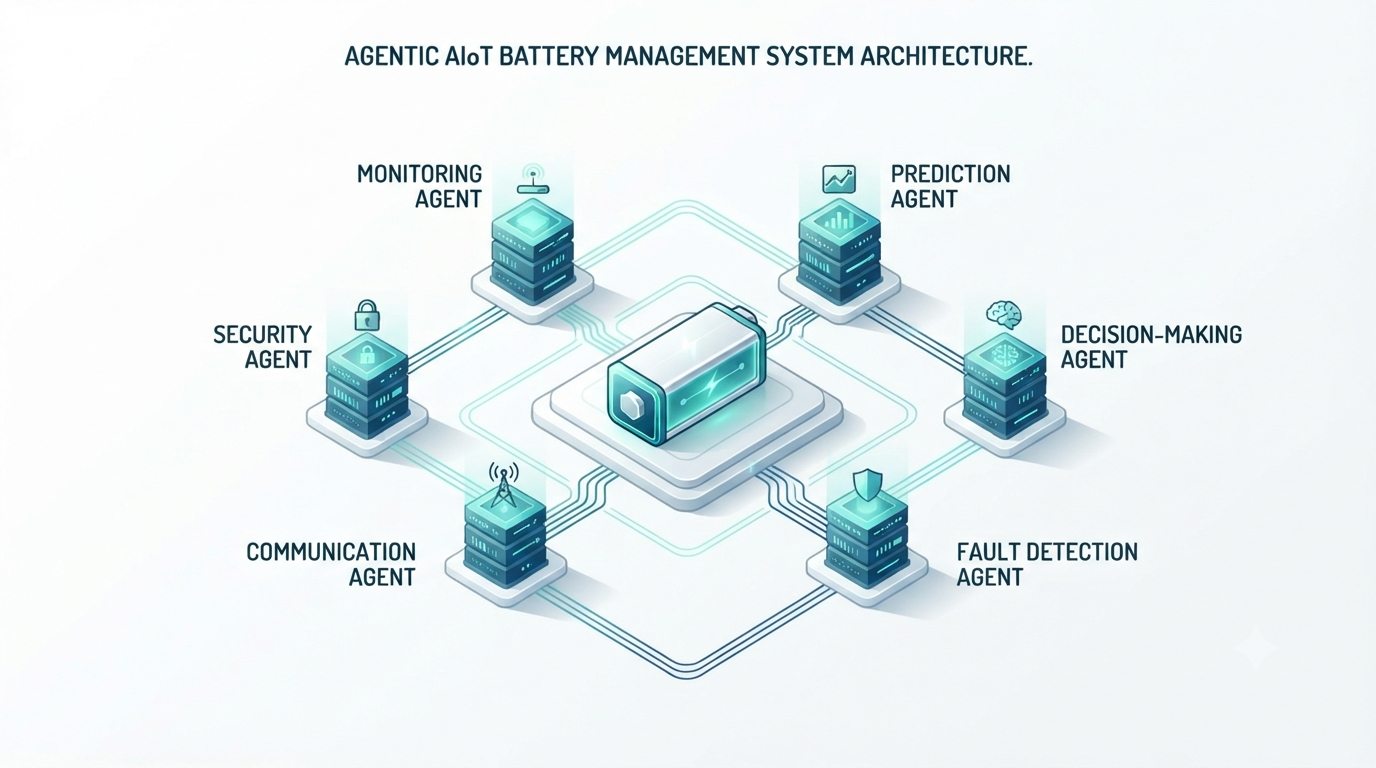
The Monitoring Agent collects sensor data and keeps tabs on battery status, built on ESP32 hardware, MQTT messaging, Node-RED, and Grafana dashboards.
The Prediction Agent forecasts energy demand and renewable generation using Python, TensorFlow, Scikit-learn, and LSTM neural network models — the kind built specifically for time-series forecasting.
The Decision-Making Agent figures out the optimal charging and discharging strategy, using reinforcement learning techniques like Deep Q Networks built in PyTorch.
The Fault Detection Agent watches for abnormal battery behavior using CNN models, sensor fusion, and thermal monitoring — catching problems before they escalate.
The Communication Agent handles device connectivity and cloud communication across MQTT, Wi-Fi, LoRaWAN, and 5G.
The Security Agent protects the system with AES encryption, blockchain-based verification, and TLS/SSL — critical given how much of this system depends on constant data exchange.
How It All Comes Together, Step by Step
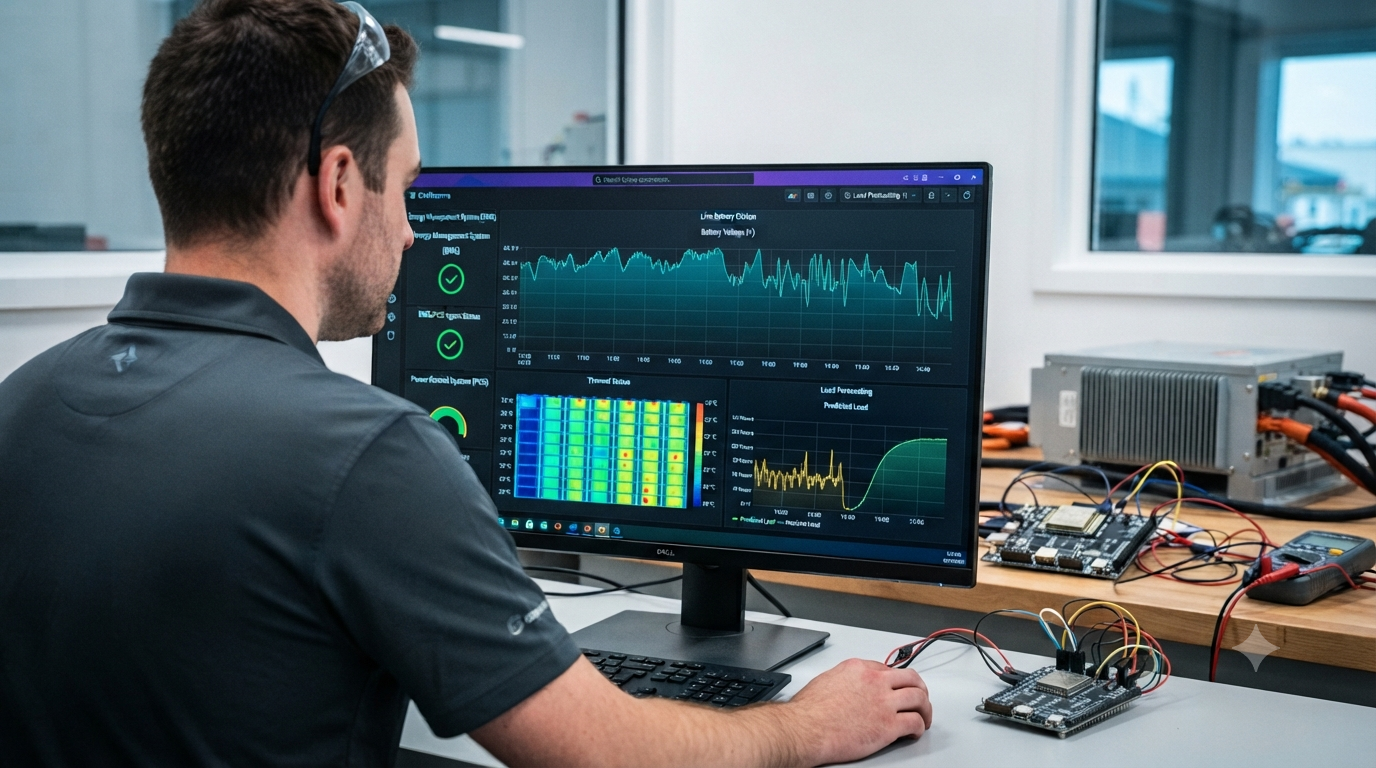
- Sensors collect battery and energy data
- The edge controller preprocesses that data locally
- AI models predict demand and battery health
- The decision agent chooses the optimal strategy
- The power control system executes the resulting commands
- Data syncs with the cloud platform
- The fault detection agent handles any abnormalities that show up
The Technology Underneath
| Component | Technologies |
| Sensors | Voltage, current, temperature sensors |
| Embedded hardware | ESP32, STM32, Raspberry Pi |
| Communication | MQTT, CAN Bus, Modbus, RS485 |
| Cloud platform | AWS IoT, Azure IoT |
| AI frameworks | TensorFlow, PyTorch |
| Databases | MongoDB, Firebase |
| Visualization | Grafana, Power BI |
| Security | Blockchain, TLS/SSL |
Where It’s Actually Used
- Smart grid integration
- Solar energy storage
- EV charging stations
- Industrial energy optimization
- Rural microgrids
What You Gain — and What It Costs
The upside is real: better energy efficiency, longer battery life, real-time visibility into system health, autonomous operation that doesn’t need constant supervision, and improved safety through early fault detection.
The tradeoffs are real too — cybersecurity risk (since more connectivity means more attack surface), high upfront implementation cost, data privacy considerations, and the general complexity of integrating so many moving parts into one coherent system.
Why This Matters Beyond the Grid
Systems like this support the broader shift toward renewable energy and help cut carbon emissions, while improving grid stability along the way. They’re also a practical path to bringing reliable electricity to remote or underserved areas, and the technology itself is opening up new job opportunities across AI, IoT, renewable energy, and embedded systems.
What’s Coming Next
Looking ahead, this space is likely to expand into fully autonomous smart grids, vehicle-to-grid integration (where EVs feed power back into the grid), AI-driven digital twins, blockchain-based energy trading, and eventually solid-state battery integration.
The Bottom Line
Agentic AIoT-based battery storage isn’t just an incremental upgrade to existing systems — it’s a shift toward energy infrastructure that can genuinely run itself, adapting to real-time conditions instead of following a fixed schedule. As renewable energy keeps scaling and grids get more complex, this kind of autonomous, multi-agent approach is likely to become foundational to how power gets stored and delivered, from major smart grids down to rural microgrids.
Based on research by P. Rohit Paul, ECE-B.