

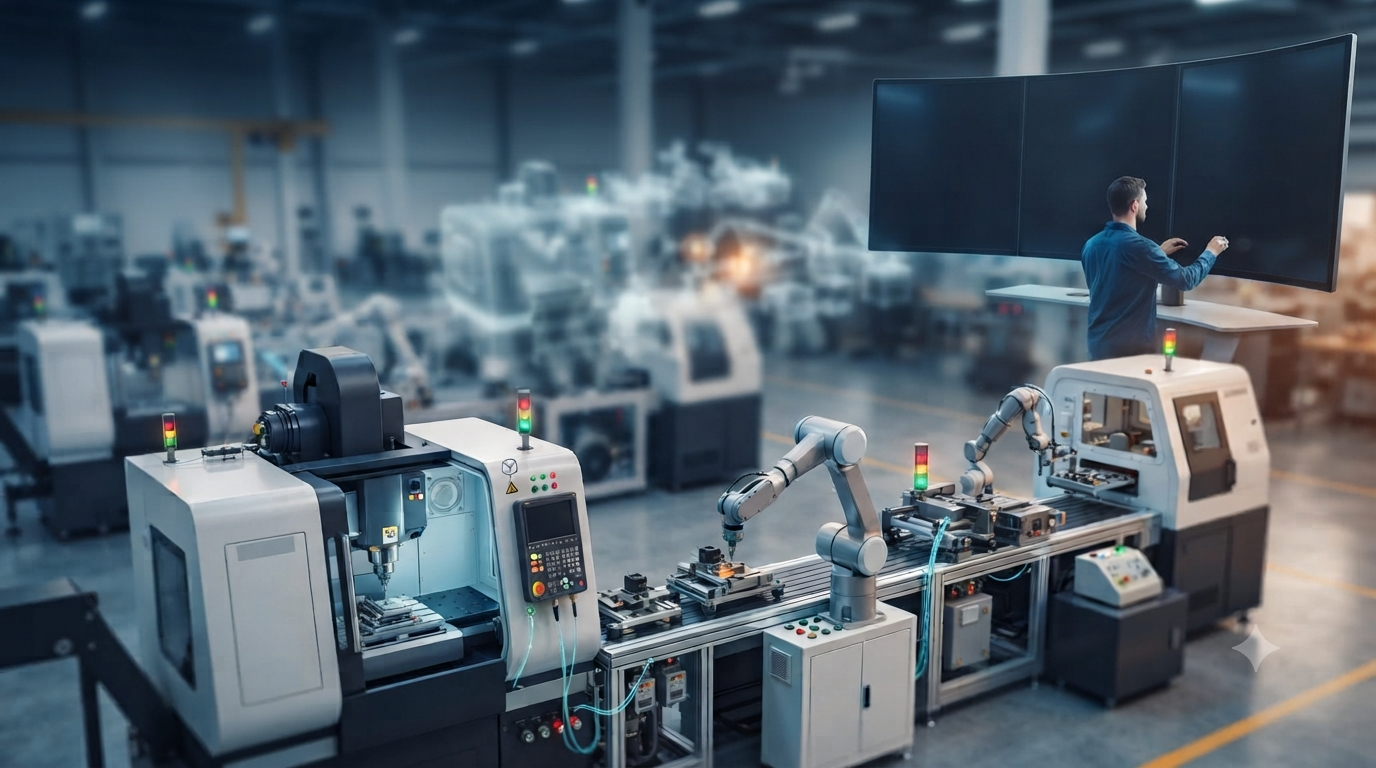
A single worn spindle bearing, a motor pulling abnormal current, or a conveyor gearbox slowly slipping out of alignment — any one of these can bring an entire production line to a halt with almost no warning. For decades, factories have managed this risk with two blunt instruments: fix it when it breaks, or replace it on a fixed calendar whether it needs it or not. Both approaches waste money — one in emergency repairs, the other in premature parts.
AIoT-enabled digital twins are changing that equation. By combining the Internet of Things with edge and cloud machine learning, manufacturers can now build a living, continuously updated virtual replica of every machine on the floor — one that knows what “normal” looks like for that specific piece of equipment, and speaks up the moment something starts to drift.
Here’s how the technology actually works, the architecture behind it, and why it’s quickly becoming a standard layer of the modern factory rather than a luxury only the largest players can afford.
Why Machine Health Needs a Digital Twin
A digital twin is not a static 3D model sitting in a CAD file. It’s a software representation of a physical machine that is fed a continuous stream of sensor data and uses that data to simulate the machine’s real-world behavior. As readings approach a danger threshold, it alerts on-site engineers before a small problem becomes a costly one.
The key shift is from reactive and scheduled maintenance to something closer to continuous diagnosis. Instead of just reporting a motor’s current temperature or vibration, an AIoT-powered twin learns the specific “normal” baseline for that exact machine and raises a flag the instant behavior starts drifting away from it.
A Reference Architecture: ISO 23247
Most modern implementations follow the ISO 23247 framework, an international standard for building digital twins of manufacturing assets. It organizes a twinning system into four conceptual domains:
- Manufacturing elements — the physical machines and the sensors bolted onto them
- Device communication entity — the layer that collects state changes and issues control commands
- Digital twin entity — the model that continuously updates and mirrors the physical asset
- User entity — the applications and people who consume the twin’s output
Layered on top of this standard is an edge-intelligence layer, which is what turns a passive digital replica into something that can actually reason about machine health.
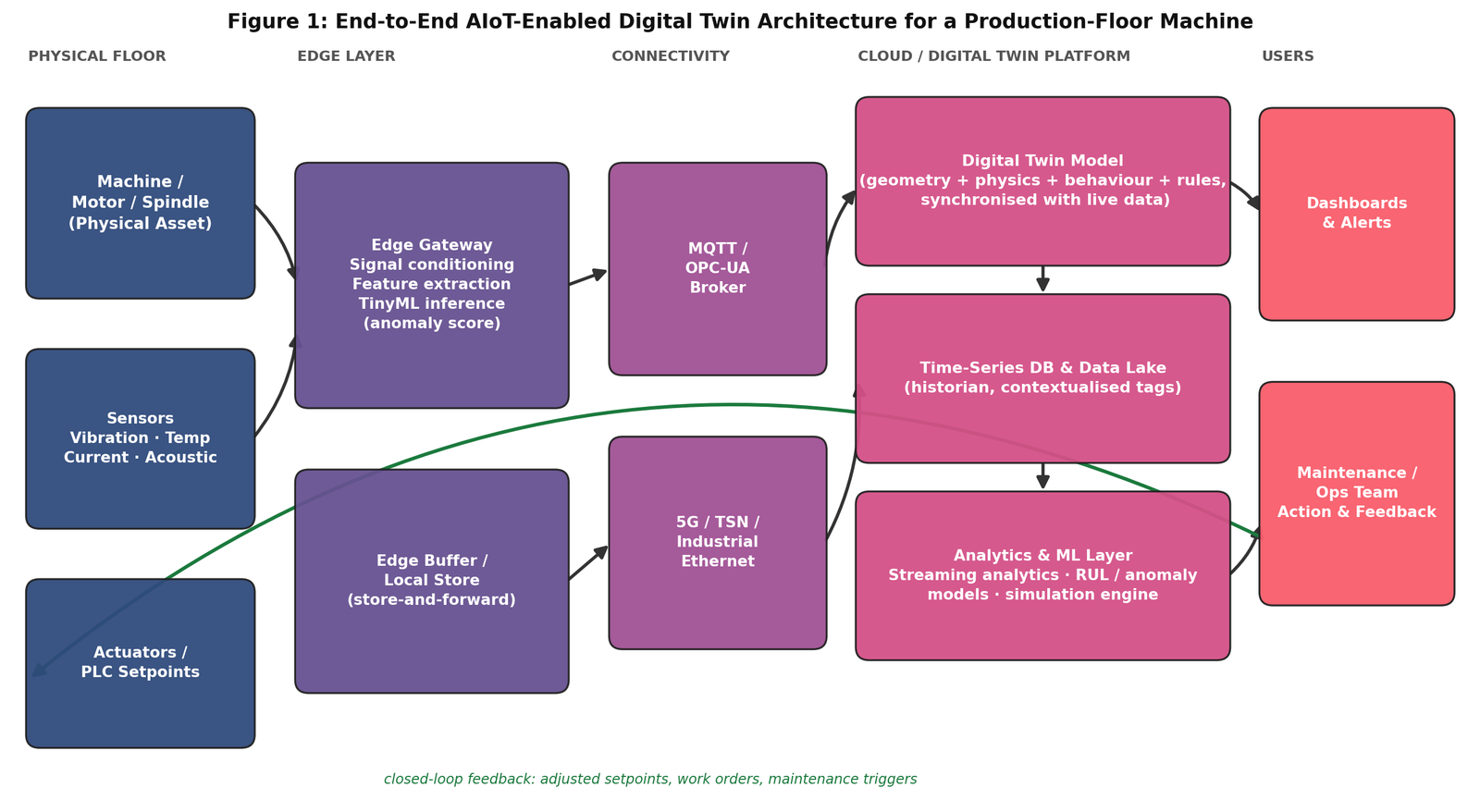
Breaking the pipeline down by physical layer:
- Physical floor — the machines themselves, instrumented with accelerometers (vibration), thermocouples (temperature), current clamps (motor load), and often ultrasonic transducers for bearing and gear noise, plus actuators that can respond to new setpoints.
- Edge layer — a small industrial gateway or microcontroller near the machine that conditions raw signals, extracts features, and can even run a lightweight ML model to produce a first-pass anomaly score without waiting on the cloud — critical in time-sensitive scenarios.
- Connectivity layer — moves data upward via industrial protocols like MQTT over Ethernet, Wi-Fi, or 5G, depending on the plant’s infrastructure.
- Cloud / digital twin platform — hosts the actual twin: a model combining the machine’s geometry and expected physical behavior, kept in sync with a time-series historian.
- User layer — dashboards, alerts, and reports for maintenance engineers and plant managers, closing the loop by feeding decisions — an adjusted setpoint, a work order, a maintenance trigger — back to the specific machine.
Where It Gets Used on the Shop Floor
Deployments typically start with high-value rotating equipment — induction motors, compressors, gearboxes — before scaling to an entire unit. Three use cases tend to dominate:
- A live dashboard for real-time decision-making
- An early-warning system that catches problems before they escalate
- A sandbox environment for testing changes on manufacturing equipment without touching the physical machine
The Non-Negotiable Requirements of Live Monitoring
A digital twin is only useful if information moves fast enough to matter. An alert that a machine overheated an hour ago is not an alert — it’s a postmortem. That puts a specific set of requirements on the underlying system:
- Low latency — data needs to move in the range of a few hundred milliseconds to a few seconds; beyond that, the insight is stale before anyone can act on it.
- Streaming, not batch — data must be processed continuously rather than accumulated and analyzed in periodic jobs.
- Synchronized sampling — all sensors need consistent, correlated timestamps so the twin can reason about cause and effect correctly.
- Reliability — factory networks drop packets. The pipeline needs local buffering and store-and-forward behavior so a critical event is never silently lost.
- Scalability — a single plant might have hundreds of sensors and edge devices; the architecture has to scale with them.
Meeting these requirements is what separates a digital twin that is genuinely live from one that’s just a slightly faster reporting tool.
The Technology Stack Behind It
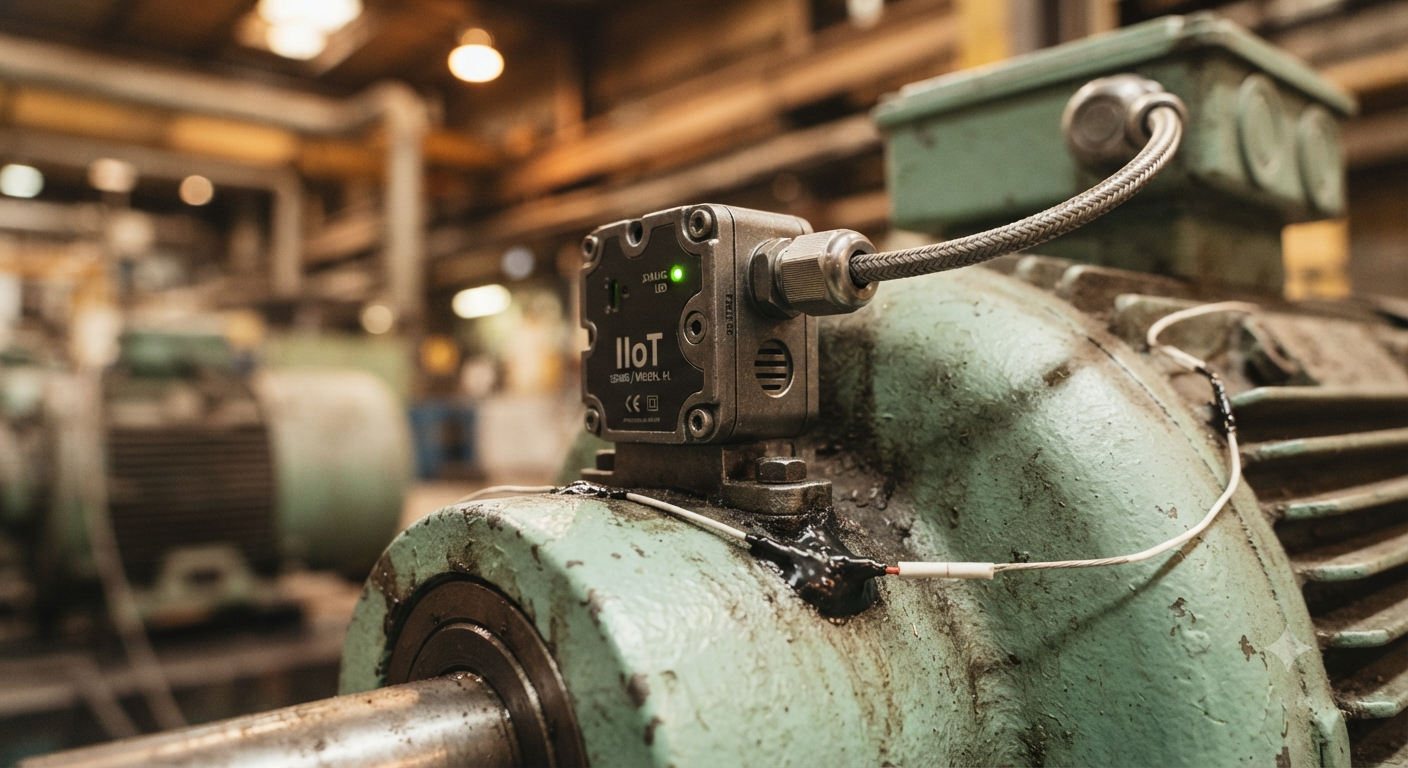
Sensing and Edge Hardware
Accelerometers, thermocouples, current clamps, and acoustic sensors capture raw machine data. That data feeds into edge devices — anything from small microcontrollers running lightweight ML models to gateways running a real-time operating system (RTOS) for heavier local analysis.
Industrial Connectivity and Messaging
MQTT is the dominant protocol in IoT deployments, largely because of its low power footprint — a major advantage in constrained environments. Where control loops demand deterministic, low-latency communication, Time-Sensitive Networking (TSN) and 5G are increasingly stepping in.
Stream Processing and Time-Series Storage
Once data reaches a central server, stream-processing engines like Apache Kafka and Apache Flink allow analytics to run continuously on moving data rather than periodic snapshots. That processed data typically lands in a time-series database such as InfluxDB or TimescaleDB, purpose-built for high-frequency, timestamp-indexed data.
Digital Twin Modeling and Visualization
Platforms like Azure Digital Twins and AWS IoT TwinMaker maintain the twin’s state graph, expose it through APIs, and render it in 2D or 3D visualizations — often paired with tools like Grafana for real-time dashboards.
Live Monitoring vs. Predictive Analysis: Not the Same Thing
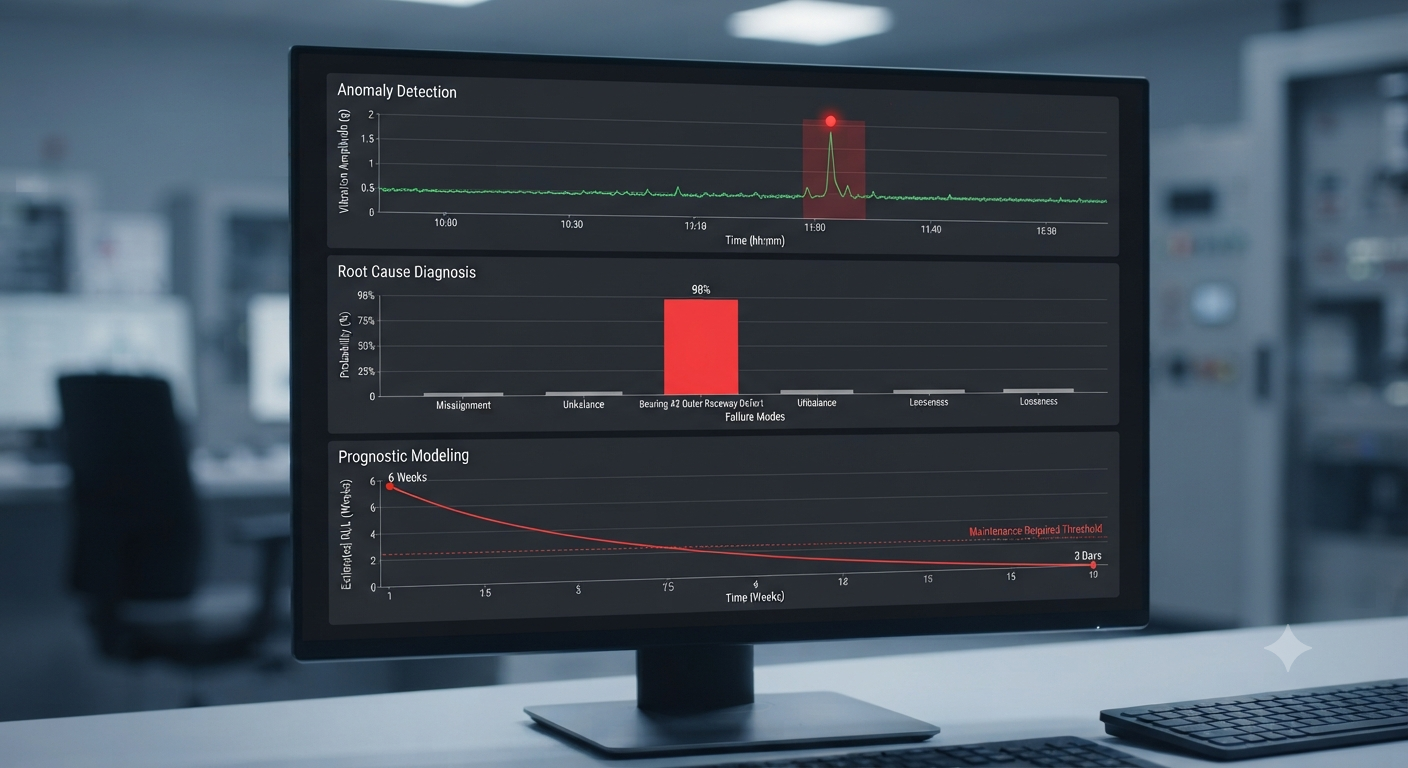
Live monitoring and predictive analysis are often mentioned in the same breath, but they answer different questions. Live monitoring tells you what is happening right now. Predictive analysis goes further and tells you what is likely to happen, and when — and it can only do that because the twin holds a structured, time-aligned history of everything the machine has done.
The relationship unfolds in three stages:
- Anomaly detection — flagging when a machine’s readings drift from its established normal range.
- Root-cause diagnosis — narrowing down which of several possible faults is actually responsible.
- Prognostic modeling — estimating how many more operating cycles the machine has before it becomes unusable.
Because the twin ties all three stages to one specific, individual machine — not a generic equipment class — the resulting maintenance schedule is genuinely optimized rather than a one-size-fits-all interval.
ML Models and Deployment on Edge Systems
Choosing the Right Model for the Job
Different stages of the predictive pipeline call for different model families:
- Anomaly detection on raw or lightly processed vibration and current signals: autoencoders and one-class SVMs, since they only need a healthy baseline to work from.
- Fault classification — pinpointing the root cause once a fault is suspected: CNNs on spectrograms, or gradient-boosted trees such as XGBoost on hand-engineered statistical features. These are comparatively cheap to run.
- Remaining-useful-life (RUL) estimation — which requires reasoning over performance trends across time: LSTMs and temporal CNNs.
In many real-world deployments, a lighter statistical or tree-based model wins out over a deep network simply because it’s easier to compress and run on constrained edge hardware without materially losing accuracy.
Why Push Inference to the Edge?
Sending everything to the cloud introduces latency that’s simply too costly in time-critical scenarios. Processing locally — generating a performance score at the edge regardless of cloud connectivity — cuts that latency dramatically and reduces the load on cloud infrastructure.
The Deployment Pipeline
Models are trained in the cloud on historical data, then compressed through techniques like pruning and quantization, packaged into an edge-friendly runtime (most commonly TensorFlow Lite), and deployed to the gateway or microcontroller.
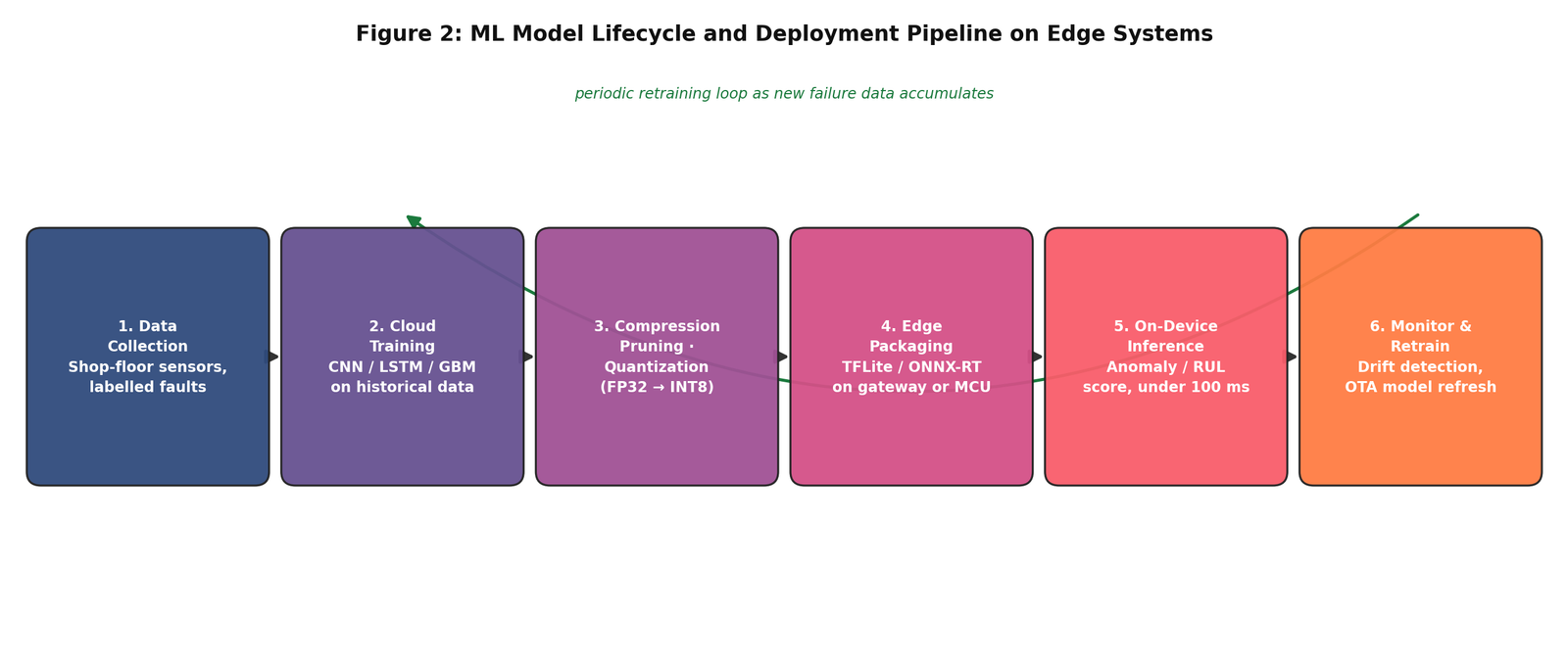
Because a machine’s operating conditions and failure patterns can drift over months of use, deployment isn’t a one-time event. It includes ongoing monitoring for a drop in model confidence or a rise in false alarms, which triggers periodic retraining and an over-the-air model update back to the same devices.
The Edge–Cloud Split
White canes and guide dogs are proven, but limited — they can’t identify objects, read text, recognize a face, or explain what’s happening around someone in real time. Even most existing “smart” assistive devices just relay sensor data without actually reasoning about it.
Agentic AI changes that. Instead of just detecting “object nearby,” the system can understand context, learn a person’s habits over time, and proactively offer help — like noticing someone’s in the kitchen at breakfast time and suggesting what’s available to eat, without being asked.
The Competitive Advantage for the Factory
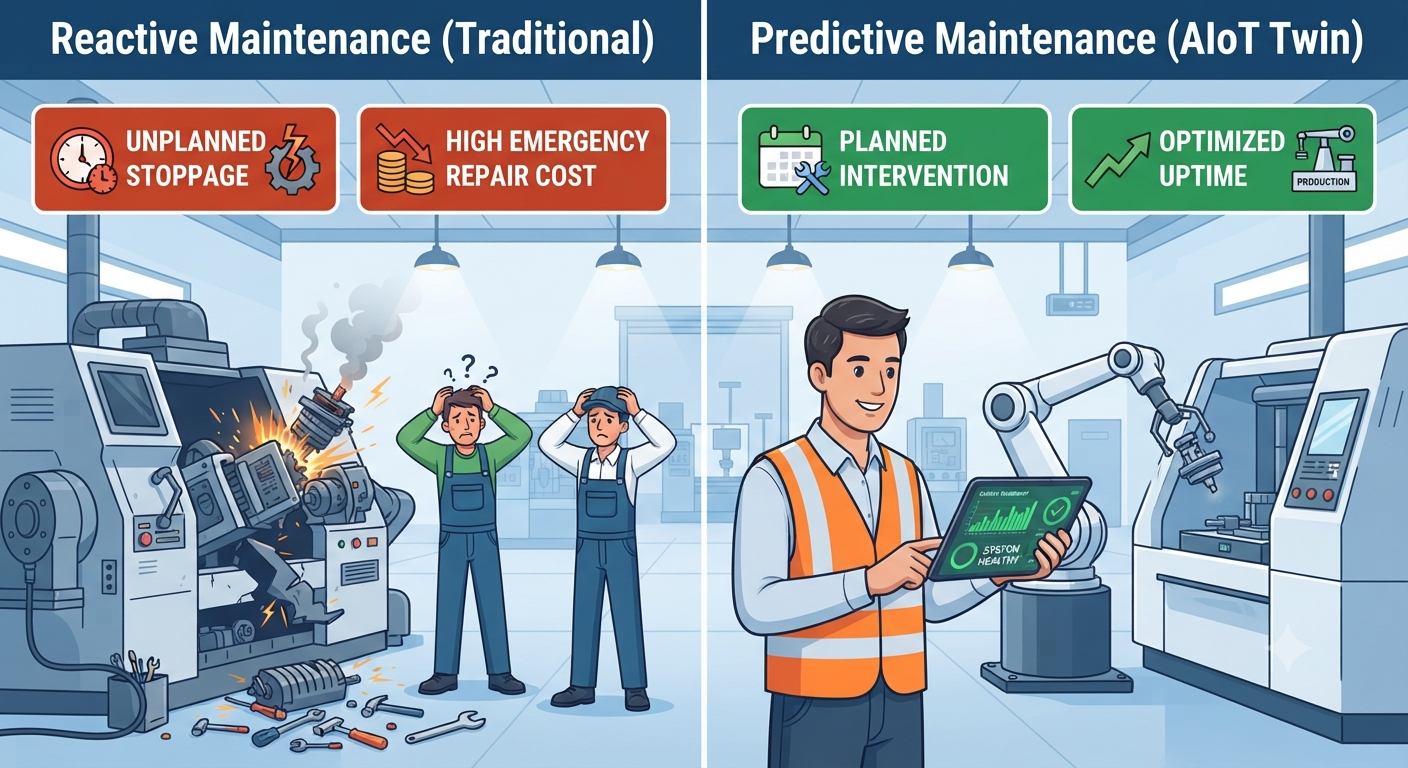
Deploying AIoT systems converts unplanned, expensive failures into planned, cheaper interventions — and gives plant managers a level of visibility they’ve never had before. Case studies from McKinsey and Deloitte quantify the impact:
- Fewer unplanned stoppages — catching faults while they’re still developing means materially fewer surprise breakdowns.
- Lower total maintenance spend — replacing only the parts that need it, during planned windows, avoids both premature-replacement costs and the premium of emergency repairs.
- Longer equipment life — catching abnormal conditions early (overheating, misalignment, overload) prevents the accumulated stress that shortens a machine’s useful lifespan.
- Better production planning — a manager who knows a gearbox has roughly three weeks of safe operating life left can schedule its replacement around existing orders instead of losing a shift unexpectedly.
- Data-driven continuous improvement — over time, the twin’s historical record becomes a factory-specific dataset for refining models, benchmarking machines, and informing future equipment purchases.
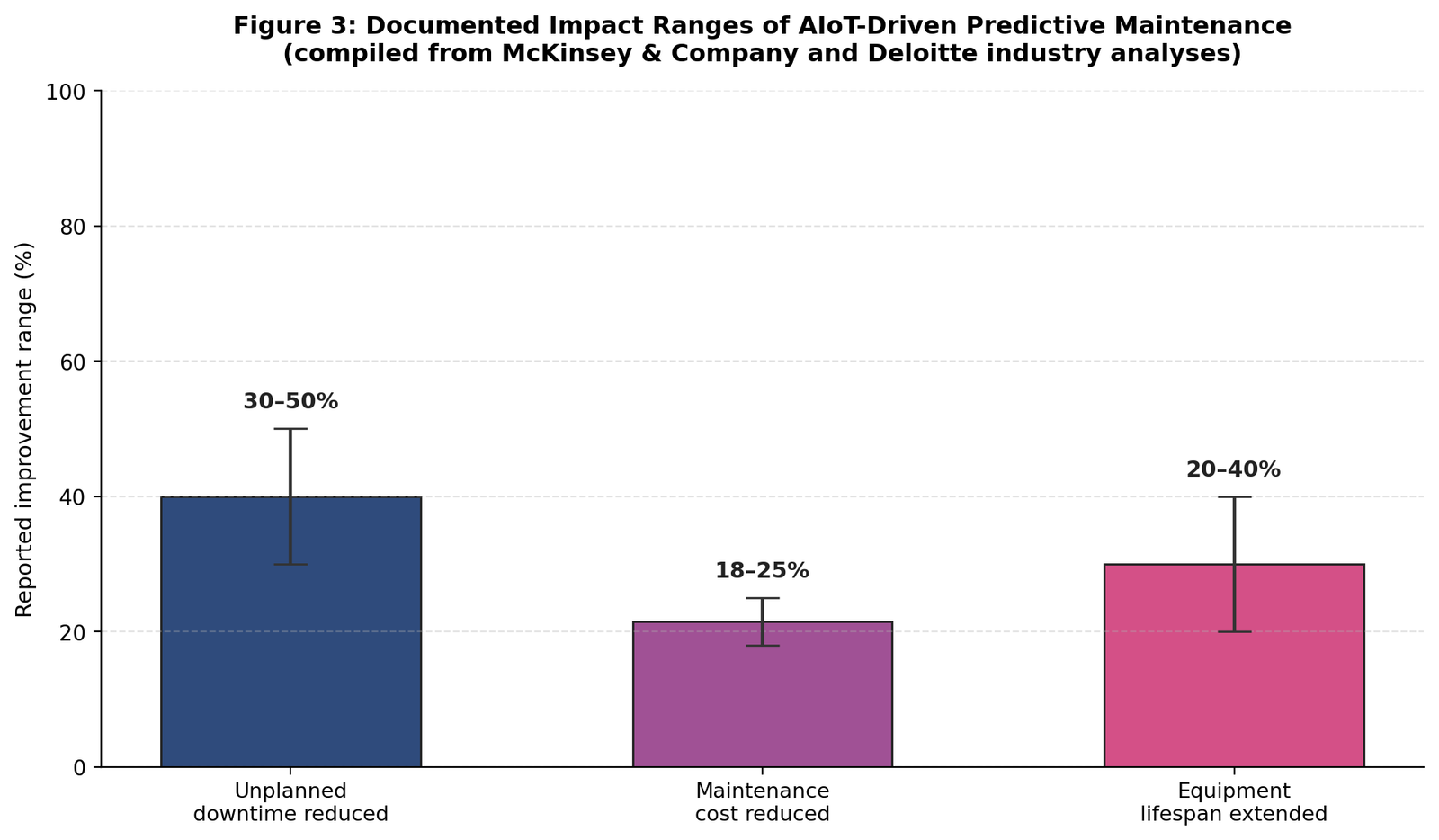
Table: Selected data points on predictive maintenance and digital twin adoption
| Metric | Reported Improvement | Source |
| Reduction in unplanned downtime | 30% – 50% | McKinsey & Company, industrial operations research |
| Reduction in overall maintenance cost | 18% – 25% | McKinsey & Company |
| Extension of equipment service life | 20% – 40% | McKinsey & Company operations survey |
| Reduction in unplanned downtime at maturity | 70% – 90% | Deloitte / Mordor Intelligence maintenance benchmarking |
| Cost of one hour of unplanned line stoppage | USD 50,000 – 260,000 | Deloitte / Siemens downtime benchmarking |
| Predictive-maintenance share of the digital twin market, 2026 | ~31% | Fortune Business Insights, Digital Twin Market Report |
Conclusion
An AIoT-enabled digital twin turns a production floor from a black box — where faults surface only through occasional inspection — into a continuously observed asset whose health and performance are visible and explainable in real time. The ISO 23247 framework provides the architectural backbone, but the real magic is in the details: minimizing transmission latency, pushing compact, optimized models to the edge so “live” monitoring is actually live, and reserving the cloud-hosted twin for the heavier analytics that require a fleet-wide or long-horizon view.
The payoff is straightforward — fewer unplanned stoppages, lower maintenance spend, longer-lived equipment, and maintenance teams that spend their time on planned work instead of firefighting. As sensors, edge compute, and ML tooling all keep getting cheaper and easier to deploy, digital twins built around machine health are moving from a differentiator only the largest manufacturers could afford to a practical, near-standard layer of the modern production floor.
References
- ISO 23247 series, “Automation systems and integration — Digital twin framework for manufacturing,” International Organization for Standardization; summarized via NIST and industry analyses of the standard’s four-domain framework.
- McKinsey & Company, industrial operations and predictive maintenance research, as reported and aggregated across multiple industry publications (IIoT World, WorkTrek, Wiss, Ingenero) — figures on maintenance cost reduction (18–25%), unplanned downtime reduction (30–50%), and equipment life extension (20–40%).
- Deloitte and Mordor Intelligence, manufacturing maintenance benchmarking research (as cited in the 2025 State of Manufacturing Maintenance industry report) — figures on downtime reduction at deployment maturity and per-hour downtime cost.
- Fortune Business Insights, “Digital Twin Market Size, Share and Growth Report,” 2026 edition — market size and predictive-maintenance segment share figures.
- Straits Research, “Digital Twin Market Size, Share & Growth Report,” 2026 edition — supplementary market size estimate.
- General GE Digital case material on predictive maintenance outcomes, as summarized in secondary industry and academic analyses of AIoT-based predictive maintenance in manufacturing.