


The Death of the Passive Pipe
For a decade, we were promised that 5G would rewrite the rules of reality. Instead, we got a faster version of the status quo: high-speed “passive pipes” that move data with efficiency but zero understanding. Today’s networks are syntactically perfect but semantically blind — they can transmit a heartbeat monitor’s signal or a cat video with equal precision, yet they comprehend the urgency of neither.
The transition to 6G marks the end of the network-as-a-utility and the beginning of the network-as-a-partner. We’re moving toward a cognitive ecosystem — infrastructure that doesn’t just carry information, but senses, reasons, and acts. This is the core of the Bharat 6G Vision: a commitment to affordability, sustainability, and ubiquity that treats intelligence not as a luxury, but as a sovereign right.
From AI-Assisted to AI-Native: The Network Becomes the Brain
In today’s 5G-Advanced landscape, AI is an add-on — exemplified by the Network Data Analytics Function (NWDAF), a tool bolted onto an existing machine to optimize specific parts of it. 6G represents a radical departure. It is AI-native, meaning intelligence isn’t an add-on — it’s the architectural blueprint itself.
In this new paradigm, AI is baked directly into Layer 1 physical protocols, Layer 2 data links, and Layer 3 network routing, turning the network into a distributed central nervous system. Data collection and inference stop being external processes bolted on after the fact; they’re built into the system fabric, letting the network adapt its own signal constellations and resource management in real time.
In short: in 6G, AI is no longer a tool for optimization — it becomes the very backbone of network design, enabling networks that are autonomous, intelligent, and self-healing.
Semantic Communication: When Meaning Matters More Than Bits

As we approach the physical limits of available spectrum, we’re facing a bandwidth crisis that faster hardware alone can’t solve. The answer isn’t more bits — it’s fewer, smarter ones. That’s the premise behind Semantic Communication (SemCom).
Traditional systems optimize for syntactic accuracy — sending every bit perfectly. SemCom optimizes for semantic intent — sending only the meaning. Using semantic encoders powered by LLMs and shared knowledge graphs, 6G networks extract just the task-relevant features of a message. If a medical agent is monitoring a patient, the network doesn’t need to stream raw video — it can transmit the intent of the clinical state instead. Because transmitter and receiver share a common knowledge base, the receiver can reconstruct meaning even under noisy conditions.
The payoff: traffic drops by orders of magnitude, and communication becomes goal-driven rather than volume-driven.
The "Bharat" Strategic Play: Digital Democracy at Scale
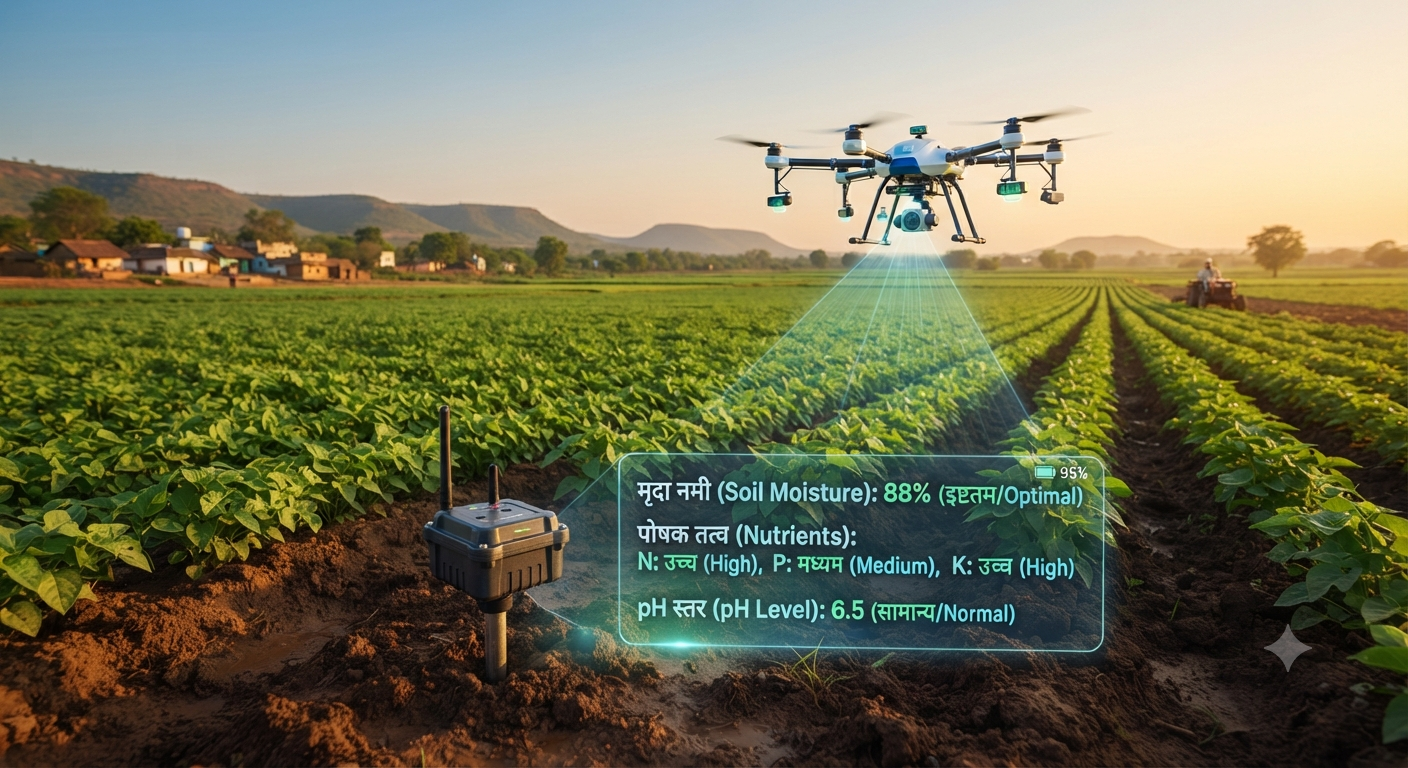
India isn’t merely adopting 6G — it’s defining a model for technological sovereignty. Driven by the IndiaAI Mission and fueled by BharatGen (the world’s first government-funded multimodal LLM for Indian languages), India is building a 6G framework explicitly optimized for the Global South:
- Healthcare for every village — 5G’s ~10ms latency was too high for remote diagnostics. 6G’s sub-1ms latency, paired with AI-native edge compute, finally unlocks real-time robotic surgery and village-level diagnostics.
- Smarter farms — AI-native edge intelligence lets soil sensors and drones coordinate irrigation and disease prediction in vernacular languages, making precision ag-tech affordable at scale.
- Self-healing disaster networks — During cyclones or floods, autonomous drone fleets form a resilient mesh network, using AI to proactively alert citizens in landslide-prone areas.
The underlying principle is straightforward: 6G must be designed for a population of over a billion people, where affordability isn’t optional — it’s foundational. AI and ML should close the digital divide, not widen it.
The Rise of "Agentic IoT": The MAPE-K Loop in Action
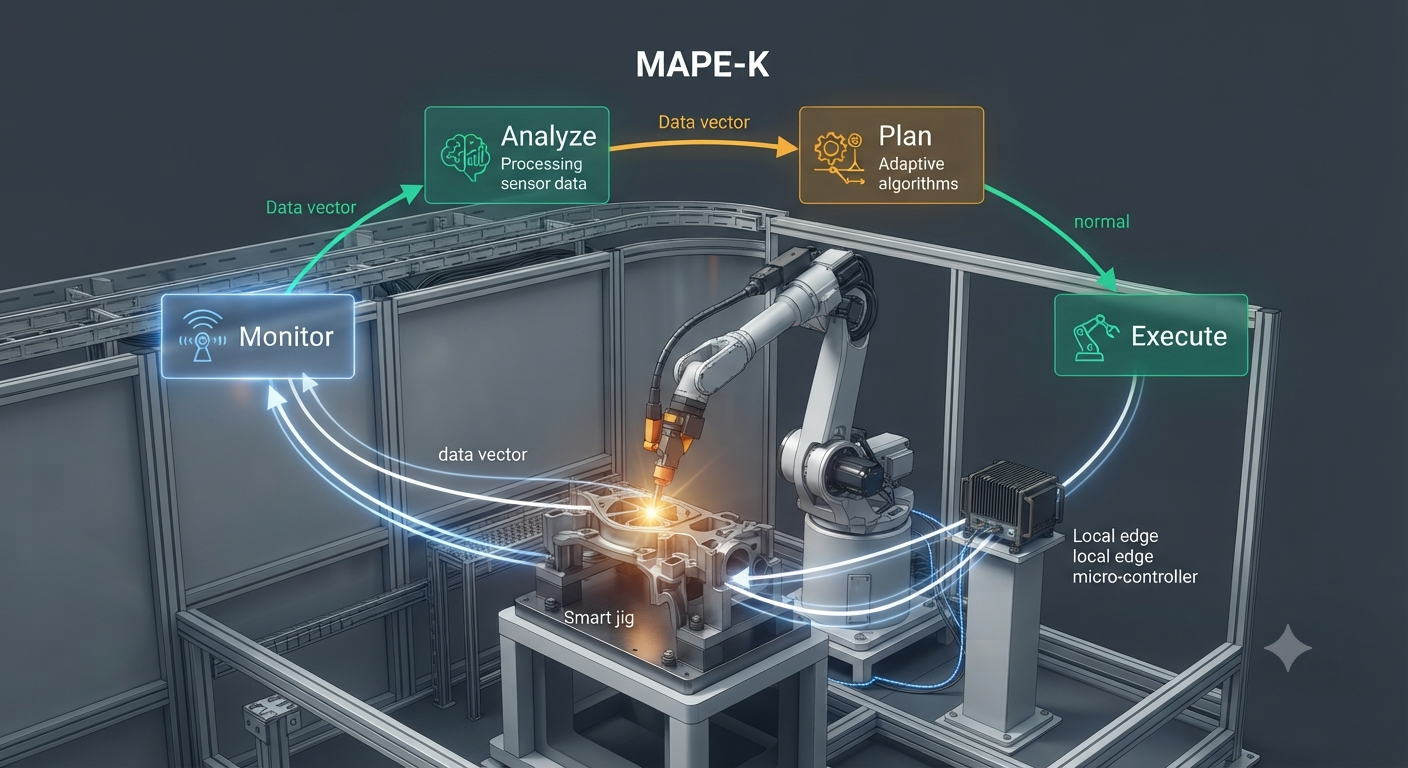
We’re witnessing a shift from passive sensing to the Internet of Agents (IoA). Unlike traditional IoT, which runs on simple “if-this-then-that” rules, Agentic AI reasons explicitly through the MAPE-K framework — Monitor, Analyze, Plan, Execute, backed by a shared Knowledge base.
Consider an autonomous welding cell inside a 6G-powered factory. In a passive system, a defect simply stops the line. In an agentic system:
- A tactical agent at the edge detects a weld defect.
- It reasons that the root cause is tool tip wear.
- It triggers an on-the-fly tool change and a re-weld — without human intervention.
This autonomy runs on a clear hierarchy:
- Device layer (TinyML) — fast, local perception and action, on the order of milliseconds.
- Edge/fog layer (tactical agents) — real-time coordination across multiple devices, on the order of seconds.
- Cloud layer (strategic agents) — global planning, long-term memory, and policy refinement, on the order of minutes to hours.
The Business Pivot: Selling Outcomes, Not Megabytes
For telecom operators, 6G forces a total rethink of monetization. The era of selling flat data plans is ending. In a world of autonomous agents, the revenue model shifts from selling megabytes to selling outcomes.
Through AI-as-a-Service (AIaaS) and hyper-granular network slicing, operators can charge based on the context and value of an interaction — a premium rate for a life-saving medical agent that needs sub-millisecond latency, a fraction of that for a smart fridge pinging its status. To solve the affordability challenge in price-sensitive markets, India is championing Shared AI Platforms, letting operators co-develop indigenous models and avoid duplicating the cost of proprietary silos.
Conclusion: The Digital Fabric of 2030
The roadmap to 2030 rests on indigenous innovation, green data centers, and sovereign AI compute grids. 6G won’t just be a faster internet — it will be a deeply integrated digital fabric, a cognitive ecosystem that behaves more like a living partner than a cold wire.
As we move from a world of connected devices to a world of negotiating agents, the strategic question is no longer how much data can we move. It’s how much intelligence can we embed. Are we ready for a network that’s alive, responsive, and woven into the pulse of daily life?