


The global narrative of the energy transition is obsessed with the box—the lithium-ion cells, the energy density, and the falling price of raw materials. But for the engineers and strategists tasked with keeping the lights on, the cells are just raw potential. The real “brain and nerves” of any Battery Energy Storage System (BESS) are the Power Conversion System (PCS) and the Communication Protocols. These are the invisible architects of the grid. Without them, a multi-million dollar energy asset is little more than a very expensive, very heavy paper weight. As we move toward a decentralized, high-velocity grid, the trade-offs between power electronics and digital languages are becoming the difference between a high-performing asset and a stranded liability. Here are five surprising realities of the modular BESS landscape.
The "Series" Trap—Why Reliability Isn't Guaranteed
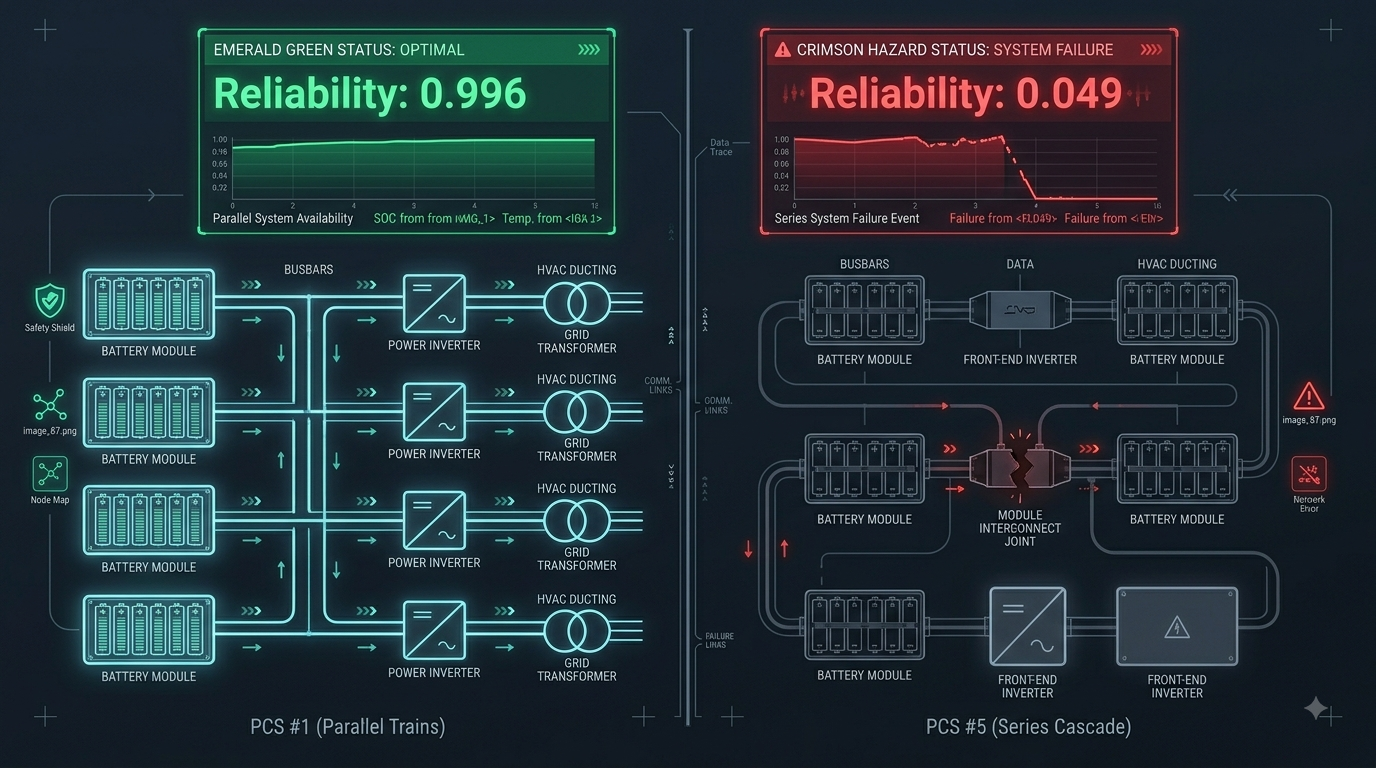
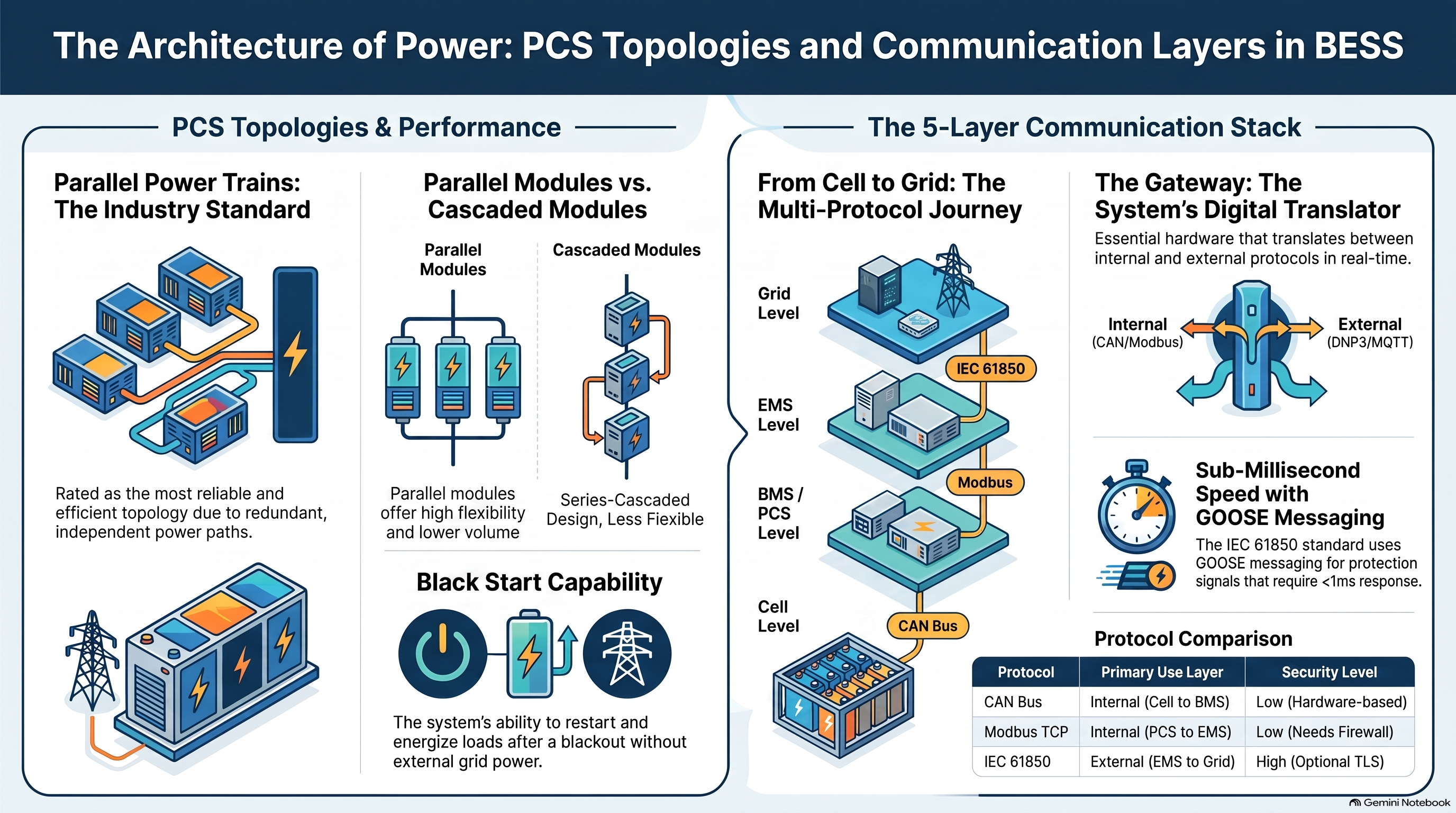
In the world of modular design, the way you connect your power trains dictates the survival of the entire asset. The industry favorite remains PCS #1 (Parallel Power Trains) , and for good reason. Think of it as a multi-lane highway: an accident in one lane doesn’t cause a total gridlock. Each inverter handles a subset of batteries, and if one fails, the rest keep the electrons moving. In contrast, academia often flirts with PCS #5 (Front-end inverter + modules in cascade) . In this model, battery packs are daisy-chained in series to a single front-end inverter. While it looks elegant on paper, it is a mathematical nightmare governed by probability theory. In a series configuration, a single component failure brings down the entire chain. The data from the University of Catalonia (UPC) is sobering “The connection of all battery packs in series and the need of interacting with the main grid through a single 3-phase inverter, make this topology PCS #5 as barely reliable. The obtained value for reliability (e.g. 0.049103) means that the probability of experiencing a failure disabling the whole PCS during the 50,000 hours of expected lifespan is very high. ” While PCS #1 maintains a reliability score of 0.996 , PCS #5 collapses to 0.049 . In the high-stakes world of grid services, betting on a 4.9% survival rate over a system’s lifespan is not just a bad design choice—it's professional malpractice.
The "Tower of Babel" Problem—Your Battery Speaks Five Languages
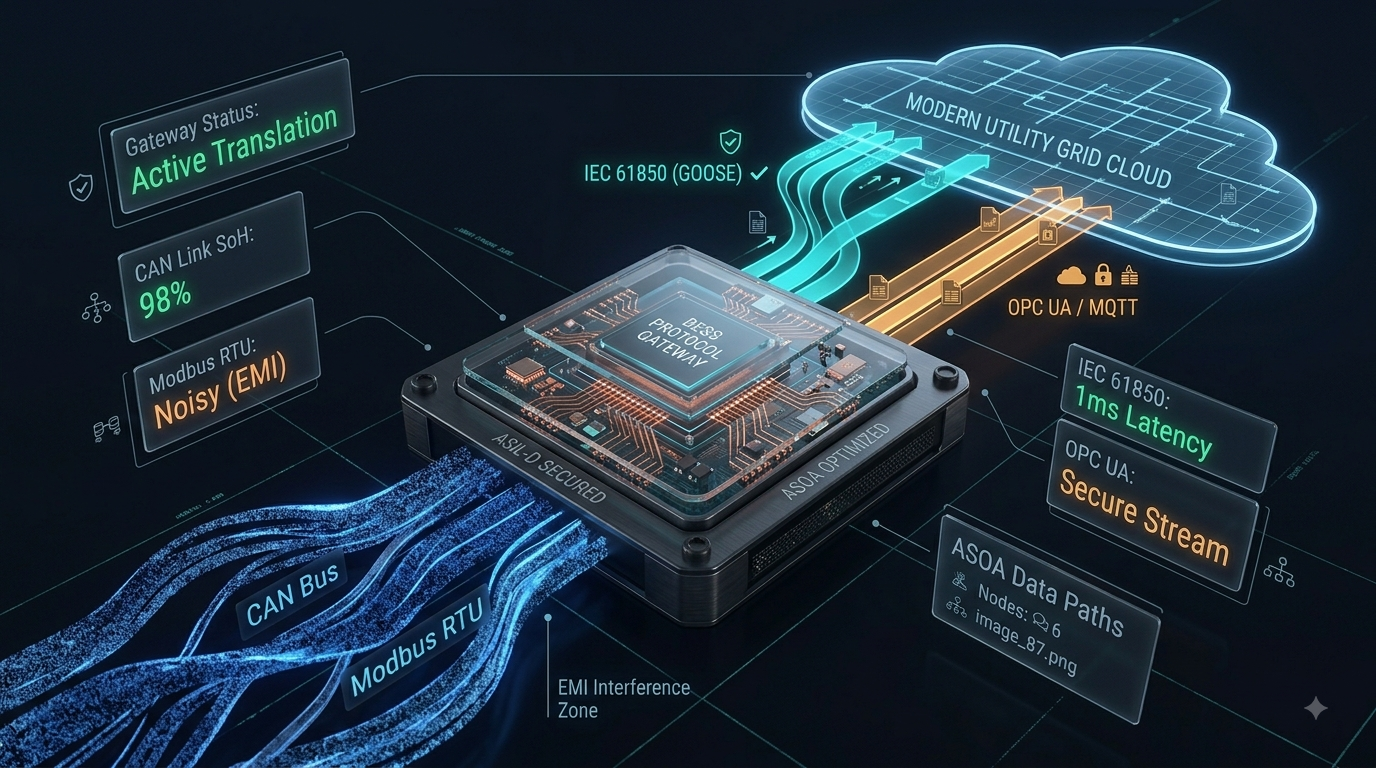
A BESS is not a monolingual machine. It is a polyglot entity operating across five distinct layers of communication. Because no single protocol can handle the high-current interference of a battery cabinet while also navigating the cybersecurity requirements of a utility SCADA system, these layers must coexist.| Layer | Component | Primary Protocol | Logic & Limitation || —— | —— | —— | —— || 1 | Cell / Module | CAN Bus / SMBus | Built for high EMI resistance; limited to 40 meters. || 2 | BMS | Modbus RTU / CAN Bus | The internal logic; handles state-of-charge (SoC). || 3 | PCS (Inverter) | Modbus TCP / PROFINET | High-speed link for power electronics control. || 4 | EMS | OPC UA / MQTT | The brain; connects local logic to enterprise analytics. || 5 | Grid | IEC 61850 / DNP3 | The utility interface; handles grid stability commands. | The friction point here is the protocol gateway . It is the most critical, yet overlooked, hardware in the system. It has to translate the “noisy” ; internal environment of CAN Bus into the structured, object-oriented language of the grid (IEC 61850) in real time. If your gateway stutters, your battery fails to respond to grid events.
The 1979 Legacy—Why the World’s Most Popular Protocol is "Naked";
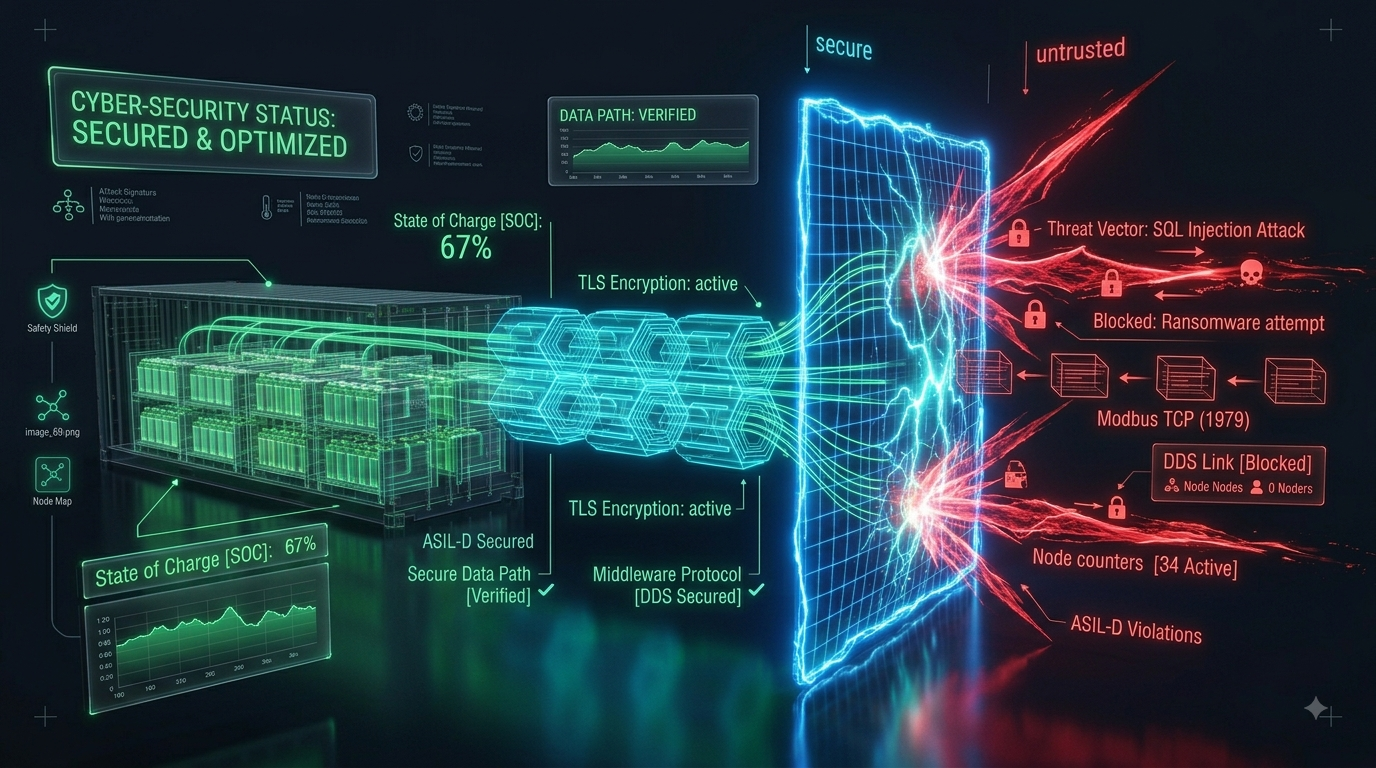
Developed in 1979, Modbus is the undisputed king of BESS protocols. It is simple, licensing- free, and supported by every vendor. However, it was designed for a pre-internet era, making it “naked” by modern standards—it has no built-in encryption or authentication. While Modbus RTU is safe inside a locked cabinet, the shift to Modbus TCP allows these signals to travel over Ethernet and, potentially, the internet. This creates a massive security surface area.| Feature | Modbus Strengths | Modbus Limitations || —— | —— | —— || Ubiquity | Universal hardware support | ✗ No built-in security (Naked) || Engineering | Easy to debug and deploy | ✗ Polling model adds critical latency || Economics | No licensing fees | ✗ “Master-Slave” is less flexible than MQTT | To protect these assets, engineers must “clothe” the protocol at the network level using VPNs, firewalls, and strict segmentation. As one source notes: “Modbus and CAN Bus have no built-insecurity… they need network-level protection.” If you are deploying Modbus without a dedicated security layer, you aren’t building an energy asset; you’re building a target.”
Efficiency vs. Complexity—The Academic "Promise" vs. Practical Reality
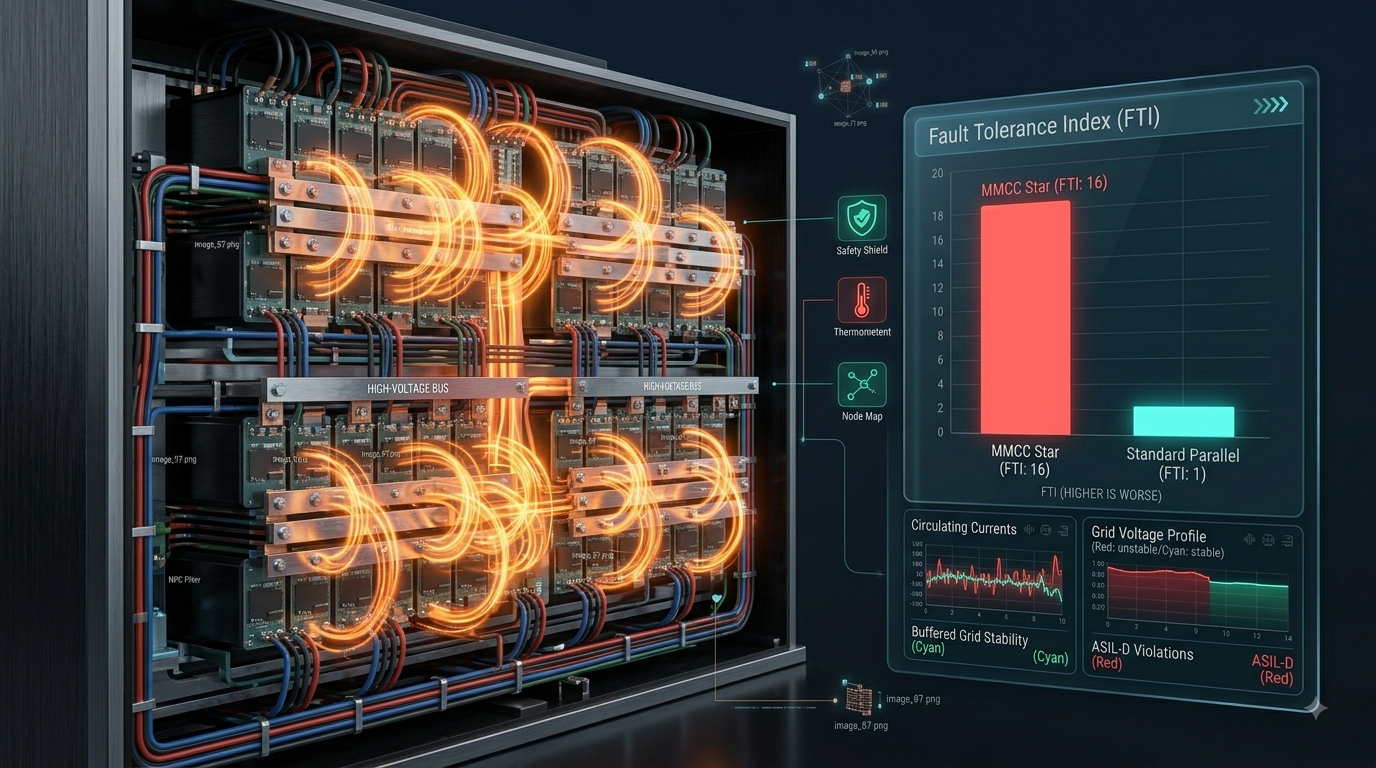
The industry is currently debating the future of Modular Multilevel Cascaded Converters (MMCC) . Academia loves them for their high-voltage potential, but they introduce a Fault Tolerance” crisis. Using the Fault Tolerance Index (FTI) , we can see that PCS #2 (Single Star MMCC) has an FTI of 16 , while the standard parallel PCS #1 has an FTI of 1 . In this index, higher is worse: PCS #2 is 16 times less tolerant to grid faults than the standard design. Furthermore, while the efficiency of these systems is competitive at 0.935 for a small number of modules, this performance drops off a cliff as the system scales. More modules should equal more power, but unless your control logic is perfect, it actually leads to “circulating currents” that bleed energy as heat. The Double Star (PCS #4) remains a promising candidate for high-power HVDC applications, but for most commercial projects, the complexity of managing state-of-charge balancing across cascaded modules outweighs the marginal efficiency gains.
The "Golden Rule" of Design—Gateway First, Hardware Second
Most BESS procurement is done backwards. Developers buy the batteries and inverters first, then figure out how to make them talk to the utility. This is a mistake. Active Command: Specify your protocol gateway before you procure a single battery rack. This decision dictates whether your asset can actually perform. For example, if your utility requires GOOSE messaging (under IEC 61850), you need a system that delivers protection signals in under 1ms. If your hardware/gateway stack is built on a slow Modbus polling loop, you will never meet that requirement. Specifying the gateway first allows for features like DNP3 Unsolicited Reporting , which lets the BESS report data only when a change occurs. This is vital for remote sites with limited bandwidth. By designing for the gateway first, you future-proof the asset: when the utility changes its requirements, you update the software on the gateway rather than ripping out field hardware.
Beyond the Cabinet

The BESS of 2026 will look very different from the systems of the last decade. We are seeing a decisive shift toward secure-by-design protocols. OPC UA is becoming the standard for cloud-to-edge communication with its native TLS encryption, while IEEE 2030.5 is no longer just a California requirement—it is the global litmus test for grid-compliant distributed energy. With the advent of the EU Battery Passport , every module will soon need to stream its “biometric” data—SoH, SoC, and carbon footprint—via lightweight protocols like MQTT .As you evaluate your next project, ask the hard question: Is your energy asset built on a digital foundation from 1979, or is it ready for the secure, multi-protocol reality of the 2026 future?